Episodes

  • Meat-Eating Grandmothers Blocked Trucks for Sheep. Can It Happen Again?
    Feb 27 2026

    In search of the missing social movement for farmed animals.

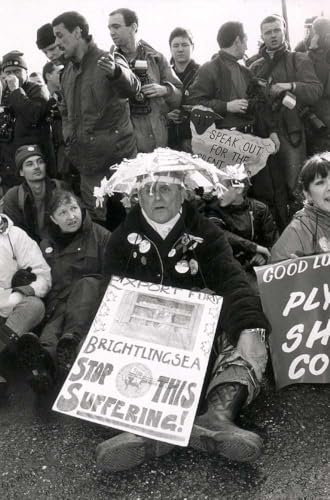
    In 1995, thousands of people—disproportionately meat-eating moms and grandmas—laid their bodies across a road in a tiny English coastal town to stop trucks carrying live sheep to slaughter. For ten months, crowds of over a thousand showed up day after day, facing down riot police, in what remains the high-water mark of mass mobilization for farmed animals. Nothing like it has happened since. In this episode, I ask why. Drawing on my own years as an organizer with Direct Action Everywhere, I work through the strategic mistakes that have kept the animal movement small and insular—from messaging that alienates the public, to campaigns designed for efficiency rather than inspiration, to an abolitionist philosophy that divided the movement over the very campaigns that could have united us. And I propose some directions for what it would take to trigger one more wave of mass protest for farmed animals before the window closes.

    This audio version of Sandcastles is produced using an AI clone of my voice. Please forgive mispronunciations. Read the original on Substack.


    This is a public episode. If you would like to discuss this with other subscribers or get access to bonus episodes, visit sandcastlesblog.substack.com
    Show More Show Less
    1 hr and 10 mins
  • You are letting animals die by missing out on AI productivity
    Feb 20 2026

    Advice for animal advocacy orgs and job seekers in the age of agents 🦞🦞🦞

    AI agents aren't coming — they're here, and they're already reshaping what it means to work in animal advocacy. In this post, I break down the last twelve months of AI breakthroughs, from Claude Code to OpenClaw, and argue that every advocacy organization should be racing to adopt these tools right now. Drawing on conversations from the Sentient Futures Summit in San Francisco, I introduce a framework for the two roles that will define advocacy organizations going forward: agent orchestrators, who can single-handedly automate the digital work of entire teams, and human interfaces, whose irreplaceable social skills become the true bottleneck to impact. I make the case that spending $20 a month on AI in 2026 is organizational malpractice, that young CS graduates are the movement's most undervalued resource, and that both small and large organizations need to rethink their structures before the pace of change leaves them behind. This is a prediction, a dare, and a practical guide — because every hour you spend deliberating is an hour your agents could have spent working for animals.

    This audio version of Sandcastles is produced using an AI clone of Aidan's voice. Please forgive mispronunciations. Read the original on Substack.


    This is a public episode. If you would like to discuss this with other subscribers or get access to bonus episodes, visit sandcastlesblog.substack.com
    Show More Show Less
    37 mins
  • Preparing the Animal Movement for AGI
    Jan 29 2026

    Punchline: I’d be grateful to anyone who spends time engaging at the link below, which is meant to elicit a wide range of ideas for what projects animal advocates should be prioritizing if we think AI will turn the world upside down in 5-15 years.

    Share your thoughts:

    https://www.tricider.com/brainstorming/36eenMwaMqN

    The episode contains some context that might make this exercise more useful to both you and me.


    This is a public episode. If you would like to discuss this with other subscribers or get access to bonus episodes, visit sandcastlesblog.substack.com
    Show More Show Less
    12 mins
  • My New Year’s Resolution: Hear No Gossip
    Jan 23 2026

    Rumors are poisonous to activist movements. As with meat, the problem is demand– and self deception.

    We all know gossip is a problem, but we keep doing it anyway—and we've gotten good at convincing ourselves it's something nobler. In this essay, I explore how gossip functions as a demand-side problem: it's not just the people spreading rumors who cause harm, but all of us who eagerly consume them. Drawing on psychology research and some uncomfortable stories from my own life, I make the case that if we want healthier activist communities, we need to stop placing orders for juicy rumors—and I share the questions I'm using to hold myself accountable in 2026.'

    This audio version of Sandcastles is produced using an AI clone of Aidan's voice. Please forgive mispronunciations. Read the original on Substack.


    This is a public episode. If you would like to discuss this with other subscribers or get access to bonus episodes, visit sandcastlesblog.substack.com
    Show More Show Less
    47 mins
  • Vegans Are Monks. We Need a Role for Laypeople.
    Jan 9 2026

    Veganism isn't scaling, but a two-tiered movement could.

    In this follow-up to my last episode on the Forget Veganuary controversy:

    * With meat consumption skyrocketing and rates of veganism stagnant, strategies focused on individual veganism appear to offer only limited potential for animal advocates.

    * The small fraction who are vegan act as a symbolic vanguard, living out our vision for a world without animal exploitation. They also serve as the movement’s crucial activist base.

    * We must find a way to expand the movement beyond the small vegan population without alienating our most dedicated supporters.

    * The solution is to treat vegans as a priestly class, an elite cadre making a deep personal commitment to live out transformational values on behalf of a wider community, and deserving the utmost respect.

    * To achieve this, we must let go of the idea that veganism is for everyone. We must offer a low-commitment way for animal lovers to align themselves with the vegan movement.

    * Farmkind’s “offset” framing is the most general solution yet proposed, and it matches a rich historical precedent: the relationship between priestly/monastic elites and the lay communities that support them.


    This is a public episode. If you would like to discuss this with other subscribers or get access to bonus episodes, visit sandcastlesblog.substack.com
    Show More Show Less
    50 mins
  • Constructive Infighting
    Jan 6 2026
    Thus begins a double feature inspired by the recent firestorm of debate over Farmkind’s anti-Veganuary campaign. This post brings readers from across the world up to speed on the best arguments from both sides, along with a related controversy from the year prior. In part 2, I share my own thoughts on “Forget Veganuary” and on the troubled relationship between animal welfare and veganism.One of my most edgy and unique opinions about the animal rights movement is that Infighting Is Bad™. Whether it’s cancelling people for having the wrong political views or carving the movement up into illusory factions like welfarist vs. abolitionist or grassroots vs. professional, I think the movement wastes a lot of energy on pointless infighting.Yet even I must admit that not all infighting is pointless. In some instances, our movement has suffered from a lack of substantive strategic debates. For years, as abolitionists and pragmatists feuded over cage-free campaigns, there was no forum for systematic public debate between the leaders of each faction. That left grunts like me stewing in resentment, unable to properly evaluate the other side’s position. (When I finally got the chance, I found it surprisingly persuasive.)I write about how animal activists can focus on what matters, and avoid getting distracted by what doesn’t matter. Subscribe for free.So today, we’re going to learn about two master classes in constructive infighting, two campaigns that forced the movement to wrestle with big strategic questions. Both case studies came out of the London activist scene, cementing its status as the top animal rights city in the world.Each story is rich with lessons, but a few commonalities jump out right from the get-go:* Each debate was sparked by an actual campaign– that is, people weren’t just running their mouths on social media, they were doing something bold in the real world.* In each case, proponents and opponents maintained an open line of communication and engaged in vigorous public debate, preserving friendships without pulling any punches in their criticisms.* While some observers changed their minds, all this public debate failed to clearly resolve the question one way or the other. But it pushed both sides to gather better evidence and become more rigorous versions of themselves.I know what you all came here for, so I’ll start with the more recent story first, and we’ll see in the course of that how it couldn’t avoid bringing up an old wound.Case #1: Farmkind says VEGANUARY IS F*****G LAMEOn December 27, 2025, the movement awoke from its post-Christmas reverie to stories in right-wing British tabloids with headlines like “Veganuary champion quits to run meat-eating campaign.” At first, it seemed like the same familiar “Why I’m no longer vegan” story we’ve all read a hundred times. But this one was different.Toni Vernilli was renouncing veganism. She was joining hands with some of the most prolific meat eaters in the country– the second, third, and fourth-ranked national competitive eating champions.But while she was telling people to eat whatever they want, her message didn’t end there. People who care about animals but still want to eat meat, she said, can offset the harm of eating meat by donating to charities that oppose factory farming. Specifically, they should go to forgetveganuary.com, use a handy calculator to determine what size monthly donation is needed to offset their meat consumption, and let the organization Farmkind distribute that donation across the most effective animal charities.The first thing a sympathetic meat eater will see once arriving on the site is this comparison mocking Veganuary participants for annoying their loved ones and craving meat (an earlier version mentioned “feeling bloated from plant protein.”)Next, they’re faced with an impossibly hard flash game testing their ability to survive 31 days as a vegan, navigating a frowning carton of oat milk through challenges like “vegan meat processed ingredients” and “iron deficiency.”Finally, they reach the donation calculator. This is meant to be a relief– there’s something I can do besides be vegan! The user inputs their weekly serving of different animal products, and the calculator spits out a recommended monthly donation sufficient to offset the suffering it causes. For an average omnivore in the UK, the donation is £17, or $23, a small fraction of what they pay into the industry for consumption.(The calculator is based on something like suffering-adjusted days, where for each animal you eat, you need to offset an equivalent amount of suffering by helping several animals. For instance, Farmland argues chickens raised according to the Better Chicken Commitment suffer around 50% less, so you need to pay for campaigns worth two BCC chickens for every chicken you eat.)The vegans reactVeganuary, of course, did not take this lying down. Quoted in the Daily Mail, they ...
    Show More Show Less
    52 mins
  • Three soul-meltingly hot takes for animal activists in 2026
    Jan 1 2026

    I have heard from a few people who enjoy this newsletter. But I’ve heard from many more people who say, “WTF man, I can’t listen to a 90-minute post every week.” To the latter group, who apparently don’t care about animals very much, I say: this post is for you. Gather round, children, and let ol’ uncle Sandcastles tell you what is going to happen in 2026.


    This is a public episode. If you would like to discuss this with other subscribers or get access to bonus episodes, visit sandcastlesblog.substack.com
    Show More Show Less
    6 mins
  • ⏳ The End of Animal Advocacy
    Dec 26 2025

    Counting the weeks until the future slips out of our hands.

    AI researchers are sprinting toward AGI because they think the finish line is five years away. Animal advocates should be sprinting too. In this post, I outline ten scenarios for how transformative AI could reshape the world—and what the animal movement should be doing now to prepare for each one.

    This audio version of Sandcastles is produced using an AI clone of Aidan's voice. Please forgive mispronunciations. Read the original on Substack.


    This is a public episode. If you would like to discuss this with other subscribers or get access to bonus episodes, visit sandcastlesblog.substack.com
    Show More Show Less
    1 hr and 36 mins