Episodes

  • The Big Rivers Project with NPS Program Manager Dusty Perkins
    May 22 2026

    Recorded along the banks of the Green River inside Dinosaur National Monument, Joey sits down with Dusty Perkins to explore the science, beauty, and ecological complexity of the Green and Yampa Rivers.

    Dusty serves as Program Manager for the National Park Service’s Northern Colorado Plateau Inventory & Monitoring Network and is a lead scientist on the Big Rivers Monitoring Project. In this conversation, he explains how scientists monitor some of the American West’s most iconic river systems, what happens when rivers are dammed and regulated, and why long-term ecological monitoring is critical for the future of these landscapes.

    From endangered fish and invasive species to river morphology, sediment flow, snowpack decline, and the emotional experience of rafting through canyon country, this episode offers a rare look at the science shaping our public lands.

    In this episode, we explore:

    • What the Big Rivers Monitoring Project actually does
    • How the Green and Yampa Rivers differ ecologically
    • The impact of Flaming Gorge Dam on river systems
    • Why sediment and seasonal flooding are essential to river health
    • The role of invasive species like tamarisk
    • How endangered fish species depend on natural river cycles
    • Why long-term monitoring matters in national parks
    • The effects of declining snowpack and aridification across the West
    • What it’s like conducting science on multi-day rafting expeditions
    • The emotional connection scientists develop with these landscapes

    Key Takeaways

    • The Yampa River remains one of the last relatively free-flowing desert rivers in the American West.
    • Dams dramatically alter water temperature, sediment transport, and seasonal flooding patterns.
    • Native fish and plant species evolved over thousands of years around natural spring runoff cycles.
    • River complexity — including back channels and floodplains — creates biodiversity and ecosystem resilience.
    • Long-term monitoring gives park managers the scientific data needed to make informed conservation decisions.

    Featured Locations

    • Dinosaur National Monument
    • Echo Park
    • Canyonlands National Park
    • Black Canyon of the Gunnison National Park
    • Green River
    • Yampa River

    Learn More

    Explore the work of the Northern Colorado Plateau Inventory & Monitoring Network through the National Park Service official website

    Learn more about Dinosaur National Monument through the National Park Service Dinosaur page

    Show More Show Less
    42 mins
  • Dinosaur National Monument: Geology & Dinosaurs with Paleontologist ReBecca Hunt-Foster
    May 15 2026

    In this episode, I sit down with paleontologist Rebecca Hunt-Foster at Dinosaur National Monument to explore one of the most fascinating fossil landscapes in North America. We discuss the geology that shaped the monument, the incredible dinosaurs that once roamed the region, and what life looked like in this ancient ecosystem roughly 150 million years ago during the Late Jurassic period.

    Rebecca also shares insights into her career path in paleontology, her work with the National Park Service, and what it’s like studying fossils and ancient environments in the American West.


    The Geology of Dinosaur National Monument

    • How the rock layers at Dinosaur National Monument were formed
    • Why the Morrison Formation is one of the most important dinosaur-bearing formations in the world
    • Ancient rivers, floodplains, and environmental conditions during the Jurassic
    • How geologists and paleontologists interpret ancient landscapes from rock and fossil evidence

    Dinosaurs of the Jurassic

    • The major dinosaur species discovered in the region
    • Giant sauropods and massive predators that lived in the ecosystem
    • Fossil discoveries that made Dinosaur National Monument famous
    • What these animals can tell us about evolution and prehistoric ecosystems

    Reconstructing a 150-Million-Year-Old Ecosystem

    • What the climate and vegetation looked like during the Late Jurassic
    • Ancient waterways and seasonal environments
    • Other animals that shared the ecosystem with dinosaurs
    • How scientists piece together food webs and habitats from fossil evidence

    If you enjoyed this episode, be sure to subscribe, leave a review, and share it with fellow dinosaur and geology enthusiasts.
    ______________
    Follow us on social!
    Instagram: https://www.instagram.com/safetravelspod
    TikTok: https://www.tiktok.com/@safetravelspod
    YouTube: youtube.com/@safetravelspod
    Safetravelspod.com

    Show More Show Less
    1 hr and 4 mins
  • Big Bend National Park: The Border Wall Debate with Bob Krumenaker
    Apr 10 2026

    Bob Krumenaker, a seasoned conservationist (over 41 years with the NPS) and former superintendent of Big Bend National Park, discusses the ecological, cultural, and political stakes involved with the proposed border wall construction in the remote, environmentally rich area of Big Bend National Park. Learn about why Big Bend is a sanctuary worth protecting and how local communities and conservation advocates are turning the tide against intrusive border infrastructure.

    In this episode:

    • Bob shares his extensive career in the National Park Service and his deep connection to desert ecosystems.
    • The unique geological and biological highlights that make Big Bend nationally significant.
    • How border security policies threaten biodiversity, night skies, water resources, and local communities.
    • The current status of border wall proposals and the bipartisan opposition rallying to preserve Big Bend's wild character.
    • The legal and political efforts underway, including wilderness designation, to secure long-term protection.
    • Practical ways for the public to get involved and support conservation efforts in their areas.
    • Lessons from Big Bend about community cooperation and environmental advocacy.

    Resources & Links:

    • Keep Big Bend Wild
    • Big Bend National Park Official Site
    • Wilderness Act of 1964
    • Border Wall Map & Updates

    Note: This interview sheds light on critical environmental and political issues facing public lands today. Your voice and involvement matter—learn more and take action through the links provided.

    Show More Show Less
    1 hr and 17 mins
  • John Day Fossil Beds National Monument: Fossil Preparation with Paleontologist Jennifer Cavin
    Feb 20 2026

    In this episode of the Safe Travels Podcast, I sit down with Jennifer Cavin, Fossil Preparator and Lab Manager at John Day Fossil Beds National Monument, to explore one of the most overlooked roles in paleontology: fossil preparation.

    When most people think about paleontology, they picture scientists excavating fossils in the field. But behind every museum-quality fossil specimen is a highly skilled fossil preparator, the meticulous expert who stabilizes, cleans, preserves, and reconstructs fossils for scientific research and public display.

    In This Episode, We Cover:

    • What a Fossil Preparator actually does in a paleontology lab
    • The difference between field excavation and laboratory fossil preparation
    • Mechanical prep vs. chemical prep techniques
    • How air scribes, micro sandblasters, and adhesives are used to reveal fossils
    • The delicate process of removing matrix without damaging bone
    • The relationship between fossil preparators and paleontologists
    • Why preparators are critical to peer-reviewed scientific research
    • The physical health risks of fossil prep, including silica dust exposure and repetitive strain injuries
    • Conservation ethics and preserving fossils for future generations

    Jennifer explains why fossil preparators are the unsung heroes of paleontology. Without their precision and technical expertise, many fossil discoveries, including ancient mammals like early horses, camels, and saber-toothed predators from the John Day Basin, would never be studied, published, or displayed.
    ______________
    Follow us on social!
    Instagram: https://www.instagram.com/safetravelspod
    TikTok: https://www.tiktok.com/@safetravelspod
    YouTube: youtube.com/@safetravelspod
    Safetravelspod.com

    Show More Show Less
    47 mins
  • John Day Fossil Beds National Monument: Geology & Paleontology with Paleontologist Nick Famoso
    Feb 13 2026

    In this episode of Safe Travels, I’m joined by Dr. Nick Famoso, Paleontology Program Manager at John Day Fossil Beds National Monument, for a fascinating deep dive into one of the richest fossil regions in North America.

    We explore the incredible geology of the John Day Basin, how millions of years of volcanic activity helped preserve ancient life, and the remarkable fossil record of prehistoric mammals that once roamed the Pacific Northwest — including some of the earliest horses, ancient rhinos, camels, and dog-like predators that filled a weasel-style ecological niche.

    Dr. Famoso also explains why fossil teeth are some of the most important clues paleontologists use to identify species, understand diets, and reconstruct ancient ecosystems.

    Whether you’re curious about paleontology careers, fossil hunting science, or the evolution of mammals, this episode offers a behind-the-scenes look at how scientists piece together Earth’s deep past.

    Topics Covered

    • Geologic history of the John Day Basin
    • How volcanoes helped preserve fossils
    • Evolution of early horses and mammals
    • Ancient rhinos, camels, and carnivorous “dog-weasels”
    • Why fossil teeth are critical to paleontology
    • What makes John Day Fossil Beds so scientifically important
    • Careers in paleontology and working in national parks

    About Safe Travels

    Safe Travels is a storytelling podcast focused on national parks, public lands, conservation, science, and the people who protect these places. New episodes feature park rangers, scientists, historians, and explorers from across the country.


    If you enjoyed this episode:

    Like, subscribe, and share to help more people discover the stories behind our national parks.
    ______________
    Follow us on social!
    Instagram: https://www.instagram.com/safetravelspod
    TikTok: https://www.tiktok.com/@safetravelspod
    YouTube: youtube.com/@safetravelspod
    Safetravelspod.com

    Show More Show Less
    1 hr and 49 mins
  • Petrified Forest National Park: The Art & Science of Museum Curation with Curator Matt Smith
    Jan 23 2026

    Have you ever wondered how a museum is built inside a national park—or what happens to the fossils once they’re discovered?

    In this episode of Safe Travels, we go behind the scenes at Petrified Forest National Park with Park Ranger and Museum Curator Matt Smith to explore the art, science, and storytelling behind creating a world-class paleontological and natural history museum.

    Matt walks us through how fossils are collected, preserved, cataloged, and interpreted, and we dive into some of the incredible museum and research collections housed at Petrified Forest National Park. From Triassic-era fossils to curated specimens rarely seen by the public, this conversation sheds light on how park collections help scientists study ancient ecosystems while educating millions of visitors.

    We also discuss how museum exhibits are designed to balance scientific accuracy, public education, and visual storytelling, and why national park museums play a critical role in conservation, paleontology research, and protecting public lands.

    Matt’s passion for paleontology, museums, and the landscapes of Petrified Forest is unmistakable throughout the episode, offering listeners a rare look at the people working behind the scenes to preserve deep time.
    ______________
    Follow us on social!
    Instagram: https://www.instagram.com/safetravelspod
    TikTok: https://www.tiktok.com/@safetravelspod
    YouTube: youtube.com/@safetravelspod
    Safetravelspod.com

    Show More Show Less
    1 hr and 7 mins
  • Petrified Forest National Park: Prairie Dogs & Park Biology with Biologist Dylan Schneider
    Jan 16 2026

    Prairie Dogs, Bats, and Pronghorn: The Living Landscape of Petrified Forest National Park

    Prairie dogs make their debut on the Safe Travels Podcast! In this episode, we sit down with Park Ranger and Biologist Dylan Schneider to explore the vital role prairie dogs play in shaping the ecosystem of Petrified Forest National Park.

    Prairie dogs are far more than charismatic grassland mammals — they are a keystone species, influencing soil health, plant diversity, and habitat availability for countless other animals. Dylan explains how their burrows and behavior help maintain balance across the park’s high desert landscape.

    Our conversation also dives into Petrified Forest National Park’s acoustic monitoring program, a cutting-edge research tool used to study and track bat populations throughout the region. By analyzing soundscapes and echolocation calls, park biologists can monitor biodiversity and ecosystem health in ways that are both non-invasive and highly effective.

    We also spotlight one of North America’s most fascinating mammals: the pronghorn. Known as the fastest land animal in the Western Hemisphere, pronghorns have evolved extraordinary adaptations that make them perfectly suited to the open landscapes of the Southwest.

    While Petrified Forest National Park is world-famous for its Triassic-era fossils and petrified wood, Dylan reveals a lesser-known story — a park that is very much alive, supporting an incredible diversity of modern wildlife. From grasslands to badlands, the park remains a dynamic and thriving ecosystem shaped by biology, sound, and time.
    ______________
    Follow us on social!
    Instagram: https://www.instagram.com/safetravelspod
    TikTok: https://www.tiktok.com/@safetravelspod
    YouTube: youtube.com/@safetravelspod
    Safetravelspod.com

    Show More Show Less
    58 mins
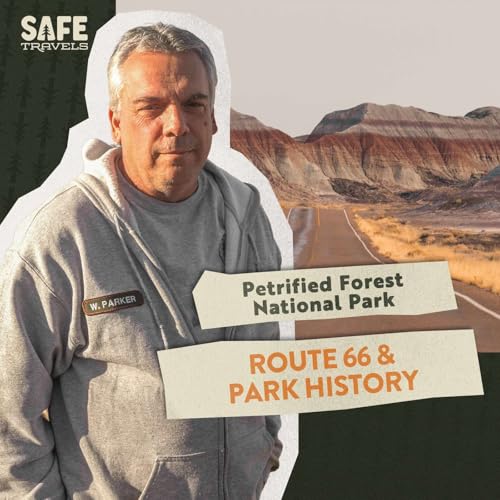
  • Petrified Forest National Park: Route 66 & Park History with Historian Bill Parker
    Jan 9 2026

    In this episode of the Safe Travels Podcast, I’m joined by Bill Parker, Chief of Resources and Park Historian at Petrified Forest National Park, for a wide-ranging conversation that explores the historical and logistical forces that have shaped one of America’s most iconic desert landscapes.

    Bill takes us beyond the park’s famous petrified wood and into the human stories tied to Route 66, early automobile tourism, and the rise of roadside Americana in northern Arizona. We dive into how Holbrook, Arizona helped inspire Pixar’s Radiator Springs, the significance of the historic REO Mountaineer, and why Petrified Forest remains one of the few national parks where Route 66 still runs directly through protected land.

    As Chief of Resources, Bill also explains the real-world challenges of preservation—from decades of petrified wood theft to the long-term impacts of highways, railroads, and modern transportation corridors on fragile cultural and natural resources. This episode offers a rare look at how infrastructure, tourism, and conservation intersect inside the National Park Service.

    Bill is an institution at Petrified Forest National Park, I'm grateful that he joined the podcast!
    ______________
    Follow us on social!
    Instagram: https://www.instagram.com/safetravelspod
    TikTok: https://www.tiktok.com/@safetravelspod
    YouTube: youtube.com/@safetravelspod
    Safetravelspod.com

    Show More Show Less
    59 mins