Running Man Self Regulation Skills Project cover art

Running Man Self Regulation Skills Project

Running Man Self Regulation Skills Project

By: Armando Dominguez PhD Health Psychology Educator Martial Artist Researcher
Listen for free

This Season's Biggest Deal | £0.99/mo for 3 months + £10 Audible bonus

£5.99/mo after 3 months - terms apply. Cancel monthly
Summary

Understanding Stress, Anxiety, and Decision-Making: Unveiling Your Paleo-Caveperson Wiring

Explore the fascinating interplay of stress, anxiety, and pain on our ability to think, choose, and act in modern life through the lens of our paleo-caveperson wiring and survival programming.
Discover why we sometimes exhibit socially inappropriate behaviors under stress and find it challenging to make sound decisions in tense situations.
Gain insights from psychology, neuropsychology, physiology, sociology, biology, and social dynamics, explained in everyday language without overwhelming scientific jargon.


Tell me what you would like to hear on the podcast and your feedback is appreciated: runningmangetskillsproject@gmail.com


Book Link for the Running Man Resiliency in the Face of Fight or Flight on Amazon:


https://www.amazon.com/Running-Man-Resiliency-Fight-Flight/dp/B0H6YGJ4WJ/ref=sr_1_1?crid=2BOI7ZY2912AF&dib=eyJ2IjoiMSJ9.PCsHx0Q_bb1rbtF4Vdy8-Q.KiSLfzdnqigm6wCU3kvtrKmnfGdICRvwM8WLVhfpx8Y&dib_tag=se&keywords=running+man+resiliency+in+the+face+of+fight+flight&nsdOptOutParam=true&qid=1783315890&sprefix=running+man+resil%2Caps%2C305&sr=8-1


rogue musician/creator located at lazyman 2303 on youtube.

Music intro and outro: Jonathan Dominguez


You can Support the running man self regulation skill project at:

https://www.buzzsprout.com/2216464/support


© 2026 Running Man Self Regulation Skills Project
Alternative & Complementary Medicine Hygiene & Healthy Living Psychology Psychology & Mental Health Science Social Sciences
Episodes
  • Why Stress Makes You Believe Things That Aren't True
    Nov 8 2026
    Ep 172. Why Stress Makes You Believe Things That Aren't TrueHave you ever been absolutely certain about what someone meant, what they intended, or why they behaved a certain way—only to discover later that your interpretation was wrong?Perhaps someone gave you an unexpected look.A conversation felt uncomfortable.A message went unanswered.Or an ordinary social interaction suddenly seemed threatening, disrespectful, or personal.In that moment, what you believed you were seeing may have felt unquestionably true.But what if your stress response was influencing not only how you felt, but also what you believed?In this episode of the Running Man Human Stress Model, we explore how stress can influence perception, attention, judgment, assumptions, and the stories we create about other people.Every day, we move through environments that require us to interpret information and make decisions.We work, provide for our families, interact with strangers, maintain relationships, and respond to circumstances that range from enjoyable challenges to difficult and sometimes threatening experiences.Throughout these interactions, our physiological state is changing.Sometimes we experience positive excitement or manageable challenges.At other times, we experience distress, uncertainty, urgency, or fear.These states can influence what we notice, what we overlook, and how we interpret the people and events around us.Under significant stress, attention may narrow toward information that appears most relevant to a perceived threat.Our ability to consider alternatives may become less flexible.We may place greater confidence in an immediate interpretation without recognizing how much information is missing.And we may begin constructing explanations that feel complete even when they are based on only part of the situation.Within the Running Man Human Stress Model, these are important conditions for the development of stress-borne beliefs.A stress-borne belief is an interpretation formed or reinforced during physiological activation that may feel compelling despite incomplete or uncertain evidence.Someone disagrees with us, and we conclude they are against us.A person does not respond, and we assume rejection.An unfamiliar expression becomes evidence of hostility.A misunderstanding becomes a judgment about someone's character.And what began as a momentary interpretation can become a story that influences how we communicate, behave, and relate to others.The danger is not simply that we make assumptions. It is that we may mistake those assumptions for established facts.Assumptions can be useful.Human beings regularly make rapid predictions from limited information, and these abilities can support efficient decisions and protective responses.But the same tendency can create difficulties when we treat an incomplete impression as a final conclusion.Especially when we are stressed.The Running Man Human Stress Model encourages us to recognize this relationship between physiological state and perception.Through the Three Rs of Stress—Recognize, Regulate, Recover—we can develop a more deliberate approach.Recognize the signs of activation and the sudden certainty that may accompany an emotionally intense interpretation.Regulate the physiological state when circumstances allow, using practiced skills involving breath, posture, grounding, and awareness.Recover the ability to consider additional information, alternative explanations, and the possibility that our first interpretation may not be the most accurate one.This is also where the Action Gate becomes important.Before acting on an assumption, there may be an opportunity to recognize that the intensity of our certainty is not the same thing as the quality of our evidence.That opportunity can influence how we respond to a colleague, a loved one, a stranger, or someone with whom we disagree.It can help us ask a question rather than make an accusation.Seek clarification rather than assign blame.And preserve a relationship that might otherwise be damaged by a conclusion reached too quickly.The goal is not to eliminate assumptions or second-guess every decision.It is to become more skillful at distinguishing what we observed, what we interpreted, and what we actually know.Because the world we experience is influenced by the state in which we encounter it.And sometimes the most important self-regulation skill is recognizing that what feels unquestionably true in a stressful moment may deserve another look.Recognize the state. Question the assumption. Recover the possibility of a more accurate understanding.Take care and walk well. #StressAndTheBrain #CognitiveBias #EmotionalRegulation #SelfRegulation #RunningManHumanStressModel Hey folks, let me know what you think about the Running Man Podcast. Let me know where you're from and how you are doing in your little part of the world! Support the showintro outro music for episodes 1 through 111 done by Jonathan Dominguez Rogue musician. He...
    Show More Show Less
    34 mins
  • Stop Chasing Happiness: How to Find Joy in the Present Moment
    Nov 1 2026
    Ep 171. Stop Chasing Happiness: How to Find Joy in the Present MomentWhat if the joy you have been searching for is not waiting somewhere in your future?What if it is something you can experience in the present moment, without first accomplishing another goal, solving another problem, or reaching another destination?We spend much of our lives preparing for what comes next.The next responsibility.The next challenge.The next achievement.The next moment when we imagine life will finally become easier, more comfortable, or more fulfilling.But while we are anticipating the future, we may overlook something profoundly important about the human experience.Joy is not always found by arriving somewhere. Sometimes joy becomes accessible when we allow ourselves to be fully present where we already are.In this episode of the Running Man Human Stress Model, we explore the relationship between joy, stress, mindfulness, self-regulation, and our perception of time.As human beings, we continually interact with the environments in which we live.Our bodies receive and respond to signals of safety, uncertainty, comfort, challenge, and potential danger.These experiences influence our physiological state, our attention, our emotions, and the meaning we give to the unfolding events of our lives.Sometimes those experiences are stressful.Sometimes they are enjoyable.And sometimes our expectations about what might happen next influence our experience of what is happening now.This relationship between the body, the environment, and our interpretation of events is central to the Running Man Human Stress Model.But there is another dimension worth exploring.What happens when we stop trying to get somewhere else and begin experiencing the moment we are already living?We often pursue happiness as though it exists at a future point on a timeline.When I finish this task.When I reach this goal.When my circumstances improve.When the stress finally ends.Then I will be happy.Yet joy can also arise through simple experiences of presence.The warmth of sunlight.The sound of someone we love.A moment of laughter.The sensation of breathing.The quiet appreciation of being alive.These experiences do not require us to reach a distant destination.They invite us to notice what is already available.Within the Running Man Human Stress Model, self-regulation can help create conditions in which these moments become easier to recognize and appreciate.By noticing our physiological state, working with our breathing, releasing unnecessary muscular tension, and returning our attention to the present environment, we may become less dominated by the urgency of stress.Our attention may broaden.Our experience of time may change.And we may recover access to aspects of life that become less noticeable when we are preoccupied with threat, obligation, or anticipation.This is not about forcing ourselves to feel joyful.Nor is it about denying pain, uncertainty, grief, or the genuine difficulties of living.It is about recognizing that our experience of life is influenced by the state in which we meet it.And that sometimes the most skillful action is not another action at all.Sometimes it is the deliberate practice of non-doing.Allowing ourselves to breathe.To notice.To appreciate.To simply be.In the Running Man Human Stress Model, we often speak about the Three Rs of Stress: Recognize, Regulate, Recover.Recognize the physiological state.Regulate what is available to regulate.Recover access to awareness, perspective, flexibility, and the self.But recovery offers more than relief from discomfort.It can also support our capacity for connection, gratitude, appreciation, and joy.The objective is not to live permanently free from stress.It is to become increasingly skillful at returning to a state in which we can participate more fully in our lives.Because life is not experienced somewhere in the future.It is experienced in the unfolding present.And perhaps one of the greatest gifts of self-regulation is not simply learning how to endure difficult moments.It is learning how to remain available for the beautiful ones. Joy is not always something we arrive at. Sometimes it is something we become available to experience when we stop rushing toward the next moment. Take care and walk well. #FindYourJoy #Mindfulness #PresentMoment #SelfRegulation #RunningManHumanStressModel Hey folks, let me know what you think about the Running Man Podcast. Let me know where you're from and how you are doing in your little part of the world! Support the showintro outro music for episodes 1 through 111 done by Jonathan Dominguez Rogue musician. He can be found on youtube at Lazyman2303. New musical intro and outro music created by Ed Fernandez guitarist extraordinaire. To get in contact with Ed please send me an email at runningmangetskillsproject@gmail.com and I will forward him the contact. Donations are not expected but most certainly appreciated. Any funds will go toward further ...
    Show More Show Less
    33 mins
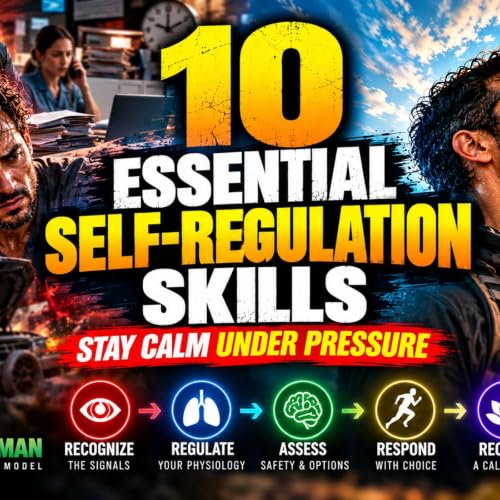
  • 10 Essential Self-Regulation Skills to Stay Calm Under Pressure
    Oct 25 2026
    Ep 170. 10 Essential Self-Regulation Skills to Stay Calm Under PressureWhat happens when life suddenly demands more from you than you expected?You are driving home when a tire goes flat.A difficult conversation unexpectedly becomes confrontational.A child or family member needs immediate assistance.An ordinary day at work becomes a series of urgent problems.Or you find yourself in a situation where safety, uncertainty, and rapidly changing circumstances require your attention.In these moments, the human stress response may activate before we have fully understood what is happening.Our heart rate may increase.Our breathing may change.Our muscles prepare for action.Our attention may narrow.And we may experience a compelling sense that something must be done immediately.But feeling an urgent need to act does not always mean that immediate action is the most useful response.Sometimes action is necessary for safety.At other times, the stress response itself may intensify our sense of urgency, making a difficult situation feel more threatening or overwhelming than it actually is.This is where self-regulation becomes an important life skill.Within the Running Man Human Stress Model, self-regulation is not simply an effort to remain calm.It is the development of practical, repeatable skills that help us recognize our physiological state, respond to changing circumstances, and preserve greater access to awareness, flexibility, judgment, and choice.In this episode, we explore 10 essential elements of self-regulation and their role in helping us meet the everyday challenges of life.From work and family responsibilities to unexpected emergencies and difficult interpersonal encounters, the ability to recognize stress and work with our physiology can influence how we experience and respond to demanding situations.We examine the importance of recognizing environmental stress signals, identifying the body's early signs of activation, and understanding how physiological arousal can influence attention, perception, and decision-making.We also consider how breathing, posture, grounding, situational awareness, and repeated practice can help develop more reliable self-regulation skills.One of the central ideas of the Running Man Human Stress Model is that physiological state influences the possibilities available to us.When our stress response becomes intense, the world may appear more threatening, time may feel compressed, and our choices may seem increasingly limited.Recognizing this relationship creates an opportunity to respond more deliberately.This connects with the Action Gate, the threshold at which regulation may help us preserve access to alternatives before activation becomes behavior.The objective is not to eliminate the fight-or-flight response.It is not to deny genuine danger.And it is certainly not to guarantee that every difficult situation will have a favorable outcome.The objective is to become increasingly skillful at recognizing what is happening within us while remaining appropriately responsive to what is happening around us.Through the Three Rs of Stress — Recognize, Regulate, Recover — we can develop a practical approach to understanding and working with our stress response.Recognize the circumstances and the signals of activation.Regulate what is available to regulate while maintaining awareness of safety and changing conditions.Recover access to perspective, flexibility, and the capacity to respond in ways that better reflect our intentions and values.These skills are not developed simply by knowing about them.They become more accessible through familiarity, repetition, and practice.And that is the larger purpose of the Running Man Human Stress Model: helping us develop skills that can serve us in the moments when life becomes demanding, uncertain, or unexpectedly difficult.The goal is not to control every circumstance. It is to become more capable of regulating the person we bring into those circumstances.Take care, practice your skills, and walk well.Hey folks, let me know what you think about the Running Man Podcast. Let me know where you're from and how you are doing in your little part of the world! Support the showintro outro music for episodes 1 through 111 done by Jonathan Dominguez Rogue musician. He can be found on youtube at Lazyman2303. New musical intro and outro music created by Ed Fernandez guitarist extraordinaire. To get in contact with Ed please send me an email at runningmangetskillsproject@gmail.com and I will forward him the contact. Donations are not expected but most certainly appreciated. Any funds will go toward further development of the podcast for equipment as we we grow the podcast. Many thanks in advance. https://www.buzzsprout.com/2216464/support#SelfRegulation #StressManagement #NervousSystemRegulation #CalmUnderPressure #RunningManHumanStressModel
    Show More Show Less
    29 mins
adbl_web_anon_alc_button_suppression_t1
No reviews yet