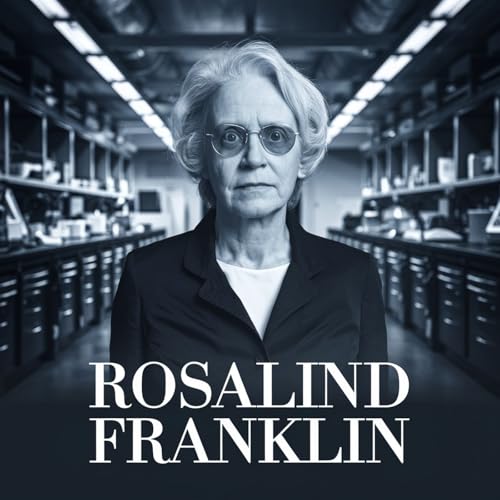
Rosalind Franklin cover art

Rosalind Franklin

Rosalind Franklin

By: Podra Network
Listen for free

The woman who photographed DNA — the overlooked genius and scientific legacy of Rosalind Franklin.Copyright Podra Network Science
Episodes
  • Reclaiming Her Place in History
    Jun 25 2026
    In this compelling episode of Rosalind Franklin, Dr Sarah Quinn explores how one of history's most important scientists has finally received her due recognition. For decades, Rosalind Franklin's crucial contributions to discovering DNA's structure were overshadowed by Watson and Crick's Nobel Prize-winning work. Through meticulous X-ray crystallography, including the famous 'Photo 51,' Franklin provided essential data that enabled the double helix model. Born in 1920, Franklin overcame significant barriers facing women in science, earning her PhD from Cambridge and conducting groundbreaking research at King's College London and later Birkbeck College. Her work extended beyond DNA to important discoveries about RNA and virus structures. After her death from cancer in 1958 at age 37, Franklin's contributions were minimized for decades. Beginning in the 1970s, feminist scholars and science historians began reclaiming her legacy, culminating in Brenda Maddox's influential 2002 biography. Today, Franklin is properly celebrated through institutes, educational curricula, and scientific recognition bearing her name. Her story represents both exceptional scientific achievement and the broader pattern of women's contributions being historically overlooked. Franklin's reclamation offers valuable lessons about scientific collaboration, proper attribution, and the importance of inclusive historical narratives in understanding scientific progress.
    Show More Show Less
    6 mins
  • The Nobel That Never Was
    Jun 18 2026
    In this compelling episode of Rosalind Franklin, Dr Sarah Quinn explores one of science's most controversial Nobel Prize omissions. When James Watson, Francis Crick, and Maurice Wilkins received the 1962 Nobel Prize in Physiology or Medicine for discovering DNA's structure, Rosalind Franklin was notably absent - having died four years earlier. This episode examines Franklin's crucial contributions to DNA research, including her famous Photo 51 X-ray crystallography image that provided key evidence for the double helix structure. We explore the complex ethical questions surrounding how her data was shared with Watson and Crick, the strained professional relationships at King's College London, and the broader implications for women in science. The discussion reveals how Franklin was remarkably close to solving DNA's structure independently and highlights her subsequent groundbreaking work on virus research at Birkbeck College. This story serves as a powerful reminder about scientific collaboration, recognition, and the often complicated nature of discovery. Dr Quinn presents a balanced examination of this controversial chapter in scientific history, exploring themes of gender bias, institutional culture, and the ongoing efforts to restore Franklin's rightful place in the DNA discovery narrative.
    Show More Show Less
    5 mins
  • A Life Cut Short: Franklin's Final Years
    Jun 11 2026
    In this poignant episode, Dr Sarah Quinn explores Rosalind Franklin's final years from 1953 to 1958, examining her transformative move from King's College London to Birkbeck College. Despite facing a hostile work environment earlier in her career, Franklin found her scientific stride at Birkbeck, where she conducted groundbreaking research on virus structure alongside future Nobel laureate Aaron Klug. This period saw Franklin publish seventeen influential papers on viral architecture, developing revolutionary techniques that combined X-ray crystallography with chemical analysis. Her work on tobacco mosaic virus and poliovirus laid crucial foundations for modern virology and vaccine development. The episode highlights how Franklin thrived in collaborative environments, mentoring graduate students while building international research partnerships. We explore the tragic irony of Watson and Crick receiving the Nobel Prize in 1962 for DNA work that relied heavily on Franklin's data, four years after her death. Quinn examines Franklin's extraordinary scientific productivity despite declining health, revealing a brilliant researcher whose contributions to structural biology extended far beyond DNA. The episode presents Franklin not as the difficult figure sometimes portrayed in early accounts, but as a dedicated scientist whose innovative methodologies continue to influence modern biotechnology and drug development research today.
    Show More Show Less
    5 mins
adbl_web_anon_alc_button_suppression_t1
No reviews yet