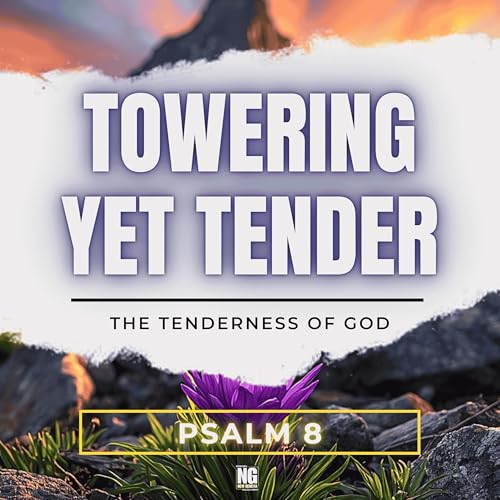
• Towering Yet Tender God
    May 27 2026

    Why would a God this great care about you?

    In Psalm 8, David looks at the night sky and asks, “What is man that You are mindful of him?” In this study, Dr. Toby Holt shows how God is both towering above all things and tender toward each of us.

    David is overwhelmed by God’s majesty — the heavens, the moon and the stars, all the work of His fingers. Against that vastness, people seem tiny. Yet the wonder of the psalm is that this towering God stoops to care for us, crowning humanity with honor and dignity. Dr. Holt explains that God exceeds us not only in size but in substance, and that we bear His image. The God who set the stars in place is also the God who is mindful of you.

    Questions this study answers:

    1. What is so striking about Psalm 8? That the God who made the vast heavens also cares about small, sinful people. His greatness and His tenderness meet in this psalm.

    2. Why does David focus on the “name” of God? Because God’s name carries His nature and majesty. To praise His name is to praise who He truly is.

    3. What proof do you have that God loves you? That the towering Creator stoops to be mindful of you and crowns you with dignity. His care for the small is the wonder of Psalm 8.

    “What is man that You are mindful of him, and the son of man that You visit him?” — Psalm 8:4 (NKJV)

    Speaker: Dr. Toby Holt is the President of New Geneva Theological Seminary, a Reformed seminary in Colorado Springs. He is known for clear, down-to-earth Bible teaching, and his sermons have been downloaded more than 1.9 million times on SermonAudio.

    Listen and go deeper: This sermon is part of the Psalms Explained study from New Geneva Theological Seminary. Find more verse-by-verse teaching across the Bible at newgeneva.org. To support this teaching ministry, visit newgeneva.org/give.

    Show More Show Less
    24 mins
  • The Lord Is My Shepherd
    Aug 1 2025

    What does it mean that the Lord is your shepherd?

    In Psalm 23, the most beloved psalm in the Bible, David calls the Lord “my shepherd.” In this study, Dr. Toby Holt unpacks why this short psalm has comforted God’s people for three thousand years.

    To call the Lord “my shepherd” is a bold, personal claim — and it also admits that we are sheep: prone to wander and in need of care. Dr. Holt walks through the psalm’s two pictures: God as the Shepherd who guards, provides, and leads, and God as the gracious Host who anoints our head and fills our cup to overflowing. Jesus took up this very image when He called Himself the Good Shepherd, whose sheep hear His voice. It is the most requested passage at funerals — because its hope reaches all the way to “the house of the LORD forever.”

    Questions this study answers:

    1. Why is Psalm 23 the most beloved psalm? Because it speaks of God’s personal care in life and in death. Its comfort meets people in their deepest needs.

    2. What does it mean to call the Lord “my shepherd”? It is a claim of trust — and an admission that we are sheep who need leading, providing, and protecting.

    3. What does it mean to be one of God’s sheep? It means knowing the Shepherd’s voice and following Him. His sheep are kept safe by the One who laid down His life for them.

    “The LORD is my shepherd; I shall not want.” — Psalm 23:1 (NKJV)

    Speaker: Dr. Toby Holt is the President of New Geneva Theological Seminary, a Reformed seminary in Colorado Springs. He is known for clear, down-to-earth Bible teaching, and his sermons have been downloaded more than 1.9 million times on SermonAudio.

    Listen and go deeper: This sermon is part of the Psalms Explained study from New Geneva Theological Seminary. Find more verse-by-verse teaching across the Bible at newgeneva.org. To support this teaching ministry, visit newgeneva.org/give.

    Show More Show Less
    28 mins
  • How Long O Lord (The Cry Of God's People)
    Jul 25 2025

    Is it okay to ask God “how long”?

    In Psalm 13, David cries out “How long, O LORD?” four times in just six verses — and then ends in worship. In this study, Dr. Toby Holt shows that honest lament and real faith can go together.

    David feels forgotten and overwhelmed, and he tells God so plainly. Dr. Holt notes that our struggle is often the duration of hardship, not only its severity. Yet David does not stay in despair: he remembers God’s past faithfulness — rescue from the lion, the bear, and Goliath — and chooses to trust again. The psalm moves from frustration to faith, ending, “I will sing to the LORD, because He has dealt bountifully with me.”

    Questions this study answers:

    1. Why did David, “a man after God’s own heart,” feel abandoned? Because faith does not erase real pain. David honestly voiced his anguish even while continuing to trust God.

    2. What does this psalm teach about honest prayer? That God welcomes our raw, honest cries. Lament is not the opposite of faith; it can be an act of it.

    3. How can worship rise even from pain? By remembering God’s past faithfulness and trusting His mercy. David sang again because he recalled how God had dealt bountifully with him.

    “But I have trusted in Your mercy; my heart shall rejoice in Your salvation. I will sing to the LORD, because He has dealt bountifully with me.” — Psalm 13:5-6 (NKJV)

    Speaker: Dr. Toby Holt is the President of New Geneva Theological Seminary, a Reformed seminary in Colorado Springs. He is known for clear, down-to-earth Bible teaching, and his sermons have been downloaded more than 1.9 million times on SermonAudio.

    Listen and go deeper: This sermon is part of the Psalms Explained study from New Geneva Theological Seminary. Find more verse-by-verse teaching across the Bible at newgeneva.org. To support this teaching ministry, visit newgeneva.org/give.

    Show More Show Less
    28 mins
  • Why Do The Nations Rage
    Jul 18 2025

    Why do people rage against God?

    In Psalm 2, the nations and their rulers conspire against the Lord — a rebellion as old as the human heart. In this study, Dr. Toby Holt unpacks this psalm’s picture of human defiance and God’s enthroned King.

    The kings of the earth plot to throw off God’s rule, but God in heaven is unmoved. Dr. Holt explains that Psalm 2 is a Messianic psalm pointing to Christ, God’s appointed King, who will one day rule the nations. For now, God shows patience toward rebels, calling them to “kiss the Son” — to submit to Christ — before judgment comes. The psalm ends with a promise: “Blessed are all those who put their trust in Him.”

    Questions this study answers:

    1. Why does God “laugh” at earthly rulers? Because their rebellion against the Almighty is futile. Nothing they plot can shake His throne.

    2. How is this psalm both political and prophetic? It speaks to real rulers who oppose God, and it points ahead to Christ, the King God has installed over all nations.

    3. How should we respond to God’s King? By trusting and submitting to the Son rather than resisting Him. Those who take refuge in Him are blessed, not condemned.

    “Why do the nations rage, and the people plot a vain thing?” — Psalm 2:1 (NKJV)

    Speaker: Dr. Toby Holt is the President of New Geneva Theological Seminary, a Reformed seminary in Colorado Springs. He is known for clear, down-to-earth Bible teaching, and his sermons have been downloaded more than 1.9 million times on SermonAudio.

    Listen and go deeper: This sermon is part of the Psalms Explained study from New Geneva Theological Seminary. Find more verse-by-verse teaching across the Bible at newgeneva.org. To support this teaching ministry, visit newgeneva.org/give.

    Show More Show Less
    27 mins
  • The Omniscience (Knowledge) Of God
    Jul 11 2025

    How well does God know you?

    In Psalm 139:1-6, David says God has “searched” and “known” him completely. In this study, part of a series on God’s attributes, Dr. Toby Holt explores the omniscience, or all-knowing, of God.

    God knows our sitting down and our rising up, our thoughts, even our words before we speak them. Dr. Holt explains that God’s knowledge is not gained over time, the way we get to know a friend — He knows all things instantly and perfectly, and is never surprised. Such knowledge, David admits, is “too wonderful” to grasp. The comfort is that the God who knows us fully — sin and all — loves us still, and can be trusted even when we do not understand what He does.

    Questions this study answers:

    1. How does God’s omniscience bring both conviction and comfort? It convicts us, because He sees everything; it comforts us, because He knows us fully and loves us anyway.

    2. Is God ever surprised or learning? No. God knows all things at once and perfectly. He never grows in knowledge or discovers anything new.

    3. How should God’s all-knowing reshape how we live? It moves us to honesty before Him and trust in Him. The God who knows everything also knows what is best.

    “Such knowledge is too wonderful for me; it is high, I cannot attain it.” — Psalm 139:6 (NKJV)

    Speaker: Dr. Toby Holt is the President of New Geneva Theological Seminary, a Reformed seminary in Colorado Springs. He is known for clear, down-to-earth Bible teaching, and his sermons have been downloaded more than 1.9 million times on SermonAudio.

    Listen and go deeper: This sermon is part of the Psalms Explained study from New Geneva Theological Seminary. Find more verse-by-verse teaching across the Bible at newgeneva.org. To support this teaching ministry, visit newgeneva.org/give.

    Show More Show Less
    28 mins
  • The Omnipotence (Power) Of God
    Jul 4 2025

    Just how powerful is God?

    In Psalm 2, the nations rage against God — and He simply laughs. In this study, the first in a short series on God’s attributes, Dr. Toby Holt explores the omnipotence, or all-power, of God.

    Earthly rulers conspire against the Lord and His Anointed, but God, enthroned in heaven, is utterly unthreatened. Dr. Holt explains what “omnipotent” really means: God can do anything He wills, though He cannot act against His own nature. He has set His King — His Son — on His holy hill, and that King will rule over all. The wise response is not to rage but to trust the Son. No human power can frustrate the will of the Almighty.

    Questions this study answers:

    1. What does God’s power look like in the face of rebellion? Unshaken. While rulers plot, God remains enthroned and in complete control. Their defiance changes nothing.

    2. Why does the psalm say God laughs at earthly rulers? Because their rebellion is futile against the Almighty. Their threats are nothing before His infinite power.

    3. How should we live in light of God’s omnipotence? By trusting Him rather than fearing the powers of this world. The all-powerful God invites us to take refuge in His Son.

    “He who sits in the heavens shall laugh; the Lord shall hold them in derision.” — Psalm 2:4 (NKJV)

    Speaker: Dr. Toby Holt is the President of New Geneva Theological Seminary, a Reformed seminary in Colorado Springs. He is known for clear, down-to-earth Bible teaching, and his sermons have been downloaded more than 1.9 million times on SermonAudio.

    Listen and go deeper: This sermon is part of the Psalms Explained study from New Geneva Theological Seminary. Find more verse-by-verse teaching across the Bible at newgeneva.org. To support this teaching ministry, visit newgeneva.org/give.

    Show More Show Less
    29 mins
  • Growing Up (Take Your Faith Seriously)
    Jun 27 2025

    How does a Christian grow up in the faith?

    In Psalm 119:9-16, the psalmist asks, “How can a young man cleanse his way?” and answers: by God’s Word. In this study, Dr. Toby Holt shows what it means to take your faith seriously and grow up spiritually.

    Spiritual maturity, Dr. Holt explains, means taking personal ownership of your faith through steady time in God’s Word — not growing godly “by osmosis.” The psalmist hides God’s Word in his heart so he will not sin, treasures it above riches, and resolves to meditate on it and delight in it. Dr. Holt compares ignoring Scripture to assembling a complex set without the instructions, or sailing without a map. Real growth comes from intentional, daily attention to what God has said.

    Questions this study answers:

    1. Why is God’s Word essential for spiritual growth? Because it is how God cleanses, guides, and matures His people. There is no growing up in the faith apart from it.

    2. What does it take to develop lasting convictions? Hiding God’s Word in the heart and valuing it above everything else. Convictions are built by treasuring Scripture, not skimming it.

    3. How do we move from shallow to serious faith? By intentional, regular time in God’s Word — meditating on it and delighting in it. Maturity comes by ownership, not osmosis.

    “Your word I have hidden in my heart, that I might not sin against You.” — Psalm 119:11 (NKJV)

    Speaker: Dr. Toby Holt is the President of New Geneva Theological Seminary, a Reformed seminary in Colorado Springs. He is known for clear, down-to-earth Bible teaching, and his sermons have been downloaded more than 1.9 million times on SermonAudio.

    Listen and go deeper: This sermon is part of the Psalms Explained study from New Geneva Theological Seminary. Find more verse-by-verse teaching across the Bible at newgeneva.org. To support this teaching ministry, visit newgeneva.org/give.

    Show More Show Less
    30 mins
  • A New Start And An Old Promise
    Jun 20 2025

    How far does God remove our sins?

    In Psalm 103:8-18, David celebrates a God who is merciful, slow to anger, and abundant in love. In this study, Dr. Toby Holt points to the unchanging promises that anchor a new start.

    David says God does not treat us as our sins deserve, and that He removes our transgressions “as far as the east is from the west.” Dr. Holt explains that two things never change: God’s character and His love for His people. God knows we are weak, “but dust,” and He pities us like a tender father. His mercy is “from everlasting to everlasting.” Preached as a New Year’s message, this psalm grounds any fresh start on God’s old, unbreakable promise.

    Questions this study answers:

    1. What promises does David recall in this psalm? That God forgives, heals, redeems, and crowns us with love — and removes our sin completely. These are anchors that do not change.

    2. How does God’s compassion shape how we see Him? It shows Him as a tender Father who knows our weakness and pities us. He deals with us in mercy, not merely in justice.

    3. Why is remembering God’s faithfulness vital? Because our hope rests on His unchanging character, not our performance. Remembering steadies us when we are weak.

    “As far as the east is from the west, so far has He removed our transgressions from us.” — Psalm 103:12 (NKJV)

    Speaker: Dr. Toby Holt is the President of New Geneva Theological Seminary, a Reformed seminary in Colorado Springs. He is known for clear, down-to-earth Bible teaching, and his sermons have been downloaded more than 1.9 million times on SermonAudio.

    Listen and go deeper: This sermon is part of the Psalms Explained study from New Geneva Theological Seminary. Find more verse-by-verse teaching across the Bible at newgeneva.org. To support this teaching ministry, visit newgeneva.org/give.

    Show More Show Less
    23 mins