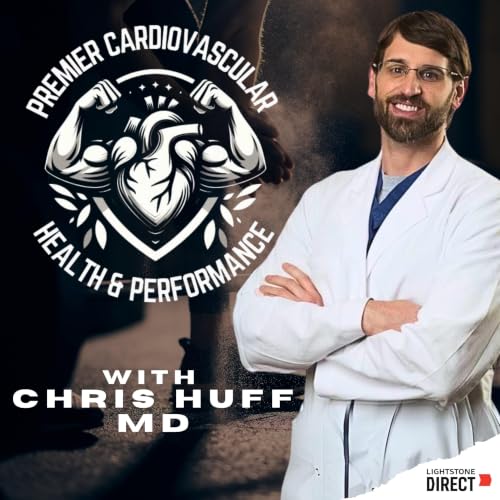
Premier Cardiovascular Health and Performance Podcast cover art

Premier Cardiovascular Health and Performance Podcast

Premier Cardiovascular Health and Performance Podcast

By: Chris Huff MD Doctor Podcast Network
Listen for free

Dr. Chris Huff, an interventional cardiologist, is here to help you master heart health. With a focus on prevention, this podcast offers real advice on how to eat better, exercise smarter, and understand your medical check-ups. Dr. Huff breaks down complex topics into clear, actionable steps, helping you live a healthier, longer life with a strong heart. Perfect for anyone looking to improve their well-being.2024 Premier Cardiovascular Health & Performance Podcast Exercise & Fitness Fitness, Diet & Nutrition Hygiene & Healthy Living Personal Development Personal Success
Episodes
  • #49: How to Survive and Thrive During a Hospital Stay: A Guide to Safer Hospital Care
    Jun 21 2026

    Most people assume that once they enter a hospital, every aspect of their care will be managed perfectly. But hospitals are complex environments filled with busy teams, multiple providers, changing shifts, and countless decisions being made every day.

    Dr. Chris Huff explains why patients and families should take an active role in their care — not out of fear, but out of awareness.

    Drawing from his experience as an interventional cardiologist trained at elite institutions, Dr. Huff discusses real examples of preventable hospital complications and shares practical strategies to improve communication, reduce errors, and help patients recover more quickly.

    Topics include:

    • Why hospitalization carries risks — even at excellent medical centers
    • The importance of telling your story clearly
    • Why teaching hospitals can often provide additional advantages
    • How to know when a transfer to a higher level of care is appropriate
    • Why being respectful and engaged can positively impact your hospital experience
    • The importance of understanding every test, medication, and procedure before agreeing to it
    • How sleep, nutrition, and mobility affect your recovery
    • What questions to ask before leaving the hospital

    This episode is a practical roadmap for patients and families who want to confidently navigate one of life’s most stressful experiences.

    What You’ll Learn
    • How to become your own best healthcare advocate
    • Why medication errors are one of the most common preventable causes of harm in hospitals
    • Why you should always understand every medication before taking it
    • How to communicate effectively with doctors, nurses, residents, and specialists
    • The benefits and misconceptions surrounding teaching hospitals
    • Why unnecessary fasting, blood draws, and overnight interruptions may slow recovery
    • How movement and physical therapy can improve your chances of going home sooner
    • The critical steps to take before discharge, including reviewing medications and follow-up plans
    • How family members can advocate effectively without creating barriers to care
    Key Takeaway

    The best healthcare outcomes happen when patients and medical teams work together.

    Ask questions. Understand your treatment. Stay engaged in your care.

    Being an informed, respectful advocate for yourself or a loved one may be one of the most powerful tools for achieving excellent hospital care.

    Let’s Connect:
    • Work with Dr. Chris Huff: Premier Cardiovascular Health
    • Facebook: https://www.facebook.com/chris.huff.9480
    • Instagram: @hufcm
    Referenced Concepts in Episode
    • Preventable hospital errors and patient safety
    • Teaching hospitals vs. community hospitals
    • Medication safety and understanding your prescriptions
    • The importance of asking questions and knowing your plan of care
    • Hospital discharge planning and follow-up
    • Mobility, nutrition, and sleep as key components of recovery
    • Being an effective advocate for yourself and your loved ones

    Disclaimer: The information provided in this podcast is for educational and informational purposes only and is not intended as medical advice. Always consult with a qualified healthcare provider before making any decisions about your health or medical treatment.


    Hosted by Simplecast, an AdsWizz company. See pcm.adswizz.com for information about our collection and use of personal data for advertising.

    Show More Show Less
    41 mins
  • #48: Mental Fortitude, Discipline, and the Systems That Drive High Performance
    May 22 2026

    Most people think performance comes down to motivation, talent, or willpower.

    Dre Baldwin explains why that thinking is incomplete.

    Discipline is a byproduct of structure, not a personality trait. It’s what shows up when motivation doesn’t, and it's what separates the people who talk about high performance from the people who actually deliver.

    • Why motivation fails and discipline finishes the race
    • How structure produces discipline, and discipline produces confidence
    • Why accountability matters more than effort or willpower
    • The “Third Day” principle that separates pros from amateurs
    • Why talented people fall short — and what the AWOL effect really means
    • How to come back from setbacks without starting from zero

    This episode reframes performance as something you build with systems — not something you wait to feel.

    What You’ll Learn
    • The difference between motivation and discipline
    • Why structure (not feelings) creates consistent performance
    • How to find and work with an accountability partner who actually holds the line
    • The hierarchy of principle → structure → discipline → confidence
    • What the “Third Day” and “Fourth Day” mean for sticking with a process
    • How to get back on track after falling off without starting over
    • Why the AWOL effect (Ability Without Output Leverage) sinks talented people
    • How to remove internal negotiation from your daily operating system
    Key Takeaway

    Discipline isn’t a personality trait.

    It’s the byproduct of a structure you follow consistently — and once that structure is in place, performance stops depending on how you feel.

    Guest Bio

    Dre Baldwin is the founder of Work On Your Game®, a system used by entrepreneurs, executives, athletes, and high performers to install discipline, decision-making structure, and execution reliability.

    Before becoming a speaker, author, and business leader, Dre built a professional basketball career the unconventional way — starting at the Division III level with no major recruiting attention and earning his opportunities through consistency, repetition, and mental discipline. That same mindset evolved into the Work On Your Game® philosophy that now reaches millions of people around the world.

    Today, Dre works with executives, athletes, entrepreneurs, and organizations on leadership, mindset, decision-making, and execution. He is a 4-time TEDx speaker, the author of 43 books, and the host of the Work On Your Game podcast, where he breaks down the habits and mental frameworks behind sustained high performance.

    Resources & Links
    • Power Presence Protocol: https://powerpresenceprotocol.com
    • Work On Your Game: https://www.dreallday.com
    • Books by Dre Baldwin (43 titles):
      • Search: Dre Baldwin author (Work On Your Game, The Third Day, The Mental Workbook, and more)
    Connect with Dre Baldwin
    • Work On Your Game
    • YouTube Channel
    • Instagram
    • LinkedIn
    • Work On Your Game Podcast
    Referenced Concepts in Episode:
    • Discipline vs. motivation
    • The Third Day & Fourth Day framework
    • AWOL effect (Ability Without Output Leverage)
    • Principle → Structure → Discipline hierarchy
    • Removing internal negotiation
    Let’s Connect:

    Work with Dr. Chris Huff: Premier Cardiovascular Health

    Facebook: https://www.facebook.com/chris.huff.9480

    Instagram: @hufcm

    Disclaimer: The information provided in this podcast is for educational and informational purposes only and is not intended as medical advice. Always consult with a qualified healthcare provider before making any decisions about your health or medical treatment.


    Hosted by Simplecast, an AdsWizz company. See pcm.adswizz.com for information about our collection and use of personal data for advertising.

    Show More Show Less
    52 mins
  • #47: Peptides
    Apr 30 2026

    A century of data, some of the most important drugs in modern medicine, and a Wild West of unregulated products being sold online with claims that outrun the evidence. That’s the peptide world right now.

    Part of the confusion is that the word "peptide" gets used for everything from injectable insulin — one of the most consequential discoveries in the history of medicine — to vials of powder shipped from overseas with no oversight at all.

    In this episode, Dr. Chris Huff pulls the curtain back. He walks through what a peptide actually is (a short chain of amino acids that acts as a signaling molecule in the body), how the story started in the 1920s with insulin, and how the field exploded with GLP-1 agonists like semaglutide— drugs that are reshaping how we think about diabetes, obesity, and even cardiovascular risk.

    He gets into the SELECT trial, the roughly 20% relative risk reduction in major cardiovascular events seen with semaglutide in patients with obesity but not diabetes, and what that finding actually means for the people sitting in his exam room.

    And he’s just as honest about the other side of the conversation, the wellness side, where peptides like BPC-157, TB-500, CJC-1295, and MOTS-c are marketed for recovery, longevity, and performance.

    If someone in your life is considering a peptide — for weightloss, injury recovery, or "longevity" — this episode is worth the listen.

    This episode is sponsored by Lightstone DIRECT. Lightstone DIRECT invites you to partner with a $12B AUM real estate institution as you grow your portfolio. Access the same single-asset multifamily and industrial deals Lightstone pursues with its own capital – Lightstone co-invests a minimum of 20% in each deal alongside individual investors like you. You’re an institution. Time to invest like one.

    What You’ll Learn
    • What a peptide actually is
    • How the peptide story started in the 1920s and changed type 1 diabetes from a fatal disease to a manageable one
    • How GLP-1 drugs work in the body — insulin, glucagon, gastric emptying, and satiety
    • What the SELECT trial showed about semaglutide and cardiovascular risk in patients without diabetes
    • The strange but true origin story of GLP-1 medications — and the desert lizard at the center of it
    • How approved peptides are actually manufactured, and why that’s different from what you’ll find online
    • Why the FDA has issued warnings about unapproved GLP-1 products
    • What’s actually known about BPC-157, TB-500, CJC-1295, and MOTS-c — and where the data stops
    • The real risks of unregulated peptides, including immune reactions and systemic inflammation
    • The questions to ask before starting any peptide therapy
    Key Takeaway

    Peptides aren’t good or bad. The right question is whether the specific peptide you’re considering has been studied in humans, manufactured to a standard you can trust, and prescribed by someone who knows your full picture. In medicine, that difference is everything.

    About the Host

    Dr. Chris Huff is a cardiologist who’s spent his career trying to make heart health less mysterious. He’s treated thousands of patients, prescribed plenty of medications, talked plenty of patients out of starting them, and brought his own LDL from 170 down into the 60s through nutrition alone. That mix of clinical experience and personal experience shows up in everything he does. He’s a believer in the data. He’s also a believer that the patient in front of him is a whole person, not a lab value.

    Let's Connect

    Work with Dr. Chris Huff: Premier Cardiovascular Health

    Facebook: facebook.com/chris.huff.9480

    Instagram: @hufcm

    Disclaimer: The information provided in this podcast is for educational and informational purposes only and is not intended as medical advice. Always consult with a qualified healthcare provider before making any decisions about your health or medical treatment.


    Hosted by Simplecast, an AdsWizz company. See pcm.adswizz.com for information about our collection and use of personal data for advertising.

    Show More Show Less
    10 mins
adbl_web_anon_alc_button_suppression_t1
No reviews yet