• Playing to Your Strong Suit as a Spade
    Sep 23 2025

    What this episode covers

    Why Spades matter: Their superpower is rigorous problem definition, research, and data synthesis—the foundation of smart strategy and R&D.

    High vs. Low Spades: Where each gets energy (inward reflection vs. outward sharing) and how that shows up at work.

    Common pitfalls: Analysis paralysis, undervaluing interpersonal dynamics, missing the big picture, and drifting into “know-it-all” or cynical territory under stress.

    How to spot a Spade: The questions they ask, the cues they give, and why silence from them does not equal disengagement.

    Communicating with Spades: Slow down, bring substance, allow thinking time, use email for reflection, and avoid interrupting their analysis.

    Maximizing Spade contributions: Enlist their expertise, set clear decision deadlines, recognize knowledge achievements, and “sell” with facts and features.

    Team design insight: Balance Spades with Diamonds (ideas), Clubs (execution), and Hearts (relationships) so decisions are both smart and adopted.

    Key Takeaways

    Define before you decide. Spades shine when the problem is ambiguous. Put them in front of fuzzy challenges and give them the mandate to clarify scope, criteria, and risks.

    Progress beats perfection. Pair the Spade mindset with a “build it, try it, fix it” cadence to prevent endless analysis.

    Respect the pace. Spades think deeply. Provide data in advance, ask pointed questions, and give time for considered responses.

    Reward with recognition that fits. Articles, patents, peer acknowledgment, and visible ownership of insights motivate Spades more than generic praise.

    Balance the system. Use Diamonds to broaden possibilities, Clubs to drive timelines and outcomes, and Hearts to energize adoption and stakeholder buy-in.

    Bottom Line

    Spades make innovation safer, smarter, and more strategic. Give them the right inputs, time, and recognition—and pair them with complementary styles—so your team can move from insight to impact.

    Resources

    📘 Personality Poker by Stephen Shapiro — deepen your understanding of all four styles and how to build balanced, high-performing teams: https://a.co/d/1xWOKjX

    Learn more, play the game, and unlock your team’s full potential at PersonalityPoker.com

    Brought to you by Stephen Shapiro—helping people and organizations create high-performing collaboration, innovation, and teams since 2001.

    Show More Show Less
    18 mins
  • Finding and Understanding Your Style
    Sep 9 2025

    What if the key to stronger teams, more effective leadership, and breakthrough innovation was hidden in a deck of cards?

    In this episode, Stephen Shapiro takes you inside the world of Personality Poker®, a game that’s been played by hundreds of thousands of people worldwide—from boardrooms in Copenhagen to Fortune 500 companies everywhere. Through laughter and card trading, participants uncover deep insights about their innovation personality and the balance (or imbalance) on their teams.

    Here’s what you’ll discover in this episode:

    The Four Suits of Innovation:

    ♠️ Spades – analytical, data-driven, “why” thinkers.

    ♣️ Clubs – structured, results-focused, “how” implementers.

    ♥️ Hearts – empathetic, relationship-driven, “who” connectors.

    ♦️ Diamonds – adventurous, creative, “what if” idea generators.

    Energy Styles (Numbers): Why introverted “inward” cards and extroverted “outward” cards shape how you show up—and how leaders often emerge from the “high cards.”

    Thinking Styles (Colors): Black = rational “dot” thinkers, Red = relational “line” thinkers—and why innovation happens at the connections between the dots.

    The Big Insight: The person you like the least is often the person you need the most. Your missing or opposite suit might drive you crazy, but they also bring the traits your team lacks.

    The Intersections: Why most people don’t fit neatly in one box, and how combinations like Thinkers, Directors, Influencers, and Builders create powerful team dynamics.

    This isn’t about putting people in boxes—it’s about sparking conversations, building awareness, and intentionally designing teams that balance creativity, execution, relationships, and results.

    Whether you’re leading a global company or collaborating with a small team, Personality Poker will help you see yourself more clearly and work more effectively with others.

    👉 Pick up your copy of Personality Poker today: https://a.co/d/1xWOKjX

    Learn more, play the game, and unlock your team’s full potential at PersonalityPoker.com

    Brought to you by Stephen Shapiro—helping people and organizations create high-performing collaboration, innovation, and teams since 2001.

    Show More Show Less
    30 mins
  • Playing Your Strongest Hand
    Jul 23 2025

    In this foundational episode, we explore two essential chapters from Personality Poker that will help you better understand yourself—and how to play the game effectively.

    Before you try to build your “perfect hand,” it’s critical to understand the difference between the four major styles:

    Preferred Style – What comes naturally to you and gives you energy

    ⚙️ Adapted Style – Traits you’ve developed out of necessity, often for your job

    🌟 Desired Style – Who you wish you were, even if it’s not natural

    🚫 Opposite Style – Traits that don’t fit you at all (and never will)

    You’ll also learn why distinguishing between these can be surprisingly difficult—and why misidentifying your style can lead to burnout, missed opportunities, or poor team dynamics.

    We also dive into the concept of your Strong Suit on Steroids—how the traits you might see as flaws (e.g., being disorganized or overly sensitive) are often just overextended strengths. These are not weaknesses—they’re your superpowers in disguise.

    Then we walk through how to play Personality Poker in three formats:

    🃏 How to Play:

    1. Solitaire (Play Solo or with a Close Friend)

    Use a 3- or 5-pile sorting method

    Uncover which traits energize you, which ones drain you, and which ones you rarely get to use (but should!)

    2. Gifting (Play with a Small Team of 4–20 People)

    Choose cards for yourself and give cards to others

    Share heartfelt stories to build trust, deepen connection, and feel seen

    3. Poker (Play with Larger Teams of 15+ People)

    Trade and refine your cards like in five-card draw

    Discover your ideal role—and who you need on your team for balance

    Optional: End with a gifting round to reinforce how others see your strengths

    💬 Key Takeaways:

    Being good at something doesn’t mean it’s your strength

    Learned/adapted behaviors can lead to burnout over time

    Unused strengths are often hidden opportunities

    The 2, 3, and 4 cards (your shadow side) may hold your biggest insights

    The goal: build a hand that reflects your true nature, not who you think you should be

    🎯 Bonus Insight:

    Personality Poker is based on the Q-sort method, a well-established psychological technique used since the 1950s. But unlike traditional assessments, this one is interactive, fast, fun, and deeply human.

    Want to play? Grab a deck, pick your format, and let the insights begin.

    Visit personalitypoker.com to learn more or get your cards.

    Learn more, play the game, and unlock your team’s full potential at PersonalityPoker.com

    Brought to you by Stephen Shapiro—helping people and organizations create high-performing collaboration, innovation, and teams since 2001.

    Show More Show Less
    28 mins
  • Are You Gambling Your Company's Future
    Jun 3 2025

    In this episode, you’ll learn:

    • Why most companies are unintentionally weakening their ability to innovate
    • The difference between visible inefficiencies and the hidden ones that do the real damage
    • How innovation and operations can work together without sacrificing long-term success
    • What the four innovation styles are—Spades, Diamonds, Clubs, and Hearts—and how they shape team performance
    • Why your style is not just who you are, but how others see you
    • How Personality Poker goes beyond traditional assessments by including self-perception, peer feedback, and unconscious preferences
    • What makes this tool more accurate, more fun, and more team-friendly than traditional assessments

    🎯 Main takeaway: Innovation fails when companies focus only on short-term results. You need balance, alignment, and diversity of thought to thrive.

    NOTE: Other than the opening remarks, the podcast was read by my AI voice clone. It's far from perfect, but it works.

    📘 Based on the book Personality Poker by Stephen M. Shapiro, published in 2010 by Portfolio Penguin. The text remains the same as what was in the original book.

    🎧 Subscribe now and discover how to play to your strong suit while building teams that are ready for anything.

    Learn more, play the game, and unlock your team’s full potential at PersonalityPoker.com

    Brought to you by Stephen Shapiro—helping people and organizations create high-performing collaboration, innovation, and teams since 2001.

    Show More Show Less
    48 mins
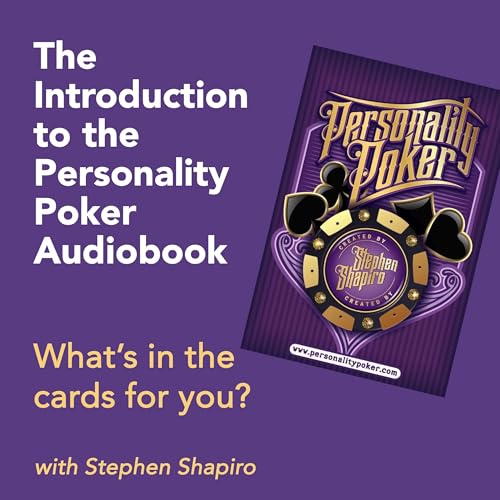
  • The Personality Poker Audiobook Introduction
    May 19 2025

    In this debut episode, you’ll discover:

    ♠️ What Personality Poker is—and how it’s radically different from traditional personality assessments

    ♦️ How a high-performance Formula One pit crew inspired the creation of the game

    ♣️ Why your innovation style matters, and how it affects team dynamics and success

    ♥️ The four phases of innovation and how they align with the four suits in a deck of cards

    🃏 Why your least favorite coworker might be the person you need most

    🧠 How “playing with a full deck” leads to better decisions, greater engagement, and breakthrough results

    Whether you’re a solopreneur, team leader, or executive, this episode lays the foundation for transforming how you think about collaboration, creativity, and contribution. You’ll also hear why knowing what makes you not tick is just as important as knowing what makes you tick.

    🔗 Learn more and get your own deck at personalitypoker.com

    Note: Aside from the brief prologue spoken by the real, live Stephen Shapiro, the audiobook content in this episode is narrated using Stephen’s AI voice clone. While the technology is impressively lifelike, it’s not flawless. Thanks for listening with an open ear!

    Learn more, play the game, and unlock your team’s full potential at PersonalityPoker.com

    Brought to you by Stephen Shapiro—helping people and organizations create high-performing collaboration, innovation, and teams since 2001.

    Show More Show Less
    25 mins
  • Welcome to the Personality Poker Podcast
    May 19 2025

    Hey there, and welcome back!

    If you’re wondering why your feed suddenly says Personality Poker instead of Invisible Solutions, don’t worry—you’re in the right place.

    I’m Stephen Shapiro, and I wanted to personally let you know that this podcast has officially been rebranded to Personality Poker as of May 2025.

    So why the change?

    Well, Invisible Solutions was all about reframing problems—and that’s still a huge part of what I do. But over time, one tool has consistently created the biggest impact in the shortest amount of time: Personality Poker.

    It’s not just a game. It’s a fast, fun, and powerful way to understand yourself, your team, and how to build collaboration that leads to real innovation.

    And that’s what this show is all about moving forward—creating high-performing teams through better self-awareness, stronger partnerships, and smarter collaboration.

    So if you’re a leader, a team member, or just someone who wants to work better with others—you’re going to love where we’re headed.

    Thanks for being here, and thank you for sticking with me through this exciting evolution.

    Be sure to follow or subscribe, because new episodes are coming soon—and we’re just getting started.

    Learn more, play the game, and unlock your team’s full potential at PersonalityPoker.com

    Brought to you by Stephen Shapiro—helping people and organizations create high-performing collaboration, innovation, and teams since 2001.

    Show More Show Less
    1 min
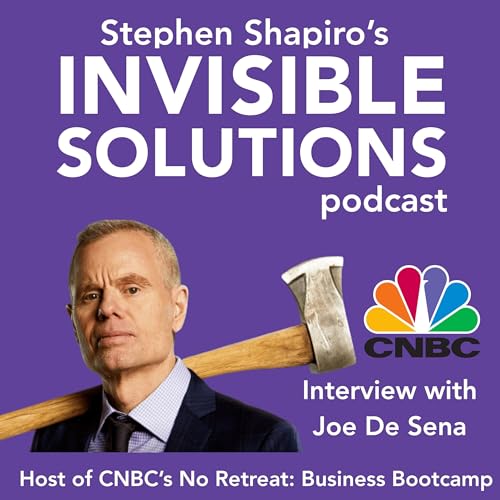
  • E37: Interview with Joe De Sena from CNBC's No Retreat
    Mar 22 2022

    Want to be a better problem solver? What if the solution is to get in the mud?

    In this episode, I interview Joe De Sena. He's the founder of Spartan and is the host of CNBC's No Retreat: Business Bootcamp.

    This incredibly powerful show puts business people in physically challenging situations as a way of getting them to be more resilient.

    In this episode, here are some of the questions we tackle:

    • Why Spartan? He feels that businesspeople need to treat themselves like an Olympian - going for the gold medal.
    • Why the TV Show? A lot of people like the idea of being in business but might not be fully committed.
    • What is the Show? The use of military-style training, tackling obstacles to build resiliency skills.
    • Why Physical Challenges? If you can master being under tremendous physical and mental stress and still push through and keep it together, you're unbreakable.
    • Why Do Businesses Fail? Most businesses fail because they quit when it gets hard.
    • How is the Show Constructed? Each week, three business issues are identified and then physical challenges are constructed to help them get stronger in dealing with them.
    • Why Does It Work? He uses an analogy on how steel is made:you heat it, pound it, and then drown it. His physical process is about tackling the problems and searing it into their brains.
    • What are the Results? Each week, at the end of the show, the positive impact is shared. For example, one company increased sales 170% in just three months.
    • How Has This Been Applied to Your Business? Joe shares how the pandemic decimated the Spartan business and how his process helped keep the company afloat (this is a very compelling story).
    • What are the Three Top Challenges for Businesses? 1) Communication, 2) Process (having Standard Operating Procedures), and 3) Cash.

    And we covered so much more.

    We also discovered that we both are Cornellians who lived in Boston and now live in the Orlando area. Small world.

    This is an episode you won't want to miss. Please share it with others who might find it valuable. And be sure to watch the show on CNBC: https://www.cnbc.com/no-retreat/

    Learn more, play the game, and unlock your team’s full potential at PersonalityPoker.com

    Brought to you by Stephen Shapiro—helping people and organizations create high-performing collaboration, innovation, and teams since 2001.

    Show More Show Less
    27 mins
  • #36: DIVOT
    Feb 22 2022

    In this freeform podcast episode, I share my thoughts on my next book: DIVOT.

    A divot is a term from golf. It's when you swing at the ball, if you go too deep, a chunk of grass goes flying, and this is a divot.

    And that's the premise of the next book - how can we go deep and create more customer value?

    Rather than changing direction (pivot) it is about deep value creation.

    In this episode, I cover a number of different topics related to the book:

    • Where do we double down on our investments?
    • How can we identify our differentiator and use that to prioritize investments?
    • How can the divot help create employee engagement and reduce burnout?
    • How can we best motivate employees (compensation, community, contribution)?
    • How can we provide stability for our employees (vs feeling like employees are working in quicksand)?
    • Why divoting is not the about standing still but is about going deeper.
    • The 5D of Differentiation (Distinctive, Desirable, Durable, Disruption-Proof, Disseminated)
    • Why we want a laser focus on investments rather than diluting and dissipating our energies
    • ...and much more

    I cover a lot of territory in this episode!

    If you have any stories to contribute to the new book, please drop me a line.

    P.S. Note that the title may change. The content might shift. And in the end it might be something other than a book. But the general philosophy of whatever I create will remain the same.

    Learn more, play the game, and unlock your team’s full potential at PersonalityPoker.com

    Brought to you by Stephen Shapiro—helping people and organizations create high-performing collaboration, innovation, and teams since 2001.

    Show More Show Less
    22 mins