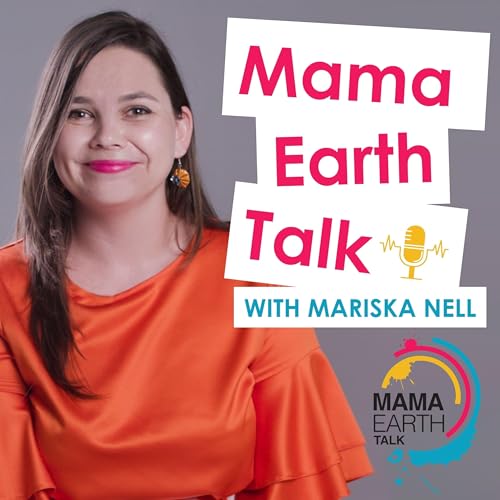
Mama Earth Talk cover art

Mama Earth Talk

Mama Earth Talk

By: Mariska Nell
Listen for free

Summary

What happens when you wear your own trash for 30 days? You start a podcast. Welcome to Mama Earth Talk—a podcast for eco-curious individuals and conscious businesses who want to make a real difference, live lighter on the planet, and do it all without the pressure to be perfect. I’m Mariska Nell, founder and host of Mama Earth Talk—a sustainability advocate, and passionate believer in progress over perfection. With a Master’s in Sustainable Design, postgraduate studies in Environmental Science, and years of hands-on experience, I’m here to help you take meaningful, heart-led action that works in real life. Mama Earth Talk shares an episode every second month packed with inspiring guest interviews, uplifting good news stories, and practical insights to keep you grounded and motivated. We also offer themed seasons, each diving deeper into specific topics like low-waste living, sustainable business, and planet-positive design—giving you the tools and inspiration to make real, lasting impact. Whether you're here to learn something new, feel inspired, or connect with a global community of changemakers—this space is for you. No guilt. No overwhelm. Just real talk, soulful progress, and hopeful stories—one small step at a time. Listen on your favorite podcast app—Apple Podcasts, Spotify, Amazon, or anywhere you tune in. You can also subscribe at https://mamaearthtalk.com/listen If something in the show speaks to you—or you know someone who’d love it—please share it and leave a review on Podchaser. https://www.podchaser.com/podcasts/mama-earth-talk-713574 Got questions or just want to say hi? I’m always around on Instagram @mamaearthtalk Mama Earth has a voice—and it is us Crazy Birds. Instagram: @mamaearthtalk Facebook: https://www.facebook.com/profile.php?id=61575371374179 Patreon: https://www.patreon.com/mamaearthtalk Website: https://mamaearthtalk.com/mamaearthtalk.com Hygiene & Healthy Living Science
Episodes
  • 206: Solving the Global Water Crisis for Just 30 Cents with Kurt Avery
    May 4 2026

    In this episode, we talk to Kurt Avery. He is the owner and founder of Sawyer Products and someone who has dedicated his life to solving one of the world’s most urgent challenges, access to clean water, through innovation, partnerships, and a business model that gives back by donating 90% of their profits in a truly powerful way.

    During this episode, we explore the global water crisis and how one simple innovation is transforming millions of lives. Kurt Avery, shares how his company is tackling access to clean water through groundbreaking filtration technology, partnerships with global organizations, and a unique business model that donates the majority of its profits.

    Timestamps to relevant points within the episode, use this format:

    [00:00] -Intro

    [02:19] – Meet Kurt Avery & the story behind Sawyer Products

    [03:31] – From snakebite kits to water filtration innovation

    [05:15] – The Haiti earthquake & global breakthrough moment

    [06:30] – Real stories showing the urgency of the water crisis

    [09:47] – Reaching 40 million people with clean water

    [10:56] – Biggest barrier: funding & scaling impact

    [13:16] – Why solving the water crisis is actually possible

    [14:12] – How the filtration technology works

    [18:29] – Partnerships with 140+ global organizations

    [20:50] – The 90% profit donation model explained

    [23:31] – New innovation: malaria-preventing baby wraps

    [27:32] – Environmental impact & sustainability benefits

    [31:01] – Scaling impact through schools and communities

    [31:22] – 23 years of struggle before success

    [32:39] – Advice for impact-driven entrepreneurs

    [36:30] – Final 5

    Links from the episodes:

    Sawyer Products

    Kurt Avery’s book: Sawyer Think

    Sawyer Foundation

    Living Lighter, A Practical Guide to Reducing Waste - Online Course by Mariska Nell

    Download your Free Beginner's Guide To Waste-Free Living

    Join our newsletter to be part of the change

    Watch the interview on YouTube

    Where can people find our guest?

    Website

    Facebook

    Instagram

    TikTok

    Key Takeaways:
    • Clean water access impacts health, education, income, and environment
    • Sawyer filters can last 10–20 years and serve entire communities
    • The company has helped 40+ million people globally
    • Their model donates 90%+ of profits to humanitarian work
    • Solving the water crisis is financially and technologically achievable today
    • Sustainability isn’t just environmental, it’s human survival and dignity

    "Kurt finds hope in the fact that solving the global water crisis could cost as little as 30 cents per person for 10 years of clean water. With scalable technology and growing awareness, we are closer than ever to making universal access a reality."

    Show More Show Less
    47 mins
  • 205: Earth Month: Small Steps, Big Impact (Plus a Special Gift for You!) with Mariska Nell
    Apr 6 2026

    In this episode, I share why Earth Month holds such a special place in my heart, how a bold experiment in 2018 sparked meaningful conversations around waste, and why sustainability doesn’t have to be overwhelming. We explore how small, realistic steps can create real impact, and I also share an exciting Earth Month announcement to help you get started on your journey.


    Timestamps to relevant points within the episode, use this format:

    [00:00]-Intro

    [00:30] Welcome + intro to the solo episode

    [01:00] The 2018 “trash suit” story & how Mama Earth Talk started

    [01:55] Why Earth Month is so special to me (and a personal connection)

    [02:30] Teaser + exciting announcement coming up

    [02:50] Why Earth Month can feel overwhelming

    [03:30] Sustainability = small, consistent steps

    [03:50] 🎉 Announcement: Free access to “Living Lighter” course

    [04:20] How to access the course (quick hack explained)

    [05:00] What the course includes (modules, videos, habits)

    [06:30] Why you only need ONE action—not 150

    [06:40] The power of small steps (water bottle example)

    [07:30] Biggest lesson: start with what feels easy

    [08:50] Practical tips for Earth Month begin

    [09:00] Tip #1: Swap one daily habit

    [09:30] Tip #2: Let your bin guide you

    [10:10] Tip #3: Make it convenient

    [10:40] Tip #4: Reduce food waste

    [11:00] Tip #5: Change the question

    [11:20] Letting go of perfection

    [12:00] You are part of something bigger

    [12:30] Your Earth Month challenge: one small step

    [13:00] Final message: imperfect action matters


    Links from the episodes:

    Mama Earth Talk Online Course

    Key Takeaways:
    • Sustainability doesn’t have to be overwhelming, start small and build from there
    • Progress over perfection is the key to long-term change
    • Your daily habits are the best place to begin your journey
    • Awareness (like noticing what’s in your bin) creates powerful change
    • Small swaps, done consistently, lead to big impact over time
    • You don’t need to do everything, just start with one step.
    • The planet needs more people taking imperfect action, not a few doing it perfectly.

    Show More Show Less
    14 mins
  • 204: What It Really Takes to Build a Sustainable Product (From a Bootstrapped Founder)
    Mar 2 2026

    In this episode, I shares the real story behind building a sustainable hard-goods brand in the pet industry, unpacking the engineering, manufacturing, certification, and financial trade-offs that most people never see. From design constraints and material decisions to B Corp, 1% for the Planet, and sustainability reporting, this is an honest founder-level look at what it actually takes to balance environmental ambition with business reality, and why sustainability is a discipline, not a label.

    Timestamps to relevant points within the episode, use this format:

    [00:00] The Question Most Consumers Never Ask

    [02:10] From Sustainability Advisor to Bootstrapped Founder

    [04:45] Progress vs Perfection in Sustainable Business

    [07:30] The 4-Pillar Sustainability Framework (Environment, People, Economy, Culture)

    [10:15] Why Sustainability Lives in Engineering Constraints

    [12:00] Designing for Longevity (And the Business Model Tension)

    [14:20] Care-Centered Design & Piper’s Physiotherapy Moment

    [16:30] Material Trade-Offs: Why Bamboo Wasn’t the Right Choice

    [19:00] Certifications Explained: What Actually Matters

    [21:30] 1% for the Planet & Financial Accountability

    [23:10] FSC Packaging, REACH & Compliance

    [24:45] B Corp: Why It’s Not a Day One Certification

    [26:30] Sustainability Reporting & Measurement

    [27:40] Why Profit Is Oxygen in Sustainable Business

    [29:00] Celebrating Brands That Are Doing the Work

    [30:00] Final Thoughts & Community Invitation

    Links from the episodes:

    1% for the Planet

    Previous Mama Earth Talk Episode with the CEO of 1% for the Planet, Kate Williams

    Pet Sustainability Coalition

    B Corp Certification

    Forest Stewardship Council (FSC)

    ISO 14001 Environmental Management Systems

    Cradle to Cradle Certification

    Mama Earth Talk Online Course

    Key Takeaways:

    • Sustainable product development is not theoretical, it’s constrained by tooling costs, manufacturing realities, minimum order quantities, and cash flow.

    • A structured sustainability framework (Environment, People, Economy, Culture) is your decision-making filter when trade-offs get hard.

    • Perfection can become paralysis, progress with sequencing is often more impactful than waiting for “100% sustainable.”

    • Sustainability in hard goods lives in engineering decisions, not marketing language.

    • Designing for longevity reduces waste, but can reduce repeat purchases. That’s a business model tension founders must face.

    • The “most sustainable-looking” material isn’t always the most appropriate one. Context matters.

    • Certifications are validation layers, not starting point, they should align with operational readiness and financial stability.

    • Material compliance (FDA, REACH, BPA-free) is foundational and often more important than flashy badges.

    • Sustainability reporting turns intention into measurement, and measurement drives accountability.

    • Profit isn’t the enemy of sustainability, it’s oxygen. Without financial viability, environmental ambition can collapses.

    • Transparency builds trust when it shows process, not perfection.

    • Celebrating brands that are doing the structural work shifts incentives across the industry.

    • Sustainability isn’t a label, it’s an ongoing discipline.

    Show More Show Less
    36 mins
adbl_web_anon_alc_button_suppression_c
No reviews yet