Let's Talk Micro cover art

Let's Talk Micro

Let's Talk Micro

By: Luis Plaza
Listen for free

This Season's Biggest Deal | £0.99/mo for 3 months + £10 Audible bonus

£5.99/mo after 3 months - terms apply. Cancel monthly
Summary
Clinical microbiology explained in simple terms, suitable for students and microbiologists alike. We discuss organisms, reactions, infectious diseases, and more. Hosted by Luis Plaza, a Medical Laboratory Scientist and microbiologist, who also shares his experiences in the field.Luis Plaza 2021-2025 Biological Sciences Science
Episodes
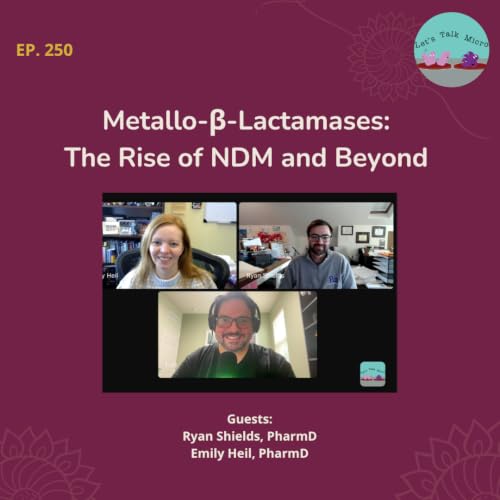
  • 250: Metallo-β-Lactamases: The Rise of NDM and Beyond
    Oct 29 2026

    Metallo-β-lactamases (MBLs) have become an increasingly important topic in clinical microbiology and infectious diseases. While these enzymes were once encountered relatively infrequently in the United States, their epidemiology is changing, with NDM-producing organisms becoming more common. What makes metallo-β-lactamases different from other carbapenemases? Why are infections caused by MBL-producing organisms particularly challenging to treat? And what new treatment options are becoming available?

    In this episode of Let's Talk Micro, Luis is joined by Dr. Ryan Shields and Dr. Emily Heil to discuss metallo-β-lactamases and their growing clinical significance. They explore the differences between serine β-lactamases and MBLs, review important enzymes such as NDM, VIM, and IMP, and discuss the challenges associated with treating infections caused by MBL-producing organisms. The conversation also covers emerging treatment options, including aztreonam-avibactam and cefepime-zidebactam, and highlights the importance of identifying specific carbapenemases to guide antimicrobial therapy.

    Join us for a discussion on the evolving landscape of metallo-β-lactamases and the essential role of the clinical microbiology laboratory in patient care.

    Guests:

    • Ryan Shields, PharmD — University of Pittsburgh

    • Emily Heil, PharmD — University of Maryland School of Pharmacy and University of Maryland Medical Center

    Additional Reading:

    McCreary EK, Heil EL, Aitken SL, et al. The global epidemiology and treatment of metallo-β-lactamase-producing gram-negative pathogens. JAC-Antimicrobial Resistance. 2026;8(5).

    https://pubmed.ncbi.nlm.nih.gov/42876900/

    Stay connected with Let's Talk Micro:

    • Website: letstalkmicro.com

    • Questions or feedback? Email me at letstalkmicro@outlook.com

    • Interested in being a guest on Let's Talk Micro? Fill out the form here: https://forms.gle/V2fT3asjfyusmqyi8

    Support the podcast:

    • Venmo

    • Buy me a Ko-fi

    Show More Show Less
    47 mins
  • 249: Micro Minutes: CLSI M100: Beyond S, I, and R
    Oct 22 2026

    When you open CLSI M100, what are you usually looking for? Susceptibility breakpoints? But did you know there's much more information available beyond susceptible, intermediate, and resistant interpretations?

    In this episode of Micro Minutes, we explore useful information found throughout CLSI M100, including its tables, comments, and appendices. From intrinsic resistance and predicting susceptibility to other antimicrobials to understanding why certain agents should not be reported as susceptible, we highlight practical examples that can help clinical microbiology professionals interpret antimicrobial susceptibility results.

    Whether you're a student or an experienced laboratory professional, join us as we take a closer look at CLSI M100 and discover what's beyond S, I, and R.

    Stay connected with Let's Talk Micro:

    • Website: letstalkmicro.com

    • Questions or feedback? Email me at letstalkmicro@outlook.com

    • Interested in being a guest on Let's Talk Micro? Fill out the form here: https://forms.gle/V2fT3asjfyusmqyi8

    Support the podcast:

    • Venmo

    • Buy me a Ko-fi

    Show More Show Less
    15 mins
  • 248: Micro Minutes: What's in a name- Bacterial Groups and Complexes
    Oct 15 2026

    Have you ever performed an organism identification using MALDI-TOF mass spectrometry and received a result showing multiple possible species, such as Enterobacter cloacae and Enterobacter asburiae, or Citrobacter freundii and Citrobacter werkmanii? Why does this happen? What do these organisms have in common, and why are they classified into groups or complexes?

    In this episode of Micro Minutes, Luis explores bacterial groups and species complexes, why they exist, and how they relate to organism identification. He discusses several familiar and lesser-known examples, including the Enterobacter cloacae complex, Acinetobacter calcoaceticus–baumannii complex, Klebsiella pneumoniae species complex, Citrobacter freundii complex, and Pseudomonas putida group.

    The episode also highlights the Burkholderia cepacia complex and why species-level identification can be particularly important in patients with cystic fibrosis.

    Finally, learn why reporting an organism at the group or complex level is often appropriate, when additional identification may be necessary, and why understanding the capabilities and limitations of your identification system matters.

    Stay connected with Let's Talk Micro:

    • Website: letstalkmicro.com

    • Questions or feedback? Email me at letstalkmicro@outlook.com

    • Interested in being a guest on Let's Talk Micro? Fill out the form here: https://forms.gle/V2fT3asjfyusmqyi8

    Support the podcast:

    • Venmo

    • Buy me a Ko-fi

    Show More Show Less
    16 mins
adbl_web_anon_alc_button_suppression_t1
No reviews yet