Episodes

  • 40. ' Why Great Leaders Ask Great Questions' - Steve Mostyn
    Jun 21 2026

    Are you working ‘in’ or ‘on’ the firm?

    This is just one of the many provocative and thought stimulating questions Steve Mostyn asks in his book 'Why Great Leaders Ask Great Questions'.

    For a long time we looked for leader to get answers. According to Steve this is because we confuse authority with leadership. True leadership in business is grounded in knowing ourselves and building a reflective practice to enhance the understanding of ourselves, our organization and our enviroment, with the aim to develop ourselves, our teams, and our business.

    In the 40th episode of the Leadership 2.0 podcast, I interview Steve Mostyn, focusing on the question how leaders can develop such a reflective practice.

    Steve is a globally recognised leader in senior executive leadership development and an internationally acclaimed thought-leader in leadership training, and the author of the book 'Why great Leaders ask Great Questions'.

    During our conversation we discussed the following topics:

    • Why Great Leaders ask Great Questions
    • How Leaders Reflect
    • Skilled Defensiveness
    • How Leaders can learn to Reflect
    • The impact of reflection on execution
    • Experiences and Empowerment
    • Should Leaders outsource their Problems?
    • Business Reviews as Joint Problem solving sessions (instead of blame games)
    • Reflective Leaders grow Reflective Leaders
    • Reflection in Executive Programs of the Said Business School


    About Steve Mostyn

    Steve Mostyn is the author of Why Great Leaders Ask Great Questions: 7 essential reflections for every aspiring leader (John Murray Business). Mostyn is one of the world’s leading designers and directors of senior executive leadership programs and an internationally recognised thought leader in leadership training. He is Associate Fellow at Saïd Business School, University of Oxford; creates and leads the Oxford University Executive Leadership Program; and is Honorary Professor, Adam Smith Business School, University of Glasgow. Mostyn has led many corporate programs for senior leaders including the UN, Standard Chartered Bank, Royal Mail, The Financial Services Authority, and Mercedes F1 Team.

    Book 'Why Great Leaders Ask Great Questions'

    Oxford Executive Leadership Program Said Business School

    Any questions or comments? Press this link and send me a message!

    Show More Show Less
    45 mins
  • 39. 'Carl Jung's Framework for Personal Development' - James Johnston
    Jun 8 2026

    We all have behavioral preferences.

    Some of us get energy from being part of a group, others from quiet reflection on their own. When it comes to how we gather data in decision-making processes, some people prefer looking at the facts presented by the current situation, while others rely more on the future possibilities the current situation offers.
    The way we make decisions is also different. There are people who prefer to make decisions based on an analytical decision-making process, with their values as 'guard rails', while others are guided primarily by their values.

    The founder of Analytical Psychology, Carl Jung, described these in his book 'Psychological Types' as Extraversion versus Introversion, Sensing versus Intuition, and Thinking versus Feeling. This was later popularized by Isabel Briggs Myers and her mother Katharine Cook Briggs in their Myers-Briggs Type Indicator (MBTI).

    Jung himself, however, was very critical about boxing people into categories. He reportedly complained that his work had been turned into 'nothing but a childish parlour game' and was particularly concerned, for instance, about the reductive application of type theory in the medical profession, where practitioners would slot patients into his system and give them the corresponding advice.

    It is important, therefore, to recognize our predispositions as strengths, but not to see them as excuses to neglect the development of our other potential capabilities.

    For example, I always preferred to take decisions based on my Intuition. That worked perfectly fine when I was a single contributor, but became increasingly ineffective as I moved to more senior roles. In order to convince my leaders, peers, and staff of my ideas and proposals, I quickly had to learn to collect and use data (Sensing). And guess what - I quickly started to like it, and in due course even built a reputation for being data savvy.

    Overcoming this "one-sidedness" — by bringing our psychological dispositions into conscious awareness and balance — is one the essential elements of 'Individuation', a key concept in Jung's work.

    Although Jung published 'Psychological Types' more than a century ago, the core notions of psychological types and individuation are still very much in use today.

    Think, for instance, about strengths-based management — which primarily focuses on exploiting the strengths of individuals, rather than focusing on their development needs — or encouraging people to develop themselves outside their comfort zone.

    In the 39th episode of the Leadership 2.0 podcast, I interviewed author James Johnston about these key notions in the work of Carl Jung.

    During our conversation we discussed the following topics:

    1. What is Individuation?
    2. What happens if Individuation is blocked?
    3. Can Individuation be accelerated?
    4. Do organizations have a psychological identity?
    5. How to prevent an organizational monoculture?
    6. The importance of understanding one's Psychological Type
    7. Can Psychological Types change over time?
    8. The development of the Gifts Compass Inventory (GCI)
    9. Practical applications of the GCI


    About James Johnston

    James (Graham) Johnston is an artist, architect, author, and entrepreneur. He is passionate about innovation to make the world a better place.

    Out of that passion, he created the Gifts Compass Inventory (GCI), an online self-assessment founded in C.G. Jung's theory of psychological types. His book, 'Jung's Indispensable Compass: Navigating the Dynamics of Psychological Types', lays out the intellectual foundation for understanding Jung's type model as a compass.
    He founded the training company Gifts Compass Inc. to train professionals in the use of the GCI and other instruments. The aim of the work is to engage the types, as Jung did, for the development of a more unique personality.

    GCI Website

    Book

    Core quardrants Daniel Ofman

    Any questions or comments? Press this link and send me a message!

    Show More Show Less
    56 mins
  • 38. 'The Executive Coaching Business' - Stefan Stenzel
    Apr 21 2026

    Only a decade ago, executive coaching was associated with either very senior business leaders coached by well-known authors and thought leaders, or with leaders who were struggling in their roles and were given a coach as a last resort.

    Today, executive coaching has become mainstream — and it has changed significantly.

    First, despite the name, it is no longer the prerogative of C-level executives or their direct reports. Many companies now offer coaching to leaders at all levels of the organisation.

    Second, it is no longer seen as a remedy for underperformance. Instead, executive coaches are increasingly viewed the way we view coaches in sport: helping already high-performing individuals to become even better.
    As an executive coach myself, I support business leaders with a wide range of challenges: transitioning into new roles, defining strategies for their teams and organisations, improving collaboration with their own leaders and teams, and navigating change.

    As a result, executive coaching has evolved from a niche activity into a serious industry. And, like any growing industry, this raises questions about developing and maintaining professional standards, pricing, quality and technology.

    Stefan Stenzel has been active in the coaching world since the early 2000s and published ‘Die Zukunft des Coaching-Business’ (‘The Future of the Coaching Business’) in 2022.

    I recently sat down with him for two conversations to explore the state of the executive coaching business today.
    In our first conversation, we focused on ‘The Executive Coaching Business’
    and covered the following topics:

    • The value of executive coaching
    • Measuring the ROI of executive coaching
    • The characteristics of a good executive coach
    • Assessing the quality of an executive coach
    • Does the downward pressure on fees impact the quality of executive coaches?
    • The red and blue oceans for executive coaches
    • The place for independent coaches in the world of Digital Coaching Platforms (DCPs)
    • Face-to-face versus digital coaching
    • External coaches versus internal coaches


    About Stefan Stenzel

    Stefan Stenzel (Dipl.-Psych.) studied Organizational Psychology at Heidelberg and Mannheim with a minor in business administration. He has almost 30 years of experience in PD and OD. Since 2001 he is working at SAP SE in the role of a HR Senior Expert for Learning in the team of Global Leadership Development with varying areas of responsibilities. Based on his initial coaching training in 1998, he is working as an internal coach at SAP since 2002. With short interruptions he is globally responsible for the external coach pool across all management levels and is currently implementing a coachbot to complement the service portfolio. He is Co-founder of DBVC e.V. in 2004. In 2023 he co-founded in this context with, Dr. Uwe Böning. the so-called Think Tank “Future of Coaching” . He is author of various publications on the topic of (the future of) coaching.

    Stefan Stenzel Linkedin

    Contact Stefan Stenzel: kontakt@coaching-reset.de

    Webpage: www.coaching-reset.de

    Book: Die Zukunft des Coaching-Business https://link.springer.com/book/10.1007/978-3-662-64421-8

    Disclaimer

    The statements and expressed opinions of Stefan Stenzel are his own and do not represent the views, positions, or policies of SAP SE.

    Any comments he made are purely personal and should not be interpreted as being endorsed with SAP SE.

    For any official information or statements, please refer directly to SAP SE.

    Any questions or comments? Press this link and send me a message!

    Show More Show Less
    44 mins
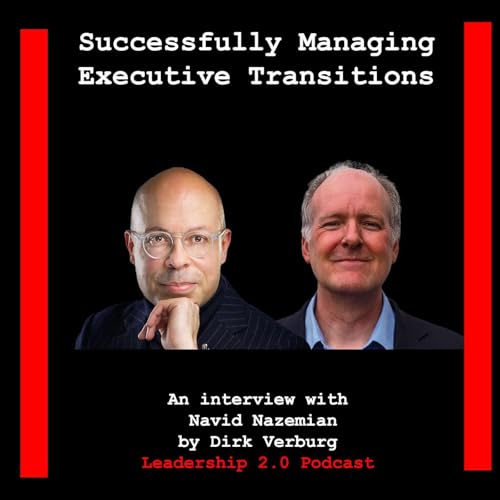
  • 37. 'Ensuring Successful Executive Transitions' - Navid Nazemian
    Feb 21 2026

    In corporate life, we accept that 40% of newly appointed executives fail - we simply accept it as an unavoidable risk.

    The financial and professional implications of failed transitions however, are significant for both the individual and the organization.

    For the individual, it means their livelihood is threatened and their professional reputation is damaged.

    For organizations, failed transitions have financial implications (recruitment costs and performance losses), as well as operational implications (new initiatives), and have a negative impact on for instance, employee engagement and the Employer Value Proposition (EVP).

    🎤 In the 37th episode of the Leadership 2.0 podcast, I talk to Navid Nazemian, my brother in arms in the Executive Transition Coaching space, about how organizations can mitigate the risk associated with executive appointments by engaging an executive coach.

    ► During our conversation, we discussed the following topics:

    • Why executive transitions should be managed
    • The number one reason why executive transitions fail
    • The value of executive coaches in executive transitions
    • Why many organizations do not use executive coaching
    • The timeframe of transition coaching
    • The structure of transition coaching
    • Identifying the right ‘early wins’
    • Balancing ‘learning and delivering’
    • Selecting ‘the team’
    • Developing transition skills
    • Managing executive exits
    • Final thoughts

    ► About Navid Nazemian

    When it comes to executive transitions, Navid Nazemian speaks with an authority that is grounded in research and complemented by authentic, demonstrated experience. His coach education took him on a three-year journey across three continents—Europe, Africa, and America.

    Working with over 250 C-level coaching clients worldwide, he distills key insights, guidance, and coaching to maximize leadership impact. Using strategies designed to avoid and overcome obstacles quickly, he has helped numerous C-suite coaching clients successfully eliminate unproductive actions and solve their toughest, most complex transition challenges.

    Navid has been recognized as HR's Most Influential Practitioner by HR Magazine, received the Outstanding Leadership Award from Education 2.0, and has been ranked as the world’s #1 Executive Coach by CEO Today for three consecutive years.

    He is the author of 'Mastering Executive Transitions: The Definitive Guide'.

    ► Newsletter: http://masteringleadership.kit.com/

    Any questions or comments? Press this link and send me a message!

    Show More Show Less
    53 mins
  • 36. 'The Dark Side of Leadership' - Manfred Kets de Vries
    Jan 12 2026

    Unfortunately, nowadays one look at a television news bulletin or a glance at a newspaper cover is enough to see the dark side of leadership. However, many people do not need to switch on the TV or read the paper to witness this; instead, they experience the dark side of leadership every day within their own organizations. They happen to work for "Psychopath Lights"—or, as Manfred Kets de Vries likes to call them 'Seductive Operational Bullies' (SOBs).

    In the 36th episode of the Leadership 2.0 podcast, I interview Manfred Kets de Vries, who has published extensively on this topic. During our conversation, Manfred and I discussed the following:

    • 00:00 Why do people want to lead others?
    • 02:32 Why do people want to be led?
    • 11:05 The Dark Dyad and Psychopaths Lights (SOBs)
    • 16:51 Why are SOBs attracted to the Financial Sector?
    • 21:30 Can SOBs Be coached?
    • 26:38 The Impact of Life Changing Circumstances On SOBs
    • 35:21 Strategies for SOB victims
    • 40:45 Why Leaders Should Understand Their Shadow Side


    ► About Manfred Kets de Vries

    Manfred F. R. Kets de Vries is the Distinguished Clinical Professor of Leadership Development and Organisational Change and the Raoul de Vitry d'Avaucourt Chaired Professor of Leadership Development, Emeritus, at INSEAD.

    His specific areas of interest are leadership, career dynamics, executive stress, entrepreneurship, family business, succession planning, cross-cultural management, team building, coaching, and the dynamics of corporate transformation and change. Manfred F. R. Kets de Vries directs The Challenge of Leadership Executive Education programme.

    He is the founder of the INSEAD Global Leadership Centre, the programme director of INSEAD's top management seminar The Challenge of Leadership, and the scientific director of the INSEAD Executive Master in Change. He has received the INSEAD Distinguished Teacher Award five times. He has held professorships at McGill University, the Ecole des Hautes Etudes Commerciales, Montreal, and the Harvard Business School, and has lectured at management institutions around the world.

    Financial Times, Le Capital, Wirtschaftswoche, and The Economist rated Manfred Kets de Vries as one of the world's top fifty leading management thinkers, as well as one of the most influential contributors to human resource management.

    In 2008, he received the Lifetime Achievement Award from the International Leadership Association (the Leadership Legacy Project), being viewed as one of the world’s six founding professionals in the development of leadership as a field and discipline.

    He is the author, co-author or editor of forty-nine books and has published over 400 papers as articles or chapters in books. His books and articles were translated into thirty-one languages. He is a member of seventeen editorial boards.

    Kets de Vries is a consultant on organisational design/transformation and strategic human resource management to leading US, Canadian, European, African, and Asian companies. As an educator and consultant, he has worked in more than forty countries.

    ► Kets De Vries Institute (KDVI) https://kdvi.com/

    Any questions or comments? Press this link and send me a message!

    Show More Show Less
    49 mins
  • 35. 'Lost In (Business) Transformation' - Rupert Brown
    Dec 14 2025

    'Lost in Business Transformation'

    Despite the fact that there is a solid body of knowledge about the topic of change management for several decades already, McKinsey's infamous notion that '70% of all change management efforts fail' is still seen as adequately representing the current situation.

    Rupert Brown is an experienced chief people officer and change management specialist with extensive expertise in mergers, acquisitions, digital transformation, joint ventures, and turnarounds. Through his book 'Lost in Transformation', Rupert aims to deliver a candid, emotionally intelligent manifesto for doing transformation differently.

    In the 35th episode of the Leadership 2.0 podcast, I interview Rupert about his book and how organizations can ensure the success of their change management efforts.

    • Why Transformation projects continue to fail
    • The difference between Change and Transformation
    • The Bad Reputation of the word 'Transformation'
    • Why we still struggle with Change Management
    • In-Groups and Out-Groups in Change Management Processes
    • Chief Acceleration Officers
    • Trust is Energy
    • Crises as Catalysts for Change
    • The impact of our Permacrisis on Change Management
    • Behavioral Skills to cope with the BANI world'
    • Change Management and AI


    ► About Rupert Brown

    Rupert Brown is an experienced chief people officer and change management specialist with extensive expertise in mergers, acquisitions, digital transformation, joint ventures, and turnarounds. His insights are captured in this book that emphasizes leading change in various organizations.
    Rupert has worked for and advised global multinationals like Procter & Gamble, Gillette, and A.P. Moller-Maersk, as well as nimble, private equity-backed, and family-owned businesses across diverse sectors such as consumer goods, shipping, software, telecommunications, education, and not-for-profit. His knowledge is particularly valuable for those feeling lost in transformation initiatives.

    ► Book https://www.amazon.co.uk/Lost-Transformation-Discover-Leadership-Derailing/dp/B0FQ1FWCKD

    ► Website https://rupert-brown.com/

    Any questions or comments? Press this link and send me a message!

    Show More Show Less
    56 mins
  • 34. ‘Adult Innovation - Find The Right Problem To Solve' - Thomas Wedell-Wedellsborg
    Nov 22 2025

    'Adult Innovation'

    Many individuals and organizations wrestle with the question of how they can become more innovative, ... and Thomas Wedell-Wedellsborg has the answers!

    Thomas Wedell-Wedellsborg is the author of What’s Your Problem? (Harvard Business Press, 2020), a book on how to solve the right problems. He is also the co-author (with Paddy Miller) of Innovation as Usual, a Harvard Business Review Press book on the art of driving innovation in regular organizations.

    In the 34th episode of the Leadership 2.0 podcast, I interviewed Thomas Wedell-Wedellsborg about innovation, both at an individual, as well as on an organizational level.

    During our conversation, we discussed the following topics:

    1. Reframing Problems
    2. Weaponizing Frames
    3. Never fall in love with your obstacles
    4. The importance of Bright Spots
    5. The Acid Test for Potential Solutions
    6. The Value of Different Perspectives
    7. Most Ideas are Bad Ideas & Do Not Celebrate Failures
    8. "Focus" versus "Throw Against the Wall and See What Sticks"
    9. How to Ensure Adoption in Corporate Environments (‘Stealthstorming’)
    10. The Past as the Best Predictor of the Future


    ► About Thomas Wedell-Wedellsborg

    Thomas has worked with managers in nearly all parts of the globe, including China, India, Russia, Singapore, Britain, France and his native country, Denmark. His research has been featured in Harvard Business Review, The Economist, The Sunday Times, The Telegraph, BBC Radio, Bloomberg Businessweek and the Financial Times. His work on innovation led HR Magazine to recognize him as a “Top 20 International Thinker”.

    As an executive advisor and keynote speaker, Thomas has addressed organizations such as Cisco, Microsoft, Citigroup, Time Warner, AbbVie, Caterpillar, Amgen, Prudential, Union Pacific, Credit Suisse, Deloitte, the Wall Street Journal, and the United Nations.

    Thomas holds an MA in Media Science from the University of Copenhagen and an MBA from IESE Business School. Prior to his business career, Thomas served for four years as an officer with the Danish Royal Guards.

    ► Five nested strategies to reframe your thinking of a problem to make sure you're solving for the right things:

    1. Look outside the frame. What are we missing?
    2. Rethink the goal. Is there a better objective to pursue?
    3. Examine bright spots. Where is the problem not?
    4. Look in the mirror. What is my/our role in creating this problem?
    5. Take their perspective. What is their problem?

    ► Key actions leaders who want others to act as innovation architects should take

    1. Focus: Direct people to look only for ideas that matter to the business. (Focus beats freedom)
    2. Connect: Urge people to connect to new worlds (customers, colleagues, external experts). (Insight comes from the outside)
    3. Tweak: Challenge people to test, challenge, and reframe their initial ideas repeatedly. (First ideas are flawed)
    4. Select: Guide people to filter and select the best ideas and discard the rest. (Most ideas are bad ideas)
    5. Stealthstorm: Help people navigate the internal organizational politics of innovation. (Stealthstorming rules)
    6. Persist: Motivate everyone to continue pursuing the other five keystone behaviors. (Creativity is a choice)

    ► Books

    ► Website

    Any questions or comments? Press this link and send me a message!

    Show More Show Less
    39 mins
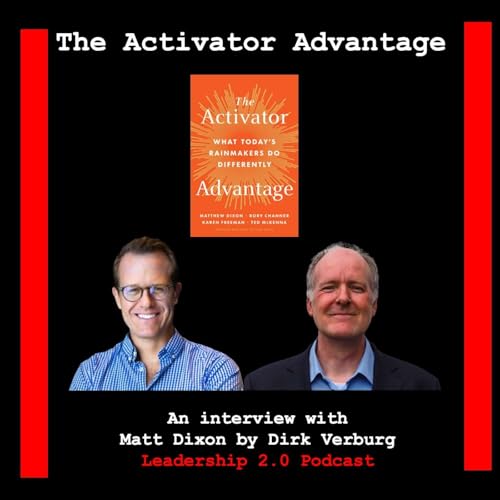
  • 33. How To Successfully Sell Professional Services: 'The Activator Advantage' - Matt Dixon
    Oct 9 2025

    'Eating radishes'

    That is how, according to Matt Dixon, many 'doer-sellers' experience selling their services.

    People do not become management consultants, executive coaches, accountants, lawyers, or engineers to sell. However, for those working in professional service firms or independently, selling is an integral part of their role.

    At the same time, professional sales processes are changing. More and more professional services are sourced through RFPs, and buying committees are replacing traditional client relationships. This means that doer-sellers need to change their approach to sales in order to stay relevant.

    Based on an extensive quantitative study of nearly three thousand partners across industries such as law, accounting, consulting, investment banking, executive search, and public relations, five distinct seller types within professional service industries were identified; however only one of them, the Activator, consistently drives growth.

    In the 33rd episode of the Leadership 2.0 podcast, I interviewed Matt Dixon about 'The Activator Advantage - What Today's Rainmakers Do Differently.

    During our conversation, we discussed the following topics:

    00:00 Sales, Acquisition or Business Development
    01:43 Why Doer-Sellers Do Not like Selling
    04:28 What Inspired Matt To Write 'The Activator Advantage?'
    07:24 The Five Types Of Professional 'Doer- Sellers'
    20:19 The Three C’s of the Activator
    28:22 Why The Purchasing Behavior Of Clients Is Changing
    32:18 The Three Categories Of Stakeholders In The Buying Process
    36:00 The Three Elements Of The Activator Mindset
    39:24 Business Development Habits
    44:19 Instilling An Activator Mindset In The Organization
    50:15 Can I Learn To Like Eating Radishes?
    52:38 Final Thoughts

    ► About Matt Dixon

    Matt Dixon is one of the world’s leading experts on sales, customer service and customer experience. He is a Founding Partner of DCM Insights, The Customer Understanding Lab.

    Prior to co-founding DCMi, he served as the Chief Product & Research Officer of Tethr, an AI venture in Austin, TX, that helps companies mine customer voice data for insights. And before that, he spent time as a Senior Partner and the Global Head of Sales Force Effectiveness Solutions at Korn Ferry Hay Group and as Group Leader of the sales, service and customer experience practices of CEB, now Gartner.

    Matt is a sought-after speaker and advisor to corporate leadership teams around the world on topics ranging from sales effectiveness to customer service and customer experience. He also (co)authored a number of books:

    • The Challenger Sale: Taking Control of the Customer Conversation
    • The Effortless Experience: Conquering the New Battleground for Customer Loyalty
    • The Challenger Customer: Selling to the Hidden Influence
    • The JOLT Effect: How High Performers Overcome Customer Indecision

    Matt is also a frequent contributor to Harvard Business Review with more than 20 print and online articles.

    Matt holds a Ph.D. from the Graduate School of Public and International Affairs at the University of Pittsburgh as well as a B.A. in International Studies from Mount Saint Mary’s University in Emmitsburg, Maryland. He lives in Silver Spring Maryland with his wife and four children.

    Visit DCM Insights at https://www.dcminsights.com/ and visit Matt on LinkedIn at http://www.linkedin.com/profile/edit?trk=hb_tab_pro_top or follow him on Twitter at @matthewxdixon

    ► Book 'The Activator Advantage'

    ► Website DCM Insights

    Any questions or comments? Press this link and send me a message!

    Show More Show Less
    57 mins