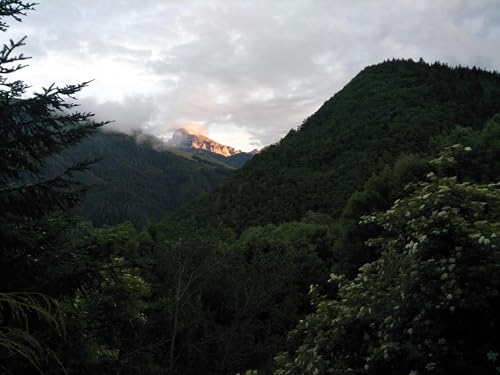
Isère, France. July, 2021. cover art

Isère, France. July, 2021.

Isère, France. July, 2021.

Listen for free

View show details
(After you have read these introductory paragraphs once, you can skip to the new/old content below. If you are listening, then the time stamp is around the two minute 45 second mark.)IntroductionThe word settled, to me, carries connotations I am keen to avoid. I have never felt settled or, perhaps, I cannot recall a time I felt settled. I do not feel settled now, writing this, and I’ve lived in the same house for three and a half years. Without even discussing the obvious issues of colonisation, I just don’t feel like I could, or should, settle; better to keep my constituent parts shook up, agitated perhaps, rather than separating and stagnant.Instead, I feel as though I have been travelling for years, maybe because I have not lived in my ‘home’ nation of Scotland for eight and a half years, perhaps because I know I won’t stay here forever, or maybe because I carry that concept of home in a way which differs from many?More precisely, I still think of myself as a slow traveller, globally feral. Recently, I have been revisiting places through the photographs and words I recorded when my feet crossed their soil. This is a way of reminding myself of where I have been, not just in space and time, but in mind, too. It is a wonderful thing, to come out of a low and rediscover myself through words I crafted, through the lens of a camera, when memory has wandered in the fog for too long. Thank you, past me.When I first started sharing letters with the world in this fashion, six or more years ago, I usually began them with a vignette of where I was, a sort-of travel diary, mixed with nature observation, locking in the setting for the reader, before I spoke of other things—and, by so doing, ensuring that place fed into the whole. It was a useful device, for reader and myself both but, as these letters were sent to so few readers, and now languish archived behind a paywall, I thought it a shame not to share these snippets again.As such, I am going to share a short series of these sketches, accompanied by a photograph from that time, sent to you in date order.I shall include the above paragraphs in each of the letters in this series, but I shall also include a link at the very start, so you can skip ahead once you are familiar with the above words. If you are listening and similarly want to skip, then the timestamp you want to navigate to will be in the same place.Taken without these paragraphs, each is a short read, and I hope you enjoy them.Isère, France. July, 2021.Moving through a natural woodland is different from passing through any other environment. You cannot rush, you cannot allow yourself to miss the little details. The more time you spend amongst the trees, the more you realise this and the quicker your pace alters: slow, slower, pause, repeat. Essentially, you return to a more natural state, a rhythm as old as our species itself.You listen, you look, these senses you already know well pulling in huge amounts of data. For most people, the vast majority of their information comes from sight and sound, but spend time in the woods and you learn to touch things—that tree bark, that rock or leaf, for example, you learn to inhale in a different way, deliberately sampling the air and all the varied perfumes it brings. You can even learn to taste that same air, or pick a leaf or fruit and chew.Then there are the senses we don’t always realise exist, let alone consciously utilise. Some of these can be a little unnerving when you first start to actively use and acknowledge them—some people call them a sixth sense which, quite frankly, is silly. We have far more than five senses, after all. Learning to listen to that little voice in your head, the one which tells you something is watching you, or that there’s something ahead on the trail, these things take time, but it is time which is well spent indeed.Of course, this isn’t supernatural at all, but simply your brain processing different information and picking up on tiny details you have consciously missed. Perhaps a change in the air brought a tendril of scent? We often fail to use our noses as we can—try it, now, sitting reading this, open your nostrils wide and inhale slowly and deliberately, you may be surprised what you can sample. Similarly, learning to snuffle like a dog at a scent trail is possible too, involving faster inhalation and sampling, your sense of smell actually being worked properly. Both these things can seem like strange magic, but also seek to remind us how civilisation can dull our own bodily functions.The woodland is a complex machine of many parts. It exists on different scales and even across time. I have walked across Scottish hillsides, devoid of any tree cover, but have known from the wide flourishes of native bluebells and anemones that I was walking through the ghost of a wood. If you look closely at the ground around you, you can often see small depressions, pockmarks from where trees were once blown over,...
adbl_web_anon_alc_button_suppression_c
No reviews yet