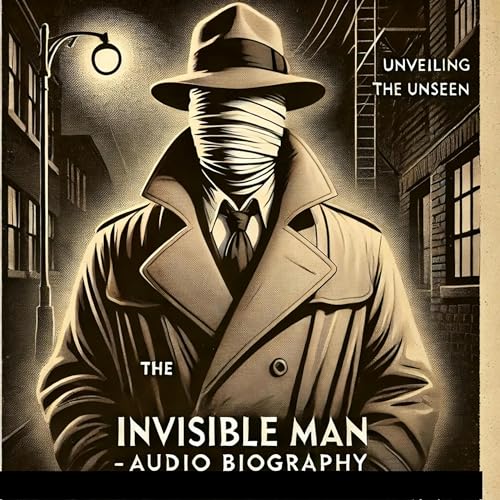
Invisible Man - Audio Biography cover art

Invisible Man - Audio Biography

Invisible Man - Audio Biography

By: Inception Point AI
Listen for free

Summary

Now You See Him, Now You Don't: An Unauthorized Biography of The Invisible Man In the distinguished pantheon of classic movie monsters, The Invisible Man holds a unique position - he's the only one you technically never see. While other monsters struggled with their visibility in society, Dr. Jack Griffin took a more direct approach to the problem by disappearing altogether. He's the ultimate proof that sometimes the best career move is to simply vanish from sight. First appearing (or rather, disappearing) in H.G. Wells' 1897 novel, and later making his invisible debut in Universal's 1933 film "The Invisible Man," this transparent terror has left an impression on popular culture that, ironically, remains highly visible to this day. In a genre filled with creatures sporting distinctive looks, he made his mark by having no look at all – a bold fashion choice that has influenced designers to this day (though mostly in the field of active camouflage research). Physical specifications for The Invisible Man are, understandably, a bit difficult to pin down. Height: present but unverifiable. Weight: depends on how many bandages he's wearing. Eye color: presumably still there somewhere. His most distinctive feature is, of course, his complete lack of distinctive features, though he did popularize the stylish ensemble of bandages, dark glasses, and smoking jacket that would become the unofficial uniform of invisible persons everywhere. The cause of his transparency – a chemical formula called "monocane" – stands as one of cinema's most effective weight loss solutions, though the side effects (complete invisibility, possible megalomania, and a tendency to maniacally laugh while disrobing) have prevented FDA approval. The formula itself combines albino blood with some other mysterious ingredients, proving that sometimes the best scientific breakthroughs happen when you're not entirely sure what you're doing. His signature look, when he bothers to maintain one, consists of medical bandages wrapped head-to-toe, dark sunglasses, and a series of increasingly dramatic overcoats. This ensemble inspired what fashion critics would later call the "mysterious stranger" look, though few could pull it off with quite the same panache as someone who literally wasn't there. The outfit says both "I'm hiding a scientific breakthrough" and "I've had a terrible accident at the pharmacy." Unlike other movie monsters who had to rely on makeup effects or practical costumes, The Invisible Man pioneered the art of not being there at all. His special effects were groundbreaking for the 1930s, featuring innovative techniques that made objects appear to move on their own and clothing walk without a visible wearer. This led to some interesting behind-the-scenes innovations, including what might be cinema's first use of black velvet body suits and wire work for scenes where invisible things needed to be visibly invisible. The Invisible Man's career trajectory is particularly noteworthyCopyright 2026 Inception Point AI Art Politics & Government
Episodes
  • Invisible Man - Audio Biography
    12 mins
adbl_web_anon_alc_button_suppression_c
No reviews yet