Watch on YouTube
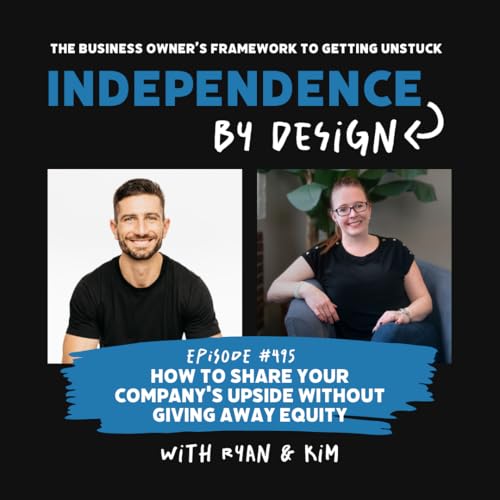
You've got one person you can't afford to lose, running an outcome you know you can't hit alone. They've started asking about the upside, and your gut says give them a piece of the company. Then you remember what real equity costs. A K-1 every April. A cap table. Permission required to sell your own business.
Kim and I get into phantom stock: real money tied to real valuation growth, without putting anyone on your cap table. It's a contract and a balance sheet liability, pegged to the same four numbers every valuation already runs on. The catch is, there's no shortcut here, unlike on the annual plan. Build the owner's goals, the valuation, and the five-year model first, or you've got it backwards.
We get into the one honest test for whether someone earned it at all (can you hit the five-year number without them?), Why you never tie the payout to a sale, and the worked example where sharing 5% of a $21.01M outcome costs you nothing, because it never existed without the person who earned it.
Top 10 Takeaways
- A salary rents someone's effort. Long-term comp ties them to the value you build together.
- The one honest test: if you can hit your five-year number without this person, don't grant phantom stock. Go hire someone who wants a salary.
- There's no shortcut on a long-term plan. Build the model, the valuation, and the five-year forecast first, or you have it backwards.
- Phantom stock is a contract and a balance sheet liability. No cap table, no K-1, no operating agreement.
- Real equity ropes you together on taxes, distributions, and the decision to sell. Phantom stock doesn't.
- Never tie the payout to a sale. Do that and your executives start needing you to sell.
- Peg it to a cash flow valuation, not the private equity premium someone might pay someday.
- Have a neutral third party value the company every year. Ten to fifteen grand ends the argument before it starts.
- Size it like a budget. Percentages first, then meaningful dollars, then what the company can actually afford.
- The math is the hard part. Once it's clear, the attorney's contract is about three grand.
Chapters:
(00:00) Introduction: Ryan and Kim on sharing company upside without equity
(02:20) A salary rents someone's effort; long-term comp ties them to value
(04:05) What usually goes wrong without a long-term strategy in place
(06:11) No shortcut: build the model, valuation, and five-year forecast first
(13:15) Phantom stock: a balance sheet liability, no cap table, no K-1
(19:40) The one honest test: can you hit the five-year number without them?
(41:00) Never tie the payout to a sale; executives will need you to sell
(47:29) Peg it to a cash flow valuation, not the private equity premium
(56:24) Have a neutral third party value the company; ten to fifteen grand ends the argument
(1:02:09) ESOPs, SARs, and creative layered approaches to ownership transitions
This episode was produced by Castos Productions.
Resources:
Executive Comp Workshop June 25 – 9 AM - 11am CST – Virtual, Live, Interactive: https://ryantansom.com/the-compensation-blueprint-workshop
90-Day Boardroom Blueprint Ryan's onboarding program that walks owners through the IBD Ownership OS, three-statement financial model, budget, and forecast — the foundation required before designing any executive comp plan.


 1 hr and 33 mins
 1 hr and 9 mins
 1 hr and 6 mins
 46 mins
 54 mins
 48 mins
 1 hr and 15 mins
 1 hr and 9 mins