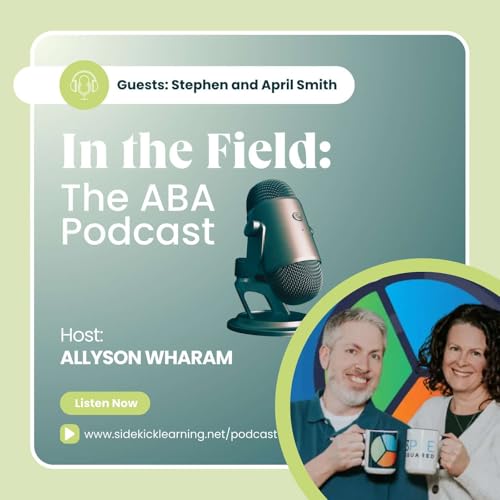
In the Field: The ABA Podcast cover art

In the Field: The ABA Podcast

In the Field: The ABA Podcast

By: Allyson Wharam
Listen for free

Welcome to In the Field- The ABA Podcast, hosted by Allyson Wharam. This podcast is a resource hub for Board Certified Behavior Analysts (BCBAs), business owners, training coordinators, individual supervisors, and graduate students accruing fieldwork in ABA.

Allyson, the creator of Sidekick, an innovative online curriculum and learning portal for behavior analysts, dives into the nuances of ABA with a focus on quality supervision, which she believes is the cornerstone of the field. Each episode offers information on topics relevant to ABA professionals, ranging from effective strategies for supervision, innovations in the field, to practical advice for improving service quality and outcomes for clients.

In the Field- The ABA Podcast is not just a show; it's a community for those who are passionate about enhancing their knowledge, skills, and practices in ABA. The podcast features interviews with experts, discussions on emerging trends, and shares actionable tips to help listeners invest in their professional growth and the advancement of the field.

Whether you are driving to an in-home session, taking a break in your busy day, or seeking inspiration and guidance, this podcast is your companion in fostering excellence in ABA. Join us as we explore, learn, and grow together in the field of Applied Behavior Analysis.

For more resources and information, visit our website at www.sidekicklearning.net.

© 2026 In the Field: The ABA Podcast
Career Success Economics Education
Episodes
  • ADHD and ABA with Nicole Stewart, BCBA
    Jun 24 2026

    In this episode of In the Field: The ABA Podcast, I sit down with Nicole Stewart, BCBA, to talk about what ADHD really looks like in kids and adults, and why it's so often overlooked in clinical work. Nicole brings over 15 years of experience in the field. She now runs a private practice offering therapy, parent coaching, and ADHD-focused training for organizations, after years of clinical work that included time at the New England Center for Children and as a clinical director.

    We get into Nicole's perspectives on what ADHD actually is on a neurobiological level, why it's so often masked or misdiagnosed (especially in girls), and why pairing and rapport, not bigger reinforcers, are usually the real lever for behavior change. We also talk about how organizations can build ADHD aware training and supervision systems for staff, not just clients.

    Key Topics:

    ADHD as a Neurobiological Difference, Not Just a Behavior Pattern: Why ADHD comes down to how the brain regulates dopamine, how that shapes prefrontal cortex and basal ganglia development, and why understanding the neurology changes how we individualize treatment.

    Masking and Missed Diagnoses: Why girls with inattentive ADHD are so often overlooked when "behavioral contrast" between home and school leads to under-diagnosis, and what that masking actually costs kids emotionally.

    Executive Functioning, Defined: Nicole breaks down executive functioning as "the CEO of the brain" and explains why a child's executive functioning age can lag years behind their chronological age, creating mismatched expectations.

    Emotional Regulation and the Fight or Flight Connection: How a highly sensitive nervous system response can turn something small (a bump in the hallway) into a major escalation, and why teaching emotional recognition has to come before teaching coping skills.

    Skill Deficit vs Performance Deficit: Why ADHD related "noncompliance" is so often misread as a skill issue or simple defiance when it's actually a performance deficit driven by interest, novelty, or response effort.

    Pairing Over Bigger Reinforcers: Why a strong, conditioned relationship with the learner is the single most effective ADHD strategy Nicole has found, more impactful than denser reinforcement schedules or larger rewards.

    Supporting Staff with ADHD, Not Just Clients: How clinical supervisors can apply universal design for learning to staff trainings, and why clear contingencies, written follow-ups, and flexible scheduling support BCBAs® and RBTs® who are themselves neurodivergent.

    Key Takeaways:

    • ADHD is a medical and neurobiological condition, not just a set of behaviors to extinguish.
    • Masking can delay diagnosis, especially in girl, leaving real struggles invisible.
    • Corrective feedback disproportionately affects kids with ADHD, often four to five times more than their peers, fueling shame and avoidance over time.
    • Pairing and rapport outperform bigger reinforcers or denser schedules when working with ADHD learners.
    • Universal design for learning benefits every learner and every staff member, not only those with ADHD.
    • Skill deficits and performance deficits require different solutions, and ADHD often hides as the latter.
    • Organizational training on ADHD, alongside autism and other comorbid diagnoses, improves individualization across the board.

    Keywords:

    ADHD, ABA and ADHD, Executive Functioning, Emotional Regulation, Skill Deficit vs Performance Deficit, Pairing, Universal Design for Learning, Masking in Girls, Neurodivergent Staff, BCBA® Supervision, RBT® Training, Nicole Stewart, Mom The Behaviorist, ADHD Coaching, Comorbid Diagnoses, ADHD in the Workplace

    Connect with Nicole Stewart:

    Website: nicolestewartbcba.com
    Instagram: @mom_the_behaviorist
    Podcast: Reinforcing Conversations
    CEUs on ADHD: Search "Nicole Stewart" on BehaviorLive

    Disclaimer:

    BCBA®, BACB® [or any other BACB® trademark used] is/are registered to the Behavior Analytic Certification Board® BACB®. This website and products are not in any way sponsored by the BACB®.

    All information and products are for educational purposes only.

    Show More Show Less
    48 mins
  • Vision, Systems, and Sustainability: Inside the ABA Business Journey of April and Stephen Smith
    Jun 10 2026
    In this episode of In the Field: The ABA Podcast, I sit down with April and Stephen Smith of 3PieSquared and the ABA Business Leaders Podcast. April is a BCaBA with nearly three decades of experience in the field, and Stephen brings a background in quality management and engineering that shaped the operational backbone of everything they built together. They ran their own ABA practice for 12 years before closing it and transitioning into full-time consulting, where they now support more than 1,600 ABA organizations across the country.This conversation covers a lot of ground: the origin story of their practice, the lessons they learned the hard way, what they wish they had when they were starting out, and why they named their new book "The ABA Business Leader's Guide: How to Start, Grow, and Sustain an Ethical ABA Practice Without Losing Your Soul." If you are a BCBA® thinking about starting a practice, already in the thick of running one, or trying to figure out how to scale without burning yourself and your team to the ground, this episode is for you.Key Topics:The Origin Story and Early Chaos: April and Stephen started with a frustration, a neighborhood walk, and a decision to figure it out as they went, including learning insurance billing the hard way while navigating a newborn and a dwindling savings account.Vision: The Thing Most Founders Skip: April and Stephen did not have a shared vision when they started and it was not until year four that they actually sat down and asked what they were building and how they wanted it to feel.Hiring BCBAs®: The Skills and Gaps You Need to Plan For: Hiring BCBAs® surfaced unexpected gaps in assessment repertoires, parent training, and soft skills, reflecting a field-wide assumption that certification equals readiness to lead and manage.Building Systems That Let You Step Back: April encourages owners to apply the same behavioral thinking they use clinically to their operations: write task analyses, define expectations in observable terms, and give consistent feedback.Delegating, Outsourcing, and Prioritizing Hires: Stephen's practical framework starts with an accountant and an attorney, then works backward from your dream job to identify what is standing between you and it.The Ethics of Profitability: The incentives in this field currently reward lower-trained staff and higher turnover. April and Stephen have built their consulting work around helping owners resist that trap.Closing a Business and the Identity Shift That Follows: April speaks openly about the identity crisis that came with closing their practice and how intertwined her sense of self had become with what they built.Boundaries, Parenthood, and the Myth of Work-Life Balance: April shares how she learned to set and model firm boundaries with staff and restructure her own workday to protect her effectiveness at work and her presence at home.Key Takeaways:Vision is not optional. Know what you are building, how big you want it to be, and what it needs to look like when you are done, before you are two years in and wondering why you feel stuck.Profitability is an ethical issue. You cannot pour back into your team, your training systems, or your clients if your margins do not support it. Financial sustainability is part of ethical practice.Systems make delegation possible. You do not need a formal business background to build them. Use what you already know: task analysis, behavioral specificity, clear expectations, and consistent feedback.BCBAs® are not automatically ready to lead or manage. Build mentorship and soft skills development into your supervision model from the beginning.Closing or exiting a business is a real transition that deserves preparation, both operationally and personally.Self-awareness is not a soft skill. Knowing when you are micromanaging, when you need support, and when your identity has become too entangled with your business is essential to sustainability.Keywords: Efficiency, Assent, Foundational Skills, Effective Treatment, Matching Law, Instructional Design, Ethics Code 2.0, Dimensions Grid, DRA, Blunt Extinction, Behavior Efficiency, Steve Ward, Whole Child Consulting, Inventory of Good Learner Repertoires, ABA Ethics, BCBA® Supervision Resources:Connect with April and Stephen Smith - Free Consultation Booking LinkBook: "The ABA Business Leader's Guide: How to Start, Grow, and Sustain an Ethical ABA Practice Without Losing Your Soul" by April and Stephen SmithWebsite: 3PieSquaredPodcast: ABA Business Leaders PodcastDisclaimer:BCBA®, BACB® [or any other BACB® trademark used] is/are registered to the Behavior Analytic Certification Board® BACB®. This website and products are not in any way sponsored by the BACB®.All information and products are for educational purposes only.
    Show More Show Less
    52 mins
  • More Than a Supervisor: How Mentorship Shapes Clinical Decision Making and Career Growth in ABA with Dr. Becky Eldridge
    May 20 2026

    In this episode of In the Field: The ABA Podcast, I sit down with Dr. Becky Eldridge, Ph.D. BCBA-D, researcher, and mentor with 17 years of experience in behavior analysis. Becky brings both personal passion and scholarly depth to the topic of mentorship, having completed her dissertation on clinical decision making for BCBAs and having witnessed firsthand what happens when new behavior analysts enter the field without adequate support. We dig into what mentorship actually is, how it differs from supervision, and why that distinction matters so much for new BCBAs who are trying to find their footing.

    Key Topics:

    Supervision vs. Mentorship: Not all support looks the same. Supervision is often tied to performance outcomes that may serve an organization. Mentorship centers on you. Your goals, your values, and what is meaningful to you. Knowing the difference can change who you turn to and when.

    Finding the Right Fit in a Mentor: Trust matters, but so does experience. Becky recommends Brené Brown's BRAVING Inventory as a starting point for evaluating fit, and emphasizes finding someone who has actually navigated the situations you are facing.

    Internal vs. External Mentorship: Becky makes a strong case for seeking mentorship outside your organization, especially early in your career. When competing contingencies exist between what is good for you and what is good for the organization, true objectivity is hard to find internally.

    What Mentorship Actually Looks Like: At its core, mentorship is about building self-management.

    Formal vs. Informal Mentorship: Formal mentorship means dedicated time and a mutual commitment to showing up consistently. Informal mentorship happens more organically, through relationships that develop over time without a structured agreement.

    Mentorship and the Evolution of the Field: The field has grown fast, and mentorship has not always kept up. Becky's advice is simple: stop waiting for it to find you. Get involved in your state chapter, go to your state conference, and meet people.

    Key Takeaways:

    • Supervision is about specific performance outcomes. Mentorship is about supporting your goals and your growth.
    • A sponsor is someone who creates or advocates for opportunities you would not have had otherwise, and that role can be distinct from both supervisor and mentor.
    • Trust is essential in a mentoring relationship, but experience matters just as much. Find someone who has done what you are trying to do.
    • Seek external mentorship, especially early in your career, when you need perspective.
    • Mentorship can be formal (dedicated time, clear expectations) or informal (opportunistic, reciprocal, peer-based). Both are valuable.
    • If you are waiting for the perfect moment or the perfect person, stop waiting. People are people. Ask.

    Resources Mentioned:

    • Building and Sustaining Meaningful and Effective Relationships as a Supervisor and Mentor, by Dr. Linda LeBlanc, Dr. Tyra Sellers, and Dr. Shahla Ala'i-Rosales
    • Dare to Lead by Brené Brown, including the BRAVING Inventory (available free on her website)

    Connect with Dr. Becky Eldridge:

    • LinkedIn: Becky Eldridge
    • Website: https://beckyeldridge.com/


    Keywords:

    BCBA mentorship, ABA mentorship, supervision vs mentorship, clinical decision making ABA, new BCBA support, BCBA career growth, self-management behavior analysis, ABA leadership, fieldwork supervision, behavior analyst professional development, Becky Eldridge, In the Field ABA Podcast, Sidekick Learning

    Disclaimer:

    BCBA®, BACB® [or any other BACB® trademark used] is/are registered to the Behavior Analytic Certification Board® BACB®. This website and products are not in any way sponsored by the BACB®.

    All information and products are for educational purposes only.

    Show More Show Less
    56 mins
adbl_web_anon_alc_button_suppression_t1
No reviews yet