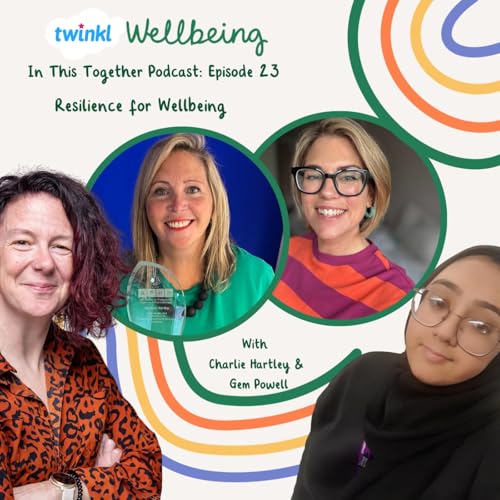
In This Together cover art

In This Together

In This Together

By: Becky Dawson
Listen for free

About this listen

In This Together, the place where we explore all things wellbeing in education. Join us as we dive into honest conversations, share practical strategies, and uncover the insights you need to foster a thriving environment for both staff , students and everyone in their lives. Get ready to feel inspired, supported, and ready to make a real difference in your community!


All rights reserved.
Hygiene & Healthy Living Psychology Psychology & Mental Health
Episodes
  • The Neuroscience of Wellbeing With Evelina Dzimanaviciute | In This Together
    Apr 10 2026

    Evelina Dzimanaviciute, an organizational development consultant and founder of Elite Mind, joins host Becky Dawson to bridge the gap between latest academic research and practical applications in schools. This episode explores how neuroscience and behavioral science can transform staff performance, self-regulation, and mental health. The discussion dives deep into managing stress through ancient wisdom and modern data, reimagining the school environment to boost resilience, and the critical importance of aligning individual values with organizational purpose.

    Translating complex science into tangible school improvements, Evelina explains the "Wellbeing Compass" and why educators often hit burnout by failing to listen to their bodies. The conversation challenges traditional views on therapy and coaching, offering a proactive toolkit for building internal resourcefulness. Whether you are a headteacher looking to improve staff retention or a teacher seeking immediate stress-relief tools, this episode provides a roadmap for a healthier, purpose-driven career in education.


    Takeaways
    • Box Breathing as a Diagnostic Tool: Beyond simple relaxation, use the "box" method to identify which "energy" (Water, Air, Fire, Earth) you lack based on which part of the breath is hardest to hold.
    • Environmental Boundaries and Neuro-Anchoring: Avoid "contaminating" spaces; eating lunch in a classroom keeps the nervous system in a high-performance state rather than allowing it to enter "rest and digest" mode.
    • The Resilience of Purpose: True purpose isn't just about feeling good; it serves as a "North Star" that provides the resilience needed to sacrifice and keep going during difficult times without burning out.
    • Biophilic Design in Schools: Recreating natural environments by bringing in plants, natural light, and fresh air is essential for aligning our biological rhythms with our work life.
    • Building Internal Resourcefulness: Shift away from "passive" labels like "anxious" or "depressed" toward skill-based wellbeing that focuses on habits, financial management, and physical strength.


    Follow & Review: If you found these insights helpful, please subscribe and leave a review on your favorite platform to help other educators find us!

    Get in Touch: Share your wellbeing stories or questions with us at teamwellbeing@twinkl.co.uk.


    Chapters

    00:00 - Introduction - Becky introduces Evelina and the intersection of science and performance.

    01:26 - The Science-Education Gap - Why it takes decades for research to reach schools and the mission of Elite Mind.

    03:49 - Understanding the Stress Mechanism - How our "zebra" brains react to modern stressors and imagined scenarios.

    06:33 - Box Breathing & Ancient Wisdom - A deep dive into the 4-count breathing technique and its neurochemical effects.

    11:12 - Reimagining School Environments - The impact of physical space on teacher resilience and the danger of "blurred boundaries".

    14:45 - Bringing the Outdoors In - Using natural light, plants, and grounding to improve neurobiology.

    17:03 - The Wellbeing Compass - Measuring the "unmeasurable" through data and behavioral habits.

    23:21 - Coaching vs. Therapy - Why combining future-oriented coaching with therapeutic self-awareness is the key to growth.

    27:48 - Living and Working on Purpose - Aligning individual values with organizational strategy to prevent turnover.

    32:42 - Environmental Influence & Final Thoughts - Knowing when to change a system and when to move to a new environment

    Show More Show Less
    35 mins
  • Executive Function & Wellbeing With Victoria Bagnall | In This Together
    Apr 3 2026
    In this episode of In This Together, host Becky Dawson sits down with Victoria Bagnall, an acclaimed educator, executive function coach, and author of The Neuro-Inclusive Educator. Victoria shares her journey as a neurodivergent teacher and specialist tutor, explaining how understanding the brain’s "management system" can transform classroom outcomes. The conversation delves into the critical link between executive function and wellbeing, offering a roadmap for shifting from compliance-based discipline to a neuro-inclusive pedagogy that fosters student autonomy.Victoria explains that executive functions—skills like organization, task initiation, and emotional regulation—are often inhibited when a child is in a "protective state" due to stress or trauma. By prioritizing wellbeing and psychological safety, educators can help students access their prefrontal cortex for higher-order learning. This episode explores how co-regulation, interoception, and explicit strategy modeling can empower all learners, regardless of diagnosis, to become self-aware and independent "self-starters".TakeawaysExecutive function as the foundation for learning: These skills encompass organization, time management, and emotional regulation, which are essential for academic success and life beyond the classroom.The link between wellbeing and brain function: When a child feels unsafe or stressed, the brain diverts energy away from executive functions toward survival instincts, often mislabeled as "defiance" or "laziness".Shifting from compliance to autonomy: Rather than using shame to control behavior, educators should foster student autonomy and self-awareness, allowing young people to take responsibility for their own learning journeys.The power of co-regulation: Teachers act as caregivers whose own nervous systems impact the classroom; by practicing self-regulation, educators can naturally help settle the energy of their students.Explicit modeling of strategies: High-impact teachers share their own struggles and humanize the learning process by explicitly modeling how they start difficult tasks or manage their time.Developing interoception: Helping students become aware of their internal body signals is a prerequisite for self-regulation and accessing learning states.Sharing is CaringVictoria recommends the Smart but Scattered book series by Peg Dawson and Richard Guare, which provides tailored strategies for children, teens, and adults. Additionally, she highlights the Self-Determination Cups activity. In this exercise, students color in "coffee cups" to represent their current levels of belonging, competence, and autonomy. This tool helps educators identify hidden barriers to engagement and design interventions that build students up rather than undermining their sense of belonging through traditional punishments.Connect with us:Follow the podcast on your favorite platform and leave a rating or review to help other educators find these vital conversations.Have thoughts or questions? Email the team at teamwellbeing@twinkl.co.uk.Chapters00:00 - Introduction - Becky Dawson introduces executive function coach Victoria Bagnall.01:55 - Defining Executive Function - Victoria explains how her own neurodivergence led her to study the brain's "management system".04:54 - Neuro-Inclusive Classrooms - Why what is good for neurodivergent students is brilliant for everyone.06:26 - The Wellbeing Connection - Understanding how "threat" states in the brain take executive functions offline.08:36 - Co-regulation in the Classroom - How a teacher’s own regulation sets the tone for 30+ students.12:18 - High-Impact Strategies - Modeling the "humanity" of struggle and using body scans to settle a class.14:52 - Interoception and Trauma - Learning to read body signals as a prerequisite for self-regulation.17:20 - Language Matters - Shifting the conversation from "misbehaviour" to "unfilled skills".18:32 - Autonomy and Metacognition - Developing "self-starters" through an autonomy-based pedagogy.21:15 - A Social Experiment with Time - How Victoria taught her six-year-old the foundational sense of time.25:28 - Moving Beyond Curriculum - Why an executive function "curriculum" isn't enough without psychological safety.28:54 - The Dream School Model - Shifting school culture over 10 years to treasure wellbeing and autonomy.32:44 - Sharing is Caring - Recommended resources, including the Smart but Scattered series and Self-Determination Cups
    Show More Show Less
    35 mins
  • Resilience for Wellbeing With Charlie Hartley and Gem Powell of BRIYM | In This Together
    Mar 27 2026
    Description


    Founder and CEO of BRIYM (Building Resilience in Young Minds), Charlie Hartley, and therapist Gem Powell join Becky Dawson and Laiba Sheikh to explore the true meaning of resilience within the education system. This episode delves into how schools can move from a reactive to a proactive stance by implementing a whole-school approach that supports the mental health and wellbeing of students, staff, and parents alike. The conversation challenges common misconceptions about "toughing it out," reframing resilience as a toolkit of techniques rooted in brain development and community support.

    Listeners will gain insights into the vital role of professional supervision for educators, ensuring that those on the frontline of pastoral care are regulated and supported to prevent burnout. From managing anxiety through scientific understanding to the "small wins" of supporting students with emotionally based school non-attendance (EBSNA), this episode explores to steps to fostering a safe, inclusive school culture. It emphasizes that wellbeing is not an "add-on" but a necessary foundation for both living and learning.


    Takeaways


    • Resilience as a Skillset: Moving away from resilience as a "survival instinct," educators can empower students by teaching a toolbox of techniques to manage emotions and recover from adversity.
    • The Power of the Proactive: Early intervention and teaching brain development (from primary through secondary) helps young people normalize their emotional experiences and anticipate changes.
    • Triangulation of Support: Effective wellbeing strategies require shared understanding between students, school staff, and parents/carers to create a consistent support network.
    • Essential Staff Supervision: Providing teachers and Designated Safeguarding Leads (DSLs) with professional supervision is crucial for maintaining a regulated, healthy workforce.
    • Reframing "Non-Resilience": Recognizing that rest, reflection, and even "non-resilient days" are vital components of long-term mental health and growth.


    Don't forget to follow us on your podcast platform and give us a rating and review to help more educators find these crucial conversations. Share your thoughts, comments, questions, or brilliant work by emailing the team at teamwellbeing@twinkl.co.uk.


    Chapters


    • 00:00 - Introduction - Meeting the BRIM team: Charlie Hartley and Gem Powell.
    • 01:31 - Defining Resilience - Moving beyond "bad press" to a toolkit-based approach.
    • 05:26 - Survival vs. Resilience - Laiba shares personal experience on the cost of "forced" resilience.
    • 07:00 - Community Connection - Why resilience isn't an island but a community-based effort.
    • 12:12 - Misconceptions in Schools - Is resilience just being "convenient" for the system?.
    • 16:39 - The Learning Pathway - Treating emotional skills with the same patience as the science curriculum.
    • 18:54 - Proactive Brain Education - Teaching students about the "supercomputer" in their heads.
    • 23:02 - Staff Supervision - Why educators need a safe space to offload and regulate.
    • 28:40 - Impact Stories - Finding motivation through student breakthroughs and parental feedback.
    • 35:48 - Supporting EBSNA - The "massive" achievement of a student returning to school.
    • 41:58 - The Magic Wand - What one change would the guests make to the education system?.
    • 45:07 - Sharing is Caring - Book recommendations for further exploration
    Show More Show Less
    48 mins
No reviews yet