Episodes

  • From Car Batteries to Commercial Solar: Building Off-Grid Power Knowledge Before It Was Popular
    Feb 17 2026

    Before solar became an industry, before grid-tied systems, incentives, or sleek lithium batteries, power resilience meant figuring things out yourself.

    This episode traces the real origins of Alexis Lewis’s solar and electrical expertise, starting not in New York City, but in Antigua, where frequent power outages made energy independence a necessity not a trend.

    In the early 1970s, when Alexis’s father built their family home, it was designed with two electrical systems:

    A standard AC utility-fed network

    A separate DC backup network, powered initially by car batteries

    This was long before residential solar was accessible. That early DC system laid the foundation for understanding load separation, redundancy, storage limitations, and power discipline lessons that still apply to modern solar and battery systems today.

    As photovoltaic technology became available locally, those backup systems evolved into true off-grid solar installations, using:

    Early low-wattage PV panels (20–50W modules)

    Heavy, transformer-based inverters

    Lead-acid battery banks, including Trojan T-105 deep-cycle batteries

    Manual electrolyte maintenance, balancing, and strict load management

    Every system was custom. Nothing was plug-and-play. Components were mixed across manufacturers, charge controllers were tuned by hand, and mistakes were expensive. This wasn’t theoretical learning it was practical, consequence-driven experience.

    That early off-grid exposure shaped how Alexis approaches solar today. Whether evaluating a commercial rooftop in New York City or advising on remote, island, or rural systems, the mindset is the same:

    Understand the loads first

    Respect system limits

    Design for failure, not perfection

    Avoid assumptions that look good on paper but fail in the field

    This episode also explains how that early foundation connects to:

    Multi-trade construction experience

    Commercial solar leadership in NYC

    Consulting for off-grid and hybrid systems across different regions

    If you already have an off-grid or hybrid system or you’re considering one and want straight answers without sales pressure this episode lays out what actually matters and what most people overlook.

    The Deep Dive on Renewable is a podcast hosted by Alex and Jordan, featuring in-depth discussions on renewable energy, sustainability, and the global clean energy transition.

    © 2026 The Servant Podcast Network. All rights reserved.

    Show More Show Less
    16 mins
  • What Constitutes Real Experience? Construction, Exposure, and the Path to Solar Competence
    Feb 17 2026

    Experience is often reduced to job titles, certifications, or years on a résumé. But in the real world especially in construction and solar experience is something very different.

    In this episode, Alexis Lewis, founder of Wadadli Solar LLC, breaks down what real experience actually looks like and how it is built long before someone ever installs their first solar module.

    Alexis shares how growing up in a construction family shaped his understanding of how things are designed, assembled, and maintained. With a father working in the construction trades even before he was born, and educators within his family, exposure to building principles started early not in theory, but in practice.

    He also reflects on his secondary education in Antigua, where students receive a broad, hands-on technical foundation. Subjects like metalwork, woodwork, drafting, architectural drawing, home economics, and typing are not electives they are core parts of the curriculum. That early exposure builds material literacy, spatial awareness, and an understanding of systems that directly translate into carpentry, electrical work, construction management, and eventually solar.

    The episode explores how time spent in carpentry teaches structural logic load paths, tolerances, fastening methods, and long-term risk. Time in the electrical trade builds respect for power flow, terminations, sequencing, and safety. Experience inside the building envelope reveals how early decisions ripple forward and how misalignment between trades creates downstream problems.

    Alexis also explains why consistent time on active construction sites matters. Repeated site exposure builds situational awareness: understanding hierarchy, communication, pace, pressure, and how work actually flows not how it’s described on paper.

    This perspective is especially critical in New York City, where construction environments are demanding, unforgiving, and shaped by decades of hard physical labor. These conditions sharpen judgment, strengthen communication, and enforce accountability quickly.

    The core message of the episode is simple but often misunderstood: Experience is not time served it is capability earned through exposure.

    In solar, the strongest professionals are rarely “solar-only.” They are builders, electricians, and construction veterans who bring their full history to the roof.

    This episode is a reflection on how experience is formed, why early exposure matters, and what truly separates competence from credentials in the built environment.

    The Deep Dive on Renewable is a podcast hosted by Alex and Jordan, featuring in-depth discussions on renewable energy, sustainability, and the global clean energy transition.

    © 2026 The Servant Podcast Network. All rights reserved.

    Show More Show Less
    18 mins
  • When Solar Spreadsheets Hide Roof Reality
    Feb 17 2026

    Most solar projects don’t fail on paper. They fail on the roof.

    In this episode, Alexis Lewis breaks down one of the most common and most expensive disconnects in commercial solar: the gap between spreadsheet assumptions and physical reality.

    Financial models are clean. Roofs are not.

    Owners, developers, and even EPCs often rely on high-level feasibility spreadsheets to green-light projects. Watts per square foot. Modeled production. Utility rates. IRR targets. On paper, everything works.

    But spreadsheets don’t show you:

    • Roof membranes nearing end of life • Hidden structural constraints • Poor drainage and chronic ponding • Unaccounted rooftop equipment and access paths • Wind uplift exposure on parapets and canopies • Fire code conflicts and setback realities • Deferred maintenance that becomes your problem later

    This episode reframes solar feasibility as what it actually is: a roof-level asset decision, not a spreadsheet exercise.

    Alexis walks through:

    • Why “paper-only feasibility” creates false confidence • The difference between design viability and asset viability • How underperforming systems are often born during early screening • What a real roof-as-an-asset review should include before design • Why O&M teams inherit the consequences of early modeling shortcuts • How owners can kill bad projects early and save capital

    If you’re an asset manager, property owner, EPC, or financier working with aging commercial roofs (especially 2010–2021 vintage systems), this episode explains why the roof itself must be treated as infrastructure not a line item.

    Solar doesn’t fail randomly. It fails predictably when reality is ignored.

    This is a conversation about discipline, accountability, and respecting the physical asset long before modules are ordered.

    If you’ve ever wondered why a project that “looked great in the model” turned into an operational headache, this episode is for you.

    The Deep Dive on Renewable is a podcast hosted by Alex and Jordan, featuring in-depth discussions on renewable energy, sustainability, and the global clean energy transition.

    © 2026 The Servant Podcast Network. All rights reserved.
    Show More Show Less
    16 mins
  • Evaluating Commercial Roofs for Solar Revenue: Turning Idle Square Footage Into a Cash-Flowing Asset
    Feb 17 2026

    Most commercial property owners track revenue per square foot inside their buildings but almost none measure the financial potential sitting right above them.

    In this episode, Alexis Lewis breaks down how commercial and industrial roofs should be evaluated not as maintenance liabilities, but as revenue-generating infrastructure. This is not a sales pitch for solar panels. It’s a practical framework for deciding whether a roof deserves capital allocation at all.

    You’ll learn how experienced asset managers and operators should think about rooftop solar through the lens of math, risk, and lifecycle planning not hype.

    Key topics covered include:

    • Why “solar feasibility” is often misunderstood and why most projects fail before they start • The minimum roof size thresholds where solar economics begin to make sense • How remaining roof life directly impacts ROI and project viability • Watts per square foot planning ranges for flat commercial roofs • Expected annual energy production per installed kilowatt in Northeast markets • Translating kWh production into real dollar value per square foot • How to quickly filter out bad projects before spending money on engineering • Common red flags: shading, structural constraints, roof warranties, and deferred maintenance • The difference between a solar project and a rooftop asset strategy

    Alexis draws from hands-on experience inspecting, managing, and rehabilitating aging commercial PV systems across New York City and the Northeast particularly systems installed between 2010 and 2021 that are now underperforming or approaching mid-life.

    This episode is especially relevant for: • Commercial property owners and operators • Asset and facilities managers • Developers evaluating rooftops at scale • EPCs and O&M providers working with aging portfolios • Anyone deciding where capital should (or should not) be deployed

    If you’ve ever asked: “Is this roof actually worth investing in?” or “Why does this solar project look good on paper but underperform in reality?”

    This episode gives you the framework to answer those questions before costly mistakes are made.

    Bottom line: A roof that doesn’t beat your financial hurdle rate per square foot isn’t an energy asset, it’s just dead space.

    The Deep Dive on Renewable is a podcast hosted by Alex and Jordan, featuring in-depth discussions on renewable energy, sustainability, and the global clean energy transition.

    © 2026 The Servant Podcast Network. All rights reserved.

    Show More Show Less
    13 mins
  • Solar Is Energy Not a Tax Strategy
    Feb 11 2026

    For the past decade, solar has often been sold backwards.

    Not as critical energy infrastructure but as a financial product wrapped in tax incentives, accelerated depreciation, and performance assumptions that rarely get stress-tested in the field.

    In this episode, I break down a hard truth that many asset owners, developers, and investors are only now confronting:

    Solar is energy first. And energy systems have lifecycles, failure modes, and operational risk whether the spreadsheet acknowledges them or not.

    Drawing from real-world experience inspecting and maintaining commercial solar systems in dense urban environments like New York City, we explore what happens after the install is complete, the EPC has demobilized, and the tax benefits have already been captured.

    This episode covers:

    • Why installed capacity (kW) is often mistaken for actual performance (kWh) • How systems can appear “online” while quietly under-delivering for years • The gap between modeled performance and field reality • Why deferred maintenance becomes invisible until it’s expensive • How ownership changes and documentation gaps amplify long-term risk • The difference between a solar system that works and one that remains profitable

    We also examine why aging commercial solar assets, especially those installed between 2010 and 2021, are entering a high-risk phase: out of warranty, lightly maintained, and often misunderstood by current owners.

    This isn’t an anti-solar conversation.

    It’s a pro-reality one.

    Because when solar is treated like infrastructure inspected, maintained, and managed with the same seriousness as other building systems it performs. When it’s treated like a one-time financial transaction, the problems don’t disappear. They just show up later.

    Usually when someone else is holding the asset.

    If you’re an asset owner, operator, investor, or decision-maker responsible for long-term performance, this episode is a reminder that the real value of solar isn’t unlocked at commissioning it’s protected over time.

    The Deep Dive on Renewable is a podcast hosted by Alex and Jordan, featuring in-depth discussions on renewable energy, sustainability, and the global clean energy transition.

    © 2026 The Servant Podcast Network. All rights reserved.

    Show More Show Less
    16 mins
  • Second-Life Solar: Powering Ghana’s Missing Middle
    Feb 10 2026

    Across much of Africa, the energy conversation jumps between two extremes: utility-scale power on one end and small solar lanterns on the other. What’s often ignored is the “missing middle” small businesses, clinics, farms, workshops, and community facilities that need reliable power but fall outside traditional grid and donor models.

    In this episode, we examine how second-life solar equipment repurposed commercial-grade panels, inverters, and balance-of-system components can be responsibly deployed to serve this gap in Ghana.

    This is not about dumping e-waste or cutting corners. It’s about engineering discipline: inspection standards, derating strategies, risk management, and aligning technical reality with local economic conditions. We discuss where second-life solar makes sense, where it absolutely does not, and how improper deployments can do more harm than good.

    You’ll hear a grounded discussion on:

    Why the “missing middle” matters for real economic development

    The difference between reuse, refurbishment, and failure-export

    Technical criteria for second-life PV viability

    O&M realities in emerging markets

    Why local capacity and accountability matter more than panel wattage

    This episode is for engineers, developers, policymakers, and operators who want practical solutions, not hype. If we’re serious about energy access, we have to be serious about system integrity.

    The Deep Dive on Renewable is a podcast hosted by Alex and Jordan, featuring in-depth discussions on renewable energy, sustainability, and the global clean energy transition.

    © 2026 The Servant Podcast Network. All rights reserved.

    Show More Show Less
    18 mins
  • Stop Leasing AI - Build, Own, and Control Your Own AI Stack
    Feb 8 2026

    For years, businesses have been trained to lease intelligence monthly subscriptions, per-seat licenses, usage caps, and opaque black-box models that quietly extract value while locking you into someone else’s roadmap.

    In this episode, we break that cycle.

    This is a deep dive into why leasing AI is strategically dangerous and how operators, engineers, and business owners can build, own, and control their own AI stack on their own hardware, on their own terms.

    We explore:

    Why SaaS AI platforms create vendor lock-in, data risk, and rising costs

    The hidden tradeoffs behind “easy” cloud AI tools

    How open-source models and local inference change the power dynamic

    What it actually means to own your intelligence layer

    The difference between using AI as a toy vs. deploying it as infrastructure

    This episode walks through the mindset shift from consumer of AI to operator of AI systems. We discuss practical architectures—local models, hybrid deployments, private servers, and self-hosted tools and why they matter for long-term resilience.

    If you’re already running your own servers, managing energy systems, maintaining infrastructure, or operating in environments where uptime, privacy, and control matter, this conversation will resonate.

    AI is not magic. It’s a toolchain. And like any critical system solar, energy storage, communications, or data you either own it, or you rent it forever.

    This episode is about drawing that line.

    Build once. Control forever.

    The Deep Dive on Renewable is a podcast hosted by Alex and Jordan, featuring in-depth discussions on renewable energy, sustainability, and the global clean energy transition.

    © 2026 The Servant Podcast Network. All rights reserved.

    Show More Show Less
    17 mins
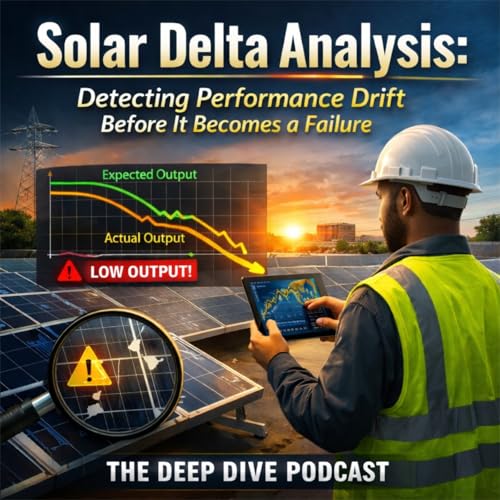
  • Solar Delta Analysis: Detecting Performance Drift Before It Becomes a Failure
    Feb 7 2026

    Solar systems rarely fail all at once. What actually happens—especially on commercial rooftops is slow, quiet performance drift. Energy output tapers off, alarms stay silent, and asset owners don’t notice until revenue losses are already baked in.

    In this episode of The Deep Dive, we break down Solar Delta Analysis a practical, field-tested method for identifying performance degradation early by comparing expected versus actual production over time.

    This is not a theoretical conversation. We walk through how delta analysis works in the real world, what data actually matters, and why nameplate capacity alone is one of the most misleading metrics in solar operations.

    You’ll hear:

    What “delta” really means in a solar O&M context

    How slow performance drift shows up long before alarms trigger

    Common causes of drift: soiling, shading changes, optimizer mismatch, communication issues, and component aging

    Why comparing system-to-system and string-to-string performance is more revealing than chasing daily kWh

    How asset owners lose money quietly when no one is watching trends

    Where most monitoring platforms fall short and how operators compensate in the field

    We also touch on why older systems (2010–2021 vintage especially) are the most vulnerable to unnoticed underperformance, and how delta analysis fits into modern inspection, repowering, and asset-management strategies.

    If you’re a building owner, asset manager, EPC, or O&M provider, this episode explains why “the system is online” is not the same as “the system is performing.” And if you’re responsible for production guarantees, this conversation should make you uncomfortable in a good way.

    Solar isn’t set-and-forget. Performance requires intent, comparison, and context. Delta analysis provides all three.

    The Deep Dive on Renewable is a podcast hosted by Alex and Jordan, featuring in-depth discussions on renewable energy, sustainability, and the global clean energy transition.

    © 2026 The Servant Podcast Network. All rights reserved.

    Show More Show Less
    20 mins