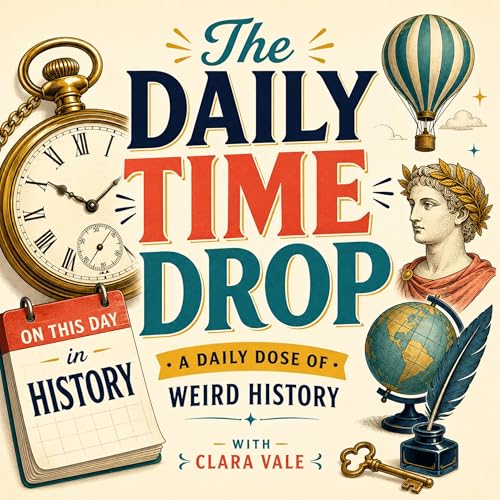
The Daily Time Drop cover art

The Daily Time Drop

The Daily Time Drop

By: Clara Vale
Listen for free

The Daily Time Drop is a daily ten minute trip through the stranger corners of history, hosted by Clara Vale.

Every episode takes one moment from this day in history and turns it into a sharp, funny, and surprising story. Expect odd inventions, bad decisions, forgotten scandals, accidental genius, royal weirdness, animal chaos, scientific breakthroughs, and the occasional reminder that humans have always been winging it with alarming confidence.

This is not a dusty history lesson. It is history with raised eyebrows, proper facts, and just enough sarcasm to keep the cobwebs off.

Perfect for your morning coffee, your commute, or that small window of time when you want to learn something without being trapped under a textbook.

Come back daily for strange events, clever context, and one excellent fact worth repeating later.

World
Episodes
  • The Captain Who Survived Being Sucked Out of His Own Cockpit
    Jun 10 2026
    The Captain Who Survived Being Sucked Out of His Own Cockpit

    On 10 June 1990, British Airways Flight 5390 departed Birmingham for Malaga with a catastrophic flaw: a cockpit windscreen secured with the wrong bolts. Thirteen minutes into the flight, the panel blew out at 23,000 feet, dragging Captain Tim Lancaster headfirst through the opening. Flight attendant Nigel Ogden grabbed his legs and held on through 500-mile-per-hour winds and sub-zero temperatures, whilst co-pilot Alastair Atchison executed an emergency landing at Southampton with a captain dangling outside the aircraft. All 81 people aboard survived. The episode also marks the 1935 founding of Alcoholics Anonymous, when Dr Bob Smith took his last drink in Akron, Ohio, and recalls Kevin Warwick’s 2002 neural communication experiment and fifteen-year-old Joe Nuxhall’s chaotic 1944 baseball debut. A day of extraordinary human resilience in the face of impossible circumstances.

    Chapters
    • Intro A British Airways flight, a Monday morning in June 1990, and a cockpit windscreen that blows out at 23,000 feet over the English Channel.
    • British Airways Flight 5390 Captain Tim Lancaster is sucked through the windscreen after incorrectly sized bolts fail. Flight attendant Nigel Ogden holds his legs for twenty minutes whilst co-pilot Alastair Atchison performs an emergency landing at Southampton. All survive. The investigation reveals maintenance failures that transformed aviation safety procedures.
    • Alcoholics Anonymous Founded On 10 June 1935, Dr Bob Smith takes his last drink in Akron, Ohio, marking the founding of Alcoholics Anonymous. The peer support model he developed with Bill Wilson becomes one of the world’s most widespread mutual aid movements.
    • Kevin Warwick’s Nervous System Experiment In 2002, cybernetics professor Kevin Warwick and his wife undergo the first direct electronic communication between two human nervous systems via implanted electrode arrays, exploring whether neural signals could bypass language entirely.
    • Joe Nuxhall, Youngest Major League Player On 10 June 1944, fifteen-year-old Joe Nuxhall becomes the youngest player in Major League Baseball history, pitching for the Cincinnati Reds during wartime roster shortages. He later returns for a long professional career and broadcasting legacy.
    • Outro Reflections on ordinary moments containing extraordinary decisions, and an invitation to follow, rate, and share the show.
    Links
    • https://www.bbc.co.uk/news/uk-england-43336156
    • https://www.aaib.gov.uk/publications/formal-reports/
    • https://www.aa.org/the-ten-steps
    • https://www.reading.ac.uk/news-archive/press-releases/pr4502.html
    • https://www.baseball-reference.com/players/n/nuxhajo01.shtml
    • https://www.nytsa.gov/aviation-safety
    Show More Show Less
    8 mins
  • A Reporter's Secret Life and the Question That Broke McCarthy
    Jun 9 2026
    A Reporter’s Secret Life and the Question That Broke McCarthy

    On 9 June 1930, Chicago Tribune reporter Jake Lingle was shot dead in a crowded pedestrian tunnel beneath Michigan Avenue. The Tribune launched a crusade, declaring him a journalistic martyr murdered for asking too many questions. Within weeks, the truth emerged: Lingle had been living far beyond his reporter’s salary, maintaining close ties to Al Capone, and allegedly owed the gangster’s organisation $100,000 in gambling debts. Twenty-four years later, on 9 June 1954, another kind of reckoning arrived. In a televised Senate hearing watched by millions, Boston lawyer Joseph Welch confronted Senator Joseph McCarthy with a question that became famous: ‘Have you no sense of decency, sir, at long last?’ The moment is widely credited as the turning point that broke McCarthy’s power. Clara Vale explores two very different stories about accountability, the difference between access and independence, and the moments when someone finally asks the question everyone else has been thinking.

    Chapters
    • Jake Lingle: The Reporter Who Wasn’t On 9 June 1930, Chicago Tribune reporter Jake Lingle was murdered in a pedestrian tunnel during rush hour. The Tribune declared him a martyred journalist, but investigations soon revealed he had been living well beyond his salary, maintaining close ties to Al Capone, and allegedly owed $100,000 in gambling debts. The case forced American journalism to confront uncomfortable questions about the line between access and complicity.
    • Have You No Sense of Decency? On 9 June 1954, during the televised Army-McCarthy hearings, Boston lawyer Joseph Welch confronted Senator Joseph McCarthy after the senator publicly attacked a young associate at Welch’s firm. Welch’s calm question, ‘Have you no sense of decency, sir, at long last?’ became a turning point. The room applauded, McCarthy’s power began to deflate, and he was censured by the Senate later that year. The moment demonstrated how a quiet refusal to be intimidated could shift national sentiment.
    Links
    • https://www.chicagotribune.com/
    • https://www.senate.gov/about/powers-procedures/investigations/mccarthy-hearings.htm
    • https://history.house.gov/Historical-Highlights/1951-2000/Joseph-Welch-and-Joseph-McCarthy/
    • https://www.archives.gov/research/military/vietnam-war/casualty-lists
    • https://www.britannica.com/biography/Joseph-McCarthy
    • https://www.britannica.com/event/Prohibition-United-States-history-1920-1933
    Show More Show Less
    9 mins
  • The Day the US Postal Service Tried Missile Mail
    Jun 8 2026
    The Day the US Postal Service Tried Missile Mail

    On 8 June 1959, the United States Navy fired a Regulus cruise missile from the submarine USS Barbero off the coast of Florida. Inside, replacing the nuclear warhead, was a postal canister containing three thousand letters. Postmaster General Arthur Summerfield watched the launch and declared it of historic significance to the peoples of the entire world. The missile travelled roughly one hundred miles, landed at Naval Air Station Mayport, and the mail was retrieved and stamped with a special ‘MISSILE MAIL’ postmark. Summerfield genuinely believed this was the future of postal delivery, envisioning coast-to-coast routes by cruise missile. The programme was never repeated. Also on this date: Robespierre presided over the Festival of the Supreme Being in 1794, weeks before his own execution; banker Alexander Fordyce fled to France in 1772, triggering a credit crisis across Britain and the Dutch Republic; two pilots died when an F-104 Starfighter collided with an XB-70 Valkyrie in 1966; and the descendants of the Bounty mutineers arrived at Norfolk Island in 1856 to begin a new settlement.

    Chapters
    • Missile Mail and Cold War Postal Ambitions On 8 June 1959, the USS Barbero fired a Regulus cruise missile containing three thousand letters, landing at Naval Air Station Mayport in Florida. Postmaster General Arthur Summerfield believed missile mail was the future, envisioning transcontinental delivery routes. The programme was never pursued further, but the letters were delivered and postmarked, some ending up in museums.
    • Robespierre’s Festival, Fordyce’s Flight, and Other Events Robespierre presided over the Festival of the Supreme Being in Paris on 8 June 1794, weeks before his arrest and execution. Scottish banker Alexander Fordyce fled to France on 8 June 1772, triggering a major credit crisis. On 8 June 1966, an F-104 Starfighter collided with an XB-70 Valkyrie near Edwards Air Force Base, killing two pilots. On 8 June 1856, descendants of the Bounty mutineers arrived at Norfolk Island to establish a new settlement.
    Links
    • https://en.wikipedia.org/wiki/Missile_mail
    • https://en.wikipedia.org/wiki/USS_Barbero_(SS-317)
    • https://en.wikipedia.org/wiki/Festival_of_the_Supreme_Being
    • https://en.wikipedia.org/wiki/Alexander_Fordyce
    • https://en.wikipedia.org/wiki/Credit_crisis_of_1772
    • https://en.wikipedia.org/wiki/XB-70_Valkyrie
    • https://en.wikipedia.org/wiki/Pitcairn_Islands
    • https://en.wikipedia.org/wiki/Norfolk_Island
    Show More Show Less
    9 mins
adbl_web_anon_alc_button_suppression_t1
No reviews yet