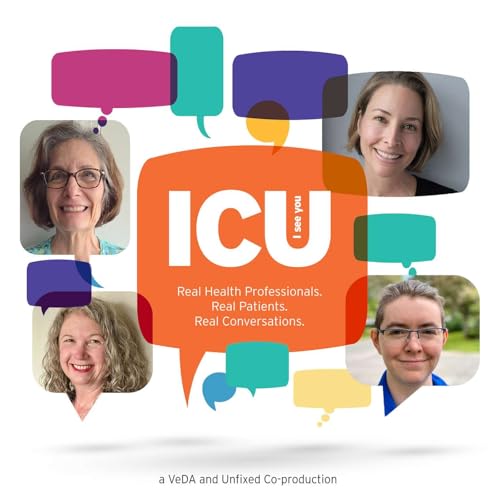
ICU - "I See You" - Vestibular Conversations cover art

ICU - "I See You" - Vestibular Conversations

ICU - "I See You" - Vestibular Conversations

By: The Vestibular Disorders Association (VeDA) & Unfixed Media
Listen for free

In the ICU ("I See You") podcast hosts Cynthia Ryan and Kimberly Warner explore the vestibular experience by facilitating conversations between vestibular patients and the health professionals who care for them. They invite patients to share their stories, and healthcare professionals to ask questions so they are equipped to care for, and truly see their patients. This podcast is a co-production of the Vestibular Disorders Association (VeDA) and Unfixed Media.

© 2026 ICU - "I See You" - Vestibular Conversations
Hygiene & Healthy Living Physical Illness & Disease
Episodes
  • Vestibular Concussion
    Jun 5 2026

    A blow to the head can do more than cause a concussion—it can disrupt the delicate systems that control balance, vision, and spatial awareness. In this episode of the ICU Podcast, we explore vestibular concussion: what it is, why it’s often overlooked, and how it can leave people feeling dizzy, disoriented, and disconnected from their surroundings. Our guests break down how the vestibular system is affected by head injury, why symptoms like vertigo, brain fog, and visual sensitivity can linger, and what recovery can look like with the right care. Whether you’re a patient, caregiver, or clinician, this conversation sheds light on an often misunderstood consequence of concussion and offers hope for healing through targeted support and rehabilitation.

    Guests

    Jess Winter is a school librarian with a background in teaching journalism and a deep passion for finding, organizing, and sharing information. After experiencing a concussion, Jess developed ongoing vestibular challenges, including vestibular migraine and persistent postural-perceptual dizziness (PPPD), which have shaped both her personal journey and her commitment to supporting others. She holds a Master’s degree in Library Science and is especially interested in pursuing work as a medical librarian, combining her love of research with a desire to help people navigate complex health information. Jess also supports VeDa through the annual Poetry-4-Balance contest and has led poetry writing for social hour.

    Dr. Danit Macklin, PT, DPT specializes in concussion and vestibular rehabilitation, holding certificates from the APTA in both pediatric and adult vestibular rehabilitation and certification as an Impact Trained Physical Therapist. She has served as faculty for the annual APTA Pediatric Vestibular Competency Conference and is a course instructor for Education Resources Inc. (ERI), where she teaches Leading-Edge Approaches for Concussion and Mild TBI Management: Applications for Comprehensive Assessment and Treatment. Dr. Macklin is the owner of Balance & Concussion Therapy Center, a private practice exclusively dedicated to concussion and vestibular rehabilitation. She serves on the BIANJ Concussion Committee, is the founder and chair of the APTANJ Vestibular Special Interest Group, and founded Concussion Awareness Day in New Jersey. She recently joined the International Neurologic Physiotherapy Association and is actively engaged with its vestibular special interest group.


    Show More Show Less
    53 mins
  • CANVAS-Cerebellar Ataxia, Neuropathy, and Vestibular Areflexia Syndrome
    May 8 2026

    In this episode of the ICU podcast, we’re exploring CANVAS—short for cerebellar ataxia, neuropathy, and vestibular areflexia syndrome—a rare, progressive neurological condition that disrupts the very systems our bodies rely on to stay balanced and oriented. CANVAS affects the cerebellum, sensory nerves, and inner ear balance system all at once, creating a “triple hit” that can lead to unsteadiness, dizziness, vision changes with head movement, and worsening coordination over time. Although researchers have only recently begun to understand its genetic cause, much remains unknown about how it develops and how best to manage it. Today, we’re joined by Celeste Suart, Patient Engagement Director at the National Ataxia Foundation, and Denise Luken, who is living with CANVAS, to share both the clinical perspective and the lived experience of navigating this complex and often misunderstood condition.

    Guest bios

    Celeste Suart, PhD, is the Patient Engagement Director for the National Ataxia Foundation. She earned her PhD in biochemistry at McMaster University, where her research focused on Ataxia, science communication, and adult education. Celeste leads the development of various patient-facing research communications, educational materials, and informational webinars. She also acts as a liaison between NAF, researchers, clinicians, industry professionals, and the ataxia community. Celeste strongly believes in the empowering nature of education. She is committed to supporting the agency of Ataxians and their families through access to research information and opportunities.

    Denise lives in North Carolina with her husband of nearly 25 years, Bill, and their two dogs. After an active life that included raising two children, working in IT, and enjoying sports like tennis and skiing, she began experiencing balance issues, falls, and coughing in her early 50s. Following years of testing, she was first diagnosed with idiopathic ataxia, and later with RFC1-related CANVAS. Now in her mid-60s, Denise stays active with regular exercise and physical therapy, using a cane or rollator for support.

    Show More Show Less
    48 mins
  • How Gut Health Impacts Vestibular Symptoms
    Apr 8 2026

    In today’s episode of the ICU Podcast, we explore the fascinating connection between gut health and vestibular disorders—and why taking care of your digestive system might be an overlooked piece of your wellness puzzle. What happens in your gut doesn’t always stay in your gut: when the lining of the intestine becomes compromised, it can lead to systemic inflammation, nutrient malabsorption, and an imbalanced microbiome—all of which may influence vestibular symptoms like vertigo, dizziness, and balance issues. The gut is also a major producer of neurotransmitters that affect mood and nervous system balance, and imbalances there could potentially affect how your brain processes vestibular signals. Today, we’ll break down what gut health really means, how it intersects with vestibular function, and practical takeaways you can consider as part of your overall health strategy.

    Guest Bios

    Leigha Kingsley is an actress, writer, producer, and director. Her acting credits include films starring Will Ferrell and Woody Harrelson, and TV shows like Criminal Minds. She is a champion for female-driven stories, and her scripts have been finalists for Sundance, HBO Project Greenlight, and the New York Television Festival. Leaha has been experiencing Vestibular Migraines for the past year. She is still new to this journey, but one thing she has noticed is that the foods she consumes have a direct correlation with how well her brain and vestibular system operate.

    Carla Alpert, FDN-P, NBC-HWC, FMCHC, is a trauma-informed Board-Certified Health & Wellness Coach and Functional Medicine Practitioner. She focuses on gut health and how it affects overall health because, unlike Las Vegas, what happens in the gut doesn’t always stay in the gut. Symptoms become the way your body tells you there’s an imbalance. Many times, problems that seem unrelated to gastrointestinal health, such as brain fog, fatigue, anxiety, and even skin issues, can stem from an imbalance in the microbiome. Carla supports her clients in uncovering the root cause(s) of digestive problems and other chronic symptoms, restoring overall health and well-being. Her mission as a coach is to help her clients explore and discover solutions to live a life with renewed vitality, radiant health, authenticity, and purpose—without the overwhelm. Learn more about Carla here.


    Show More Show Less
    1 hr and 1 min
adbl_web_anon_alc_button_suppression_t1
No reviews yet