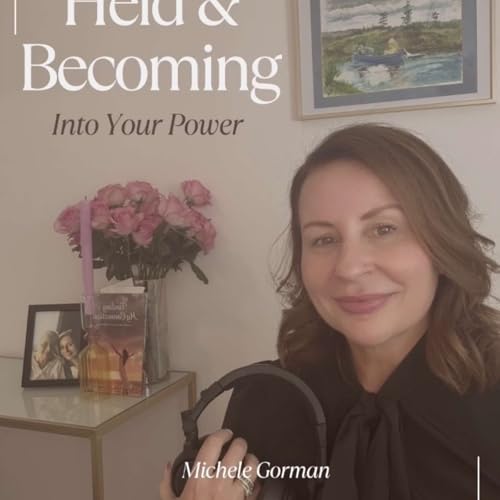
Held & Becoming : Into Your Power cover art

Held & Becoming : Into Your Power

Held & Becoming : Into Your Power

By: Michele Gorman
Listen for free

You were never broken. You were adapting. Held & Becoming: Into Your Power is a podcast for anyone ready to stop abandoning themselves and finally come home to who they truly are. Through honest conversations on healing, attachment, and nervous system regulation, each episode offers space for reflection, grounded insight, and the practice of holding yourself with love, accountability, grace, and compassion.

© 2026 Held & Becoming : Into Your Power
Hygiene & Healthy Living Personal Development Personal Success Psychology Psychology & Mental Health Social Sciences
Episodes
  • Reclaim Your Voice
    Jun 24 2026

    Send us Fan Mail

    The moment you try to speak up and your chest tightens, your throat closes, or your mind goes blank, it is easy to assume something is wrong with you. We see it differently: your nervous system may be doing exactly what it learned to do to keep you safe. This conversation is about reclaiming your voice after years of staying quiet, staying small, or staying agreeable because honesty once felt risky.

    We start by tracing how early attachment wounds shape our relationship with self-expression. When a child fears the very people they depend on, the body adapts in powerful ways, and those patterns can follow us into adulthood as people pleasing, perfectionism, caretaking, and silence. Through poetry from Finding My Power, we name “old fear” and reframe these responses as adaptations, not flaws, so you can meet yourself with compassion rather than judgment.

    Then we get practical about trauma healing and nervous system regulation. We talk about how therapy helps you feel what was never safe to feel, and why consistency matters more than perfectionism when you are rewiring attachment patterns. We also share grounding tools like meditation, journaling, writing, nature walks, and quiet reflection, plus the real work of boundaries, protecting your energy, honoring intuition, and choosing alignment even when it costs you familiarity.

    If you are ready to speak more honestly and live with more self-trust, press play. Subscribe, share this with someone who needs it, and leave a review to help more listeners find the path back to their voice.

    Show More Show Less
    15 mins
  • Self-Love And Forgiveness
    Jun 17 2026

    Send us Fan Mail

    Forgiveness gets sold as a shortcut: let it go, move on, be the bigger person. But when you’ve been hurt, rushing to forgive can become another way of abandoning yourself. We slow it down and redefine forgiveness as something steadier and more honest: acknowledging what happened, refusing to excuse harmful behavior, and putting responsibility back where it belongs so you can stop carrying what was never yours.

    We also dig into attachment theory and how early relationships shape the way we experience love, safety, and connection. When love is inconsistent or painful, the nervous system adapts by reading the room, changing ourselves, and doing whatever it takes to stay connected. Those patterns aren’t character flaws, they’re survival strategies. The hard part of healing is recognizing how often that survival required self-abandonment, and then learning to come back to yourself with compassion.

    Along the way, we share two poems, “Sorry” and “Unbraiding,” to name the grief, tenderness, and hope that can surface when you finally stop judging your younger self and start thanking them for surviving. If you’re working on nervous system healing, inner child healing, boundaries, or self-compassion, this conversation offers language and reflection prompts you can return to again and again. Subscribe, share this with someone who needs it, and leave a review with one thing you’re ready to set down.

    Show More Show Less
    13 mins
  • Trust Can Be Relearned Through Safety And Compassion
    Jun 11 2026

    Send us Fan Mail

    Trust doesn’t usually disappear in one moment. It fades in a thousand small ways when early relationships feel inconsistent, unsafe, or emotionally misattuned and the nervous system learns to stay on guard. I’m Michele Gorman, and I’m naming what so many of us live with quietly: the overachiever drive, the perfectionist pressure, the caretaker role, and the constant second-guessing that comes from not trusting our own inner voice.

    We move through attachment theory in plain language and connect it to real life patterns like rumination, excessive worry, and the habit of hunting for other people’s opinions because our own judgment doesn’t feel reliable. I share parts of my story of growing up without dependable models of trust, and how that shaped my ability to listen to intuition. You’ll also hear two poems from Finding My Journey, one on Trust and one on Compassion, to capture the emotional truth behind this work in a way that facts alone can’t.

    Then we get practical and honest: attachment patterns are learned, which means they can be relearned. Self-trust rebuilds slowly through consistent experiences of safety, including the safety we create for ourselves through boundaries and self-honoring choices. We also clarify what compassion is and what it is not. Compassion doesn’t mean forgetting, excusing harm, or reopening doors that should stay closed. It means seeing clearly and choosing differently, so we stop repeating generational patterns and start building a future rooted in trust and safety.

    If this resonates, follow the show, share it with someone who needs it, and leave a review so more people can find this path back to themselves. What’s one place in your life where you’re ready to trust your own voice again?

    Show More Show Less
    12 mins
adbl_web_anon_alc_button_suppression_t1
No reviews yet