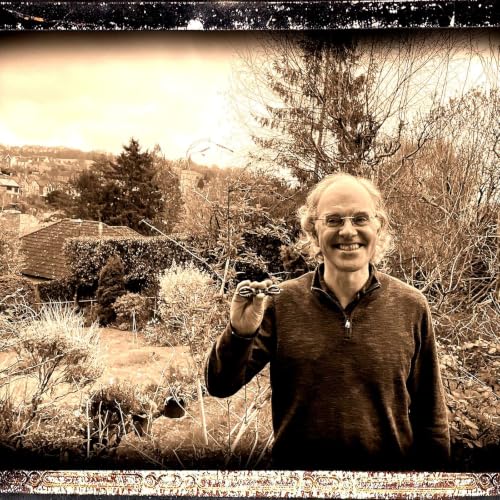
Heat! Camera! Action! cover art

Heat! Camera! Action!

Heat! Camera! Action!

By: Jules Pretty
Listen for free

The planet’s losing.


We’re in a hole. Climate, nature and social inequality crises. Story with a swerve gets us out. It’s the shape of all our lives. Up-down, down-up. And this shape of slantwise story, it creates hope and agency.


In this podcast, we hear from culture leaders and wanderers, the crossers of boundaries, the story-tellers. They share their ideas on how we get out of holes. Good story is not just a hiding place. It’s a finding place.


The podcast vibe is the warm-dark daguerreotype photograph, invented at the start of the industrialised era, before human-induced carbon pollution of the atmosphere.


My guests are writers and poets, artists and scientists, environmental and business leaders, farmers and landowners, local and national activists, festival directors, therapists, religious leaders. All are storytellers too.


The music clips at the start and end of episodes were recorded at public dances in Punakha and Thimphu (Bhutan).


My new book will be supporting this podcast, and will be published in March 2027. It is called "Bamboo and Butterfly: Transformative Stories for Climate and Nature Recovery."

© 2026 Heat! Camera! Action!
Art
Episodes
  • 10 Richard Bawden on a long life as a radical agricultural educator, and how it feels to be dying from cancer
    Jul 1 2026

    In this online conversation, I’m chatting with an old friend and radical agricultural and development educator, Richard Bawden. He’s on the Sunshine Coast in Queensland, I’m in Suffolk. This is a longer pod than usual. Richard is dying from cancer (he’s not living with it). It’s metastasised, it’s now untreatable. The phases are coming fast.

    And yet. We laugh, tell stories, wander over a life of 87 years. In lieu of something written, it’s a conventional autobiography, squeezed into just over an hour. Before the end of the recording, I say, using clunky language, “Let’s not take up too much of your time.” Richard says, “Why not! I’m enjoying this.”

    We’ve bumped this episode up the schedule. If you have any comments on the chat, I’ll make sure they get to Richard.

    Richard grew up on a mixed farm in Cornwall. At Wye College, the principal, Dunstan Skilbeck calls out one day, as he walked across the square, “Where are you going? Where are you going with your life?” Now, that’s a good question from a mentor. “You like sheep, don’t you?”

    Richard ends studying sheep parasitology in Australia. He goes on to head Hawkesbury Agricultural College, installing a new curriculum in 1981 focused on agroecology and experiential learning, with students learning to be the people in the systems they are studying. This experiential learning becomes truly radical, and links with educational and development groups all over the world.

    Then the empire strikes back. The wardens of the old system come out with big sticks, and beat the novel system of learning and being into darkness.

    We talk of the emergence of regenerative systems, ask what does good looks like. We also talk of the central importance of worldviews (weltanschauung in German). It’s all about worldviews – these shape what we think is important. They change through experience, through being, in the world.

    Richard recommends Lester Milbrath’s 1985 book “Envisioning a Sustainable Society: Learning Our Way Out.” This is how we get out of the climate hole. We learn our way out.

    He recommends, first by thyself. Be existential. Figure out why you hold the beliefs you have, and whey are different to others.

    I finish by reading an excerpt from Mary Oliver’s wondrous poem, Last Night the Rain Spoke to Me.

    “The tree was a tree, with happy leaves…

    Imagine, imagine,

    The long and wondrous journeys, still to be ours.”

    My new book will be supporting this podcast, and will be published in March 2027 by Unbreaking/5m. It’s called "Bamboo and Butterfly: Transformative Stories for Climate and Nature Recovery."

    Show More Show Less
    1 hr and 5 mins
  • 09 Mandy Haggith on poetry as a kind method for climate and nature action
    Jul 1 2026

    In this online chat, author, poet and community activist Mandy Haggith talks from her Assynt croft in the north-west of Scotland. She is using poetry to create a sense of agency when so much seems bleak. We hear of community development in Scotland, how policy has enabled local people to but estates, islands and urban plots. It’s hard, though, to create the income streams for local people. Mandy talks of the use of poetry in local projects on nature recovery and reducing fossil fuel dependence. She says, “At least, verse can’t make it worse.”

    She says, “Little changes can snowball into vast change. We don’t all need to be heroes.”

    Mandy’s books include The Lost Elms, five collections of poetry, and five novels, including The Last Bear; Bear Witness, The Walrus Mutterer. See her website: https://www.mandyhaggith.net/

    Mandy recommends Hermann Hesse’s Siddhartha and Barbara Kingsolver’s Prodigal Summer.

    Her action: go and plant a tree (if you have the resource). Do imaginative time travel: go into the past, find things that are wonderful, beautiful, uplifting. However far you went back, now go forward the same amount of time into the future, and take that good thing with you. Imagine how that feels.

    People feel better. It seems to generate hope about the future.

    My new book will be supporting this podcast, and will be published in March 2027 by Unbreaking/5m. It’s called "Bamboo and Butterfly: Transformative Stories for Climate and Nature Recovery."

    Show More Show Less
    36 mins
  • 08 Rich Yates on leading Essex Wildlife Trust and the social values of nature recovery
    Jun 24 2026

    At Abbotts Hall by the Blackwater Estuary, chief executive of Essex Wildlife Trust, Rich Yates, chats about the 67 years of county wildlife action. We sit in sunshine by a pond, and hear about the Trus’s many reserves and visitor centres. And how the focus on nature has shifted from protecting and conserving to improving. This puts people at the heart of it all. The Trust relies on a dense network of 2000 volunteers to manage their 100 reserves and engage with the public.

    We talk of the timescales of conservation and nature recovery: 60+ years (so far) for Fingringhoe Wick, 24 years for saltings after coastal realignment, 15 years for Mucking waste tip to reserve, and 1-2 years for the ghost ponds of Essex to come back.

    Rich says, “The story of conservation is the story of people.”

    Rich recommends Kate Raworth’s Doughnut Economics.

    Rich’s object is a guitar plectrum.

    His heroes are local education leader Gary Horne and EA Festival organiser Joanne Ooi.

    His recommended action: go on, join a Wildlife Trust local to you.

    Website: https://www.essexwt.org.uk/

    My new book will be supporting this podcast, and will be published in March 2027. It is called "Bamboo and Butterfly: Transformative Stories for Climate and Nature Recovery."

    Show More Show Less
    44 mins
adbl_web_anon_alc_button_suppression_t1
No reviews yet