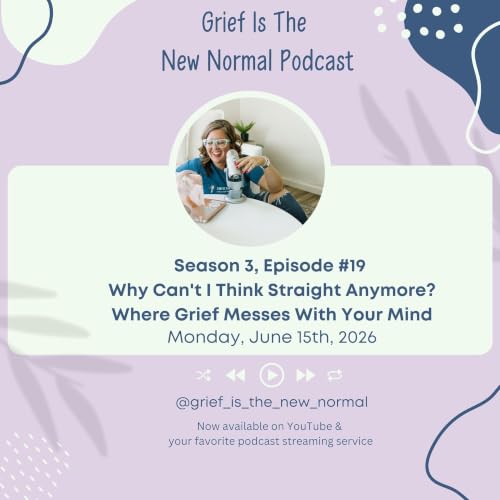
Grief is the New Normal Podcast with Dr. Heather Taylor cover art

Grief is the New Normal Podcast with Dr. Heather Taylor

Grief is the New Normal Podcast with Dr. Heather Taylor

By: Dr. Heather Taylor PsyD Psychologist
Listen for free

Grief is the New Normal is the podcast that refuses to sugarcoat loss—because grief isn’t a problem to fix, it’s a reality to live with. Hosted by Dr. Heather Taylor, a licensed psychologist with over a decade of experience in grief and trauma, this show dives deep into the messy, nonlinear, and very real ways grief impacts our lives. Whether you’re navigating the death of your person, wrestling with the weight of an invisible loss, or trying to figure out who you even are after everything changed—this podcast is here for you. With a mix of solo deep dives, expert interviews, and candid conversations, Dr. Taylor unpacks the emotions no one warns you about, challenges outdated grief narratives, and offers both practical tools and hard-earned wisdom to help you feel less alone. No toxic positivity. No “fixing” your grief. Just honest talk, validation, and the reminder that you don’t have to do this alone. Because in a world that wants you to move on, Grief is the New Normal is here to help you move through. Tune in for honest stories, practical tools, and a reminder that your grief—and how you carry it—is valid. Available on Spotify, Apple Podcasts, and wherever you get your podcasts.© 2024 Grief is the New Normal Psychological Services All Rights Reserved. Hygiene & Healthy Living Psychology Psychology & Mental Health Social Sciences
Episodes
  • Grief is the New Normal Podcast: S3E21 Why Am I Acting Like A Completely Different Person? Where Grief Shows Up in What You Do
    Jun 25 2026
    Behavioral Grief Reactions: Why Grief Changes What You Do, Not Just How You Feel You have been saying yes to everything because stopping feels terrifying. You have not responded to a text in two weeks. You reorganized the closet three times this month. You are on your second bottle of wine more nights than you want to admit. You got the tattoo. That is not you being impulsive, flaky, or self-destructive. That is grief taking the wheel. In episode four of the six-part Common Grief Reactions series, Dr. Heather Taylor gets into the behavioral side of grief, the part that shows up in your daily habits, your relationships, your phone, your pantry, and your couch. The part that tends to carry the most shame and gets explained away as stress or a personality change or just a weird phase, when really it is grief trying to metabolize itself through action, avoidance, or control. If you have ever looked at what you have been doing since your loss and thought "what is wrong with me," this episode is for you. Nothing is wrong with you. You are grieving, and those two things explain a lot. In this episode you will learn: Why grief changes not just how you feel but what you actually doThe two ends of the behavioral grief spectrum: over-functioning and under-functioning, and why both are protectiveWhy most grieving people cycle between both and what that cycling actually looks likeThe most common numbing behaviors in grief, including alcohol use, doom scrolling, impulse decisions, and perpetual busyness, and why none of them are moral failuresHow to tell the difference between coping and avoidance, and why that distinction mattersWhy staying perpetually busy is one of the most sophisticated and culturally approved numbing behaviors we haveHow to get curious about your grief behaviors without shaming yourself for any of themThe one question to ask yourself when you want to understand what a behavior is really about Behavioral grief patterns discussed in this episode: Over-functioning, under-functioning, grief avoidance, numbing behaviors, alcohol use after loss, doom scrolling, impulse decisions, isolation, social withdrawal, grief and anger, grief and irritability, busyness as avoidance, grief coping strategies, grief behaviors, grief and control Story Time with Heather: Dr. Taylor shares what happened the week after her brother died, when she poured herself and her whole grieving family into making holiday gift card aprons for Barnes and Noble, and what it taught her about over-functioning as a grief response. She also talks about her depression slippers, the one-year anniversary, and what it looked like when the over-functioning finally gave way. STAY Framework connection: This episode works with two letters. T, Track the Loss, which means tracing a behavior back to its source and asking what loss is actually underneath it. And Y, Yield to the Moment, which means responding to what is genuinely needed right now, not what your pre-grief self would have done or what the productivity app on your phone is telling you to do. Practical tools from this episode: Replace judgment with curiosity: shift from "what is wrong with me" to "what is my grief asking for right now"Pick one small anchoring habit to create a thread of predictability in an unpredictable seasonName the behavior as grief out loud: "I am not flaky, I am grieving"Ask the core question: is this behavior helping me move through grief or helping me move away from it? Series navigation: Episode 1: Physical Grief Reactions: When Loss Lives in the BodyEpisode 2: Emotional Grief Reactions: The Feelings Nobody Puts in a Sympathy CardEpisode 3: Cognitive Grief Reactions: Grief Brain Is RealEpisode 4: Behavioral Grief Reactions: Why Grief Changes What You Do (you are here)Episode 5: Spiritual and Existential Grief Reactions (coming next)Episode 6: Social Grief Reactions ------------------------------------- Grief is not a problem to solve. It is a human experience to move through, and most of us were never taught how. Grief is the New Normal is hosted by Dr. Heather Taylor, licensed psychologist and grief specialist with over a decade of experience in grief, trauma, and reproductive psychology. This show exists to change the conversation around loss by expanding what grief looks like, who it belongs to, and what it actually means to integrate it into your life. Whether you're grieving a death, a diagnosis, a relationship, an identity shift, or the world as you knew it, your grief is real, it deserves space, and you are not behind. And if you're a clinician, coach, or helper carrying your own grief while holding space for others, this show was built for you too. Dr. Taylor brings research-informed frameworks, honest clinical perspective, and the STAY framework, a grief-informed approach to living with loss that goes far beyond the five stages. Expect nuance, depth, and conversations that take grief seriously. No toxic positivity. No fixing. Just honest conversation, ...
    Show More Show Less
    18 mins
  • Grief is the New Normal Podcast: S3E20 Grief, EMDR, and Disneyland: Finding Joy in the Mess with Jessica Vickers, LMFT
    Jun 18 2026
    Grief is not just about death. It lives inside fertility journeys, inside the waiting and the not knowing, inside the losses that do not come with funerals or casseroles or anyone checking in six months later. And sometimes it lives right alongside joy, which is one of the most disorienting and least talked about parts of the whole experience. In this episode, Dr. Heather Taylor sits down with Jessica Vickers, licensed marriage and family therapist, certified perinatal mental health counselor, EMDR clinician, and founder of the Happiest Healers Club. Jessica shares her own grief story, her clinical approach to perinatal and infertility loss, how EMDR supports grief integration, and why therapists need community and play just as much as their clients do. This one is warm, real, a little bit Disney-filled, and deeply human. In this episode you will learn: What ambiguous grief looks like in the context of infertility and the perinatal journey, and why it is one of the hardest grief types to holdHow EMDR supports grief processing by moving the nervous system from maladaptive beliefs toward adaptive meaning-makingWhy the second and third pregnancy losses hit differently, and how to support clients who are still in the middle of not knowingWhat continuing bonds look like in practice, including how Jessica stays connected to her dad and her best friend through Disneyland, Groot ears, and tree plantingWhy nothing good happens when we are dysregulated, and what to do before you act on grief or rage or fearHow to talk about your grief with new people in your life who never knew your personWhat survivor guilt sounds like in grief, and how to gently challenge itHow EMDR physically calms the body before it works on the storyWhy therapist burnout is a grief response too, and what the Happiest Healers Club is doing about it Topics and concepts discussed in this episode: Ambiguous grief, infertility grief, perinatal loss, miscarriage, pregnancy loss, EMDR for grief, bilateral stimulation, grief integration, continuing bonds, survivor guilt, grief and joy, caregiver fatigue, anticipatory grief, disenfranchised grief, grief and the nervous system, clinician burnout, therapist self-care, meaning-making after loss, grief and community ----------------------------- Jessica Vickers is a licensed marriage & family therapist, and also a certified perinatal mental health counselor. Jessica has been a therapist for over 13 years, and specializes in working with women of color and women going through the perinatal journey. Jessica utilizes EMDR in her virtual private practice. She is a Black woman, a wife, a mom, and the founder of The Happiest Healers Club. @jessicavickersmft on Instagram -------------------------------- Grief is not a problem to solve. It is a human experience to move through, and most of us were never taught how. Grief is the New Normal is hosted by Dr. Heather Taylor, licensed psychologist and grief specialist with over a decade of experience in grief, trauma, and reproductive psychology. This show exists to change the conversation around loss by expanding what grief looks like, who it belongs to, and what it actually means to integrate it into your life. Whether you're grieving a death, a diagnosis, a relationship, an identity shift, or the world as you knew it, your grief is real, it deserves space, and you are not behind. And if you're a clinician, coach, or helper carrying your own grief while holding space for others, this show was built for you too. Dr. Taylor brings research-informed frameworks, honest clinical perspective, and the STAY framework, a grief-informed approach to living with loss that goes far beyond the five stages. Expect nuance, depth, and conversations that take grief seriously. No toxic positivity. No fixing. Just honest conversation, real validation, and a community built around grief literacy, disenfranchised grief, anticipatory grief, collective grief, and the full spectrum of human loss. grief support podcast · disenfranchised grief · anticipatory grief · grief after loss · grief for clinicians · grief-informed care · grief literacy · coping with grief · grief and identity · mental health and grief · reproductive grief · pet loss grief · collective trauma and grief · grief integration · STAY framework New episodes dropping regularly Connect with Dr. Heather Taylor: Website: griefisthenewnormal.com Instagram: @grief_is_the_new_normal Substack: How We STAY with Grief https://drheathertaylor.substack.com/ Newsletter: Bridging the Grief Gap on LinkedIn https://www.linkedin.com/in/heather-taylor-psyd-licensed-psychologist/ Journal: Authentically Unapologetic, available on Amazon https://a.co/d/0dM0DloC Contact: hello@griefisthenewnormal.com This episode is sponsored by Oasys EHR. Try Oasys free for your first month. Use code HEATHER-2865 at oasysehr.com. Music by The Dadicorns. Copyright 2026.
    Show More Show Less
    53 mins
  • Grief is the New Normal Podcast: S3E19 Why Can't I think straight anymore? Where Grief Messes with Your Mind
    Jun 15 2026
    Grief Brain Is Real: The Neuroscience of Cognitive Grief Reactions You have reread that email four times and still cannot tell anyone what it said. You walked into a room and have no idea why you are there. You used to read a book a week and now you cannot get through a chapter. You feel like you are failing at being a functional adult. You are not failing. You are grieving. And your brain is in the middle of one of the most demanding neurological processes it will ever be asked to do. In episode three of the six-part Common Grief Reactions series, Dr. Heather Taylor goes upstairs into the mind to explain what is actually happening in the grieving brain, why it happens, and what to do about it with compassion instead of shame. In this episode you will learn: What grief brain actually is and what the neuroscience says about why it happensWhy your prefrontal cortex basically goes offline during grief and what that costs you functionallyHow grief disrupts memory, concentration, decision-making, and executive functionWhat the "year two ambush" is and why the second year of grief often hits harder than the firstWhy grief warps your sense of time and what that means for your autobiographical memoryHow to tell the difference between grief-related cognitive changes and something that needs clinical attentionWhat "bare minimum mode" means and why it is not giving up, it is working with your brainPractical, compassion-first strategies for functioning during grief without shaming yourself into the ground Cognitive grief symptoms discussed in this episode: Memory loss and forgetfulness, concentration difficulties, decision fatigue, time distortion, intrusive thoughts and looping memories, dissociation, executive dysfunction, task initiation problems, neurofatigue, grief fog, brain fog after loss Story Time with Heather: Dr. Taylor shares what happened to her own reading life after her brother died, how the one escape that had carried her since childhood suddenly stopped working, and how she and her clients have found ways to adapt rather than just wait for the fog to lift. She also shares a sneak peek at her new spinoff podcast, Grief Between the Pages, exploring grief through the lens of romantasy and fiction. STAY Framework connection: This episode works with the S in STAY: Slow Down. Dr. Taylor breaks down why trying to out-discipline or out-willpower grief brain makes it worse, and what it actually looks like to reduce cognitive load as an act of care rather than surrender. Practical tools from this episode: Bare minimum mode: giving yourself permission to function at a reduced capacity because that is what is actually happeningExternal scaffolding: sticky notes, phone alarms, calendar reminders for things your working memory cannot hold right nowBreaking tasks into micro-steps to lower the initiation costTalking to yourself like someone you love when you freeze, forget, or fall shortUsing the fog as information: cognitive heaviness often signals an emotional wave is coming Research and references: Mary-Frances O'Connor, neuroscientist and author, on the grieving brain and predictive modelingThe prefrontal cortex and limbic system in griefExecutive function and emotional loadAutobiographical memory and temporal disorientation in grief Series navigation: Episode 1: Physical Grief Reactions: When Loss Lives in the BodyEpisode 2: Emotional Grief Reactions: The Feelings Nobody Puts in a Sympathy CardEpisode 3: Cognitive Grief Reactions: Grief Brain Is Real (you are here)Episode 4: Behavioral Grief Reactions: The Weird Things We Do When We Are Hurting (coming next)Episode 5: Spiritual and Existential Grief ReactionsEpisode 6: Social Grief Reactions ------------------------ Grief is not a problem to solve. It is a human experience to move through, and most of us were never taught how. Grief is the New Normal is hosted by Dr. Heather Taylor, licensed psychologist and grief specialist with over a decade of experience in grief, trauma, and reproductive psychology. This show exists to change the conversation around loss by expanding what grief looks like, who it belongs to, and what it actually means to integrate it into your life. Whether you're grieving a death, a diagnosis, a relationship, an identity shift, or the world as you knew it, your grief is real, it deserves space, and you are not behind. And if you're a clinician, coach, or helper carrying your own grief while holding space for others, this show was built for you too. Dr. Taylor brings research-informed frameworks, honest clinical perspective, and the STAY framework, a grief-informed approach to living with loss that goes far beyond the five stages. Expect nuance, depth, and conversations that take grief seriously. No toxic positivity. No fixing. Just honest conversation, real validation, and a community built around grief literacy, disenfranchised grief, anticipatory grief, collective grief, and the full spectrum of human loss. grief support podcast · ...
    Show More Show Less
    20 mins
adbl_web_anon_alc_button_suppression_t1
No reviews yet