Genetic Frontiers cover art

Genetic Frontiers

Genetic Frontiers

By: Susanna Smith & Brandy Mello
Listen for free

A podcast about the promise, power, and perils of genetic information (geneticfrontiers.org)2024-2025 Hygiene & Healthy Living Physical Illness & Disease Science
Episodes
  • Privacy, Discrimination & Your Genetic Data
    Jun 25 2026
    Susanna Smith On today's episode, I will be talking with legal scholar Anya Prince, who is a professor at the University of Iowa College of Law. Anya's writing and research focuses on health and genetic privacy, particularly the potential for genetic discrimination and the privacy implications of big data and genomic and genetic clinical care and research. I became really interested in Anya's work because she's published extensively about GINA, the Genetic Information Non-Discrimination Act, writing analysis about what legal protections exist for genetic information in the United States and examining through survey work what healthcare professionals, insurance commissioners, and the public do—and don't—understand about healthcare privacy and the potential for genetic discrimination. I'm interested in how we protect people's genetic information because as a provider of genetic disease, I personally could stand to lose a lot if protections are insufficient. I also take the view that people, all people, should be able to exercise privacy and control over how their healthcare In my view, we don't have enough protections in place yet, and we're not well prepared for a future or even the present moment in which genetic information is increasingly driving healthcare decisions and operates as a valuable form of data currency. So thank you for joining me today on Genetic Frontiers, Professor Prince. Anya Prince Thanks for having me. Susanna Smith I want to start by talking a bit about the big picture. How is privacy viewed or valued in American culture, the legal system, and in healthcare? Anya Prince Yeah, so I think, you know, so many people say, oh, privacy is dead. We don't have privacy anymore. But when you actually start talking to individuals about privacy, they really value it in lots of different ways. But I think one of the big problems is there's a disconnect between how the public thinks that privacy is viewed or valued and how the legal system actually values it. So overall, and we'll talk about the details, I'm sure, today, but the law is not very good at protecting health privacy. And so most notably, the law treats the privacy of health data and genetic data differently depending on if it's within clinical care, within a research setting, or within a commercial space. And so it's really hard for the public to see whether or not the protections match the values that they have for the privacy of their health information. Susanna Smith How would you describe Americans' relationship to privacy? Anya Prince I think that they value it. I also think that people are happy to share information, especially if they know how it might be used, or if they trust who they're sharing with. So on the one hand, you know, people use social media and post all sorts of things that could tell them about, you know, tell others publicly about their health information and so there's lots of ways where we're not as private about our health information as one might think. But there's also data that when you tell people that they might be part of a biobank, or you tell people that their genetic information has been commercialized. They're actually surprised about that and uncomfortable with that. And so I think we have a little bit of a both-and, right? In some ways people don't think about privacy on a regular basis. They just go through the world and social media and the internet without necessarily having that in the forefront. But when you start to ask people how they want their information to be used, I think we start to see more of those values coming in. Susanna Smith Yeah, and I think trust is a big part of it, right? Like, how private you want to keep information is often about how you trust whether it's going to be used in a way that might harm you. So how do you think about the importance of privacy and or data security when it comes to healthcare data versus genetic data specifically? Anya Prince So I think, so some argue that thinking about the privacy of genetic information or health information without thinking about just general privacy at large is exceptionalism that we should not think about health privacy or genetic privacy as anything different than just how do we protect data at large? Some people argue that, but I think it makes sense to think about the privacy of health data and the privacy of genetic data as more important or something that should be given extra consideration, both in the law and both by the public. Part of that is that your genomic data, your health data is incredibly valuable so there's, you know, most of the cybersecurity attacks and threats to data privacy come to hospitals and places that hold our health information because it's just valuable on the dark web. But it's also valuable for advertisers, right? If they know that you might have a predisposition to diabetes, they might try to sell you insulin pumps or healthier foods or whatever ...
    Show More Show Less
    45 mins
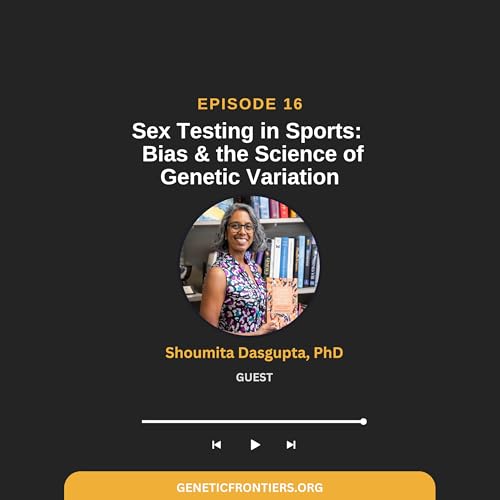
  • Sex Testing in Sports: Bias & the Science of Genetic Variation
    Apr 21 2026
    A conversation with Shoumita Dasgupta, PhD, a geneticist, anti-racism educator, and the author of Where Biology Ends and Bias Begins: Lessons on Belonging from Our DNA about transgender athletes in women's sports, the science of human genetic variation, and the relationship between our genetics and our sex, gender, race, and identity. EPISODE TRANSCRIPT Susanna Smith Hi everyone. This is Genetic Frontiers. A podcast about the promise, power and perils of genetic information find us wherever podcasts are found and go to geneticfrontiers.org to join the conversation about how genetic discoveries are propelling new personalized medical treatments, but also posing ethical dilemmas and emotional quandaries. I'm your host, Susanna Smith. On today's episode, I will be talking with Dr. Shoumita Dasgupta, PhD, who is a Professor of Medicine and Assistant Dean for Diversity and Inclusion at Boston University. Professor Dasgupta is a geneticist by training, and she is an internationally recognized anti-racism educator and the author of a new book, Where Biology Ends and Bias Begins: Lessons on Belonging from Our DNA. In this book, Professor Dasgupta tackles a number of really big subjects, including the relationships we derive between our DNA and aspects of our identity, such as our race or ethnicity, our sex, gender, or sexual orientation and our understandings of genetic difference and disability. She digs into what is actually known about the inner workings of our bodies and our genetics versus the stories we, as humans, have created to make meaning of our DNA for ourselves. Many of the stories we tell ourselves are detached from the realities of what scientists have learned about human biology. Often these stories are laced with bias and grounded consciously or subconsciously in the idea that human beings can be categorized, organized, understood, and assigned value based on aspects of our biology. It's an overly simplistic idea, but it's foundational to how the United States was built, and how this country and many others continue to operate. What scientists have found over the last century is that human biology exists on a wide spectrum of diversity, plurality, and complexity that we are only now beginning to understand. Human beings aren't easily categorized or understood through their DNA. What Professor Dasgupta offers in Where Biology Ends and Bias Begins is a guide and a challenge to everyone who wants to dig into how our understanding—and misunderstandings—about human genetics shape how we see ourselves and other people. Thank you, Professor Dasgupta, for joining me today on Genetic Frontiers. Shoumita Dasgupta Thank you so much, Susanna. It's my pleasure to be here with you today. Susanna Smith So I want to start with a topic that is very much in the news and the political crossfire today, and has been a hot-button topic in the United States for a long time, which is transgender athletes in women's sports. In your book, you give a bit of history about how, before genetic testing, women athletes were made to parade themselves, their bodies were certain of their femaleness by viewing, and then only after were they allowed to compete in women's sports. Then in the early to mid-1980s, various forms of chromosomal analysis started to be used in athletics, and in some cases turned out unexpected results. And in the book, you write about a particular athlete, Maria José Martínez Patiño, who was the Spanish national champion in hurdles in the 1980s, and went on to compete internationally. Could you share a bit of Maria's story with our listeners? Shoumita Dasgupta Absolutely, I'd be delighted to. Maria José Martínez Patiño was a track and field athlete. And when she was competing, there were a variety of different sex-based tests that they did to determine eligibility of athletes. And so, in this testing, there was really a major conflation between sex and gender, so it's somewhat helpful to understand the difference between the two. Sex has to do with the biology of one's body. You know, what's in your DNA? What organs do you have? What sex hormones are circulating through your system? And it turns out that sex is typically assigned at birth, based entirely on external anatomy. So, this particular way of determining sex just really doesn't kind of capture the overall complexity of the spectrum of sex, and the fact that sex is not binary, it's not simply male or female, but there are many, many intersex people on the planet as well. Then there's gender. And gender has to do more with, you know, who you identify with in your heart and in your mind. Do you feel like a boy, a girl, a man, a woman, a mix, or none of the above? That has to do with what gender is. And sexual orientation is an entirely different category, which has to do with who you are attracted to and who you love. Now, in sport, there's a real fixation on binary categorization. The competitive categories tend to be men's sport ...
    Show More Show Less
    50 mins
  • Episode 15: Making "Smarter" Babies: The Mythology of American Eugenics
    Feb 3 2026

    Emily Klancher Merchant, PhD, author of "Breeding for IQ" in the Los Angeles Review of Books, talks about how "intelligence—not race—has always been at the center of American eugenics." She cautions that "eugenics does not work by breeding smarter humans;" no technology has been shown to do this but the widespread, American belief that intelligence is primarily genetic is allowing governments to shirk responsibility for ameliorating social inequality and promote projects that favor those who are already priviliged.

    Full episode transcript at: https://www.geneticfrontiers.org/transcript-ep-15

    GUEST BIO

    Emily Klancher Merchant, PhD, is a historian of science, technology, and medicine, focusing on the human sciences in the United States since World War I. She is Associate Professor of Science and Technology Studies at the University of California at Davis.

    RESOURCES

    • https://www.emilyklancher.com/

    • Emily Klancher Merchant. Building the Population Bomb. Oxford University Press. 2021.

    • Emily R. Klancher Merchant. "Breeding for IQ." Los Angeles Review of Books. August 22, 2024.

    • Elizabeth Catte. Pure America. Arcadia Publishing. 2021.

    • Molly Ladd-Taylor. Fixing the Poor. John Hopkins University Press. 2020.

    Show More Show Less
    43 mins
adbl_web_anon_alc_button_suppression_t1
No reviews yet