• Why AI Loves Reddit Most with Brent Csutoras
    May 21 2026

    EPISODE 57

    Brent Csutoras has spent nearly two decades inside Reddit, Digg, and the message-board underbelly of the internet - and he joins Kevin and Jason to explain why the human voice is now the most valuable thing in marketing. Brent breaks down why Reddit shows up everywhere in AI answers, the biggest mistakes brands make when they enter online communities, and how his team flipped Asurion from a toxic, "scam"-labeled brand into one that controls its narrative across every LLM. He shares the TikTok campaign that pulled in 300 death threats in 30 minutes (and still won the room), why owning the small negatives gives you control of the big ones, and why the next 12 months are a Reddit-and-AI land grab on the scale of short domains and links 20 years ago. If your brand is afraid to show up in the rooms where customers are actually talking, this episode is for you.


    CHAPTERS

    00:00 - The next 12 months is the land grab

    00:45 - Marketing in a world where attention is harder to earn

    04:01 - Welcome Brent: two decades inside the most misunderstood platform

    06:39 - The biggest mistake brands make on Reddit

    09:18 - How to reverse a toxic community (TikTok and Asurion)

    13:15 - Why Reddit shows up everywhere in AI answers

    17:40 - Stop selling features, start solving the real problem

    21:24 - What every marketer should stop doing immediately

    25:10 - The Reddit land grab and the brands sleeping on it

    26:18 - The Asurion turnaround: owning the negative

    31:02 - How to show up in AI answers beyond Reddit


    LINKS

    Connect with Brent Csutoras

    OGS MediaLinkedIn


    Stay Connected with Founder Mode

    Subscribe to our newsletter


    Connect with Kevin

    LinkedInX/Twitter


    Connect with Jason

    LinkedInX/Twitter

    Show More Show Less
    36 mins
  • Hire Attitude, Not Experience with Jose Li
    May 14 2026

    EPISODE 56

    Jose Li, founder and CEO of 71lbs, joins Kevin and Jason to break down how he turned a frustration most companies tolerate, opaque and overcharged shipping invoices, into a 14-year-old business that has saved 5,000 customers more than $80 million. After running FedEx's retail and e-commerce practice, Jose left to tackle the two biggest pain points companies face with carriers: saving money and understanding what they're actually paying. He explains the little-known money-back guarantee policy that leaves $2 billion unclaimed every year, how COVID nearly killed the business and forced a pivot into contract negotiations (now 50%+ of revenue), and why trade shows and in-house cold calling still outperform almost everything else. Jose also shares his vision for layering weather and third-party data on top of shipping decisions, the hiring mistakes that taught him perfect FedEx résumés don't translate, and the chip on his shoulder from 800+ investor rejections that still fuels him today.


    CHAPTERS

    00:00 / Cold Open: $2 Billion in Unclaimed Refunds

    03:30 / Meet Jose Li, Founder of 71lbs

    03:43 / Spotting the Gap: Two Pain Points Nobody Was Solving

    07:14 / From an IP Address to a Real Business

    08:30 / The Money-Back Guarantee Most Companies Don't Know About

    11:50 / How COVID Almost Killed the Business

    12:58 / AI, Weather Data, and the Future of Shipping Decisions

    15:10 / Getting the First 10 Customers and Building a Sales Machine

    23:52 / Why Trade Shows Are Still the Best Channel

    26:47 / The Chip on the Shoulder That Keeps Him Going

    30:16 / Founder Mode Top 5 Takeaways


    LINKS

    Connect with Jose Li

    71lbs.comLinkedInX/Twitter


    Stay Connected with Founder Mode

    Stay Connected with Founder Mode

    Subscribe to our newsletter


    Connect with Kevin

    LinkedInX/Twitter


    Connect with Jason

    LinkedInX/Twitter

    Show More Show Less
    32 mins
  • Sleep, Listen, Say No
    May 7 2026

    EPISODE 55

    Kevin and Jason tackle the three things every founder pretends they have under control: sleep, the first 90 days of taking over a company, and the say-no muscle. Kevin explains why sleep is the ultimate performance enhancing drug, then unpacks his contrarian take on the first 90 days — by week three you better have an opinion or people start writing you off. He walks through his recent takeover of Search Engine Journal, including the five-question email that stack-ranked his team, the day-zero move to close every credit card and reissue them through Mercury with a named human owner, and the surprise that 15-20% of expenses simply never came back. They close on the say-no muscle, the 14-hour flight test for shutting work off, and how AI tools are creating new leverage to delegate the work you'd otherwise feel obligated to do yourself.


    CHAPTERS

    00:00 – Cold open: Sleep is the ultimate PED

    00:51 – Welcome and the three topics

    01:00 – The founder sleep crisis

    03:52 – Topic two: Taking over a new company

    04:00 – Why consultants get more leverage than FTEs

    07:09 – Getting acquired and the listening tour

    09:02 – The week three framework (not day 90)

    12:13 – Search Engine Journal takeover and the five-question email

    16:03 – Closing every credit card on day zero

    20:17 – Topic three: Building the say-no muscle

    24:31 – The 14-hour flight test

    26:25 – Five key takeaways


    LINKS

    Sleep masks Kevin recommends

    Alaska BearWAOW


    Stay Connected with Founder Mode

    Subscribe to our newsletter


    Connect with Kevin

    LinkedInX/Twitter


    Connect with Jason

    LinkedInX/Twitter

    Show More Show Less
    28 mins
  • Fire Your Worst Customers
    Apr 30 2026

    EPISODE 54

    Kevin and Jason break down why Anthropic is out of compute, why that's actually a strategy, and what it means for everyone using Claude right now. They dig into the Mythos model as the best marketing moment in AI, why artificial scarcity works, and why $200/month for Claude Max is the cheapest hire you'll ever make. Then they shift to AI in the enterprise — why one "AI Week" won't rewire your company, why Anthropic's one-person growth marketing team is the new bar, and the playbook for founders selling into big companies: pick a hard enough wedge, stop selling the product, and sell transformation instead.


    CHAPTERS

    00:00 – Cold Open: The Mythos Model Is Too Good To Release

    00:35 – Welcome to Founder Mode

    00:59 – Why Anthropic Is Out of Compute

    02:28 – Good Customer, Bad Customer: Who's to Blame?

    04:00 – $200/Month Is the Cheapest Hire You'll Ever Get

    05:31 – Token Maxing and the New Scarcity

    07:01 – How to Fire Bad Customers (And Why Anthropic Is Doing It Wrong)

    10:50 – The Mythos Model: The Best Marketing Moment in AI

    13:19 – AI in the Enterprise: Why One AI Week Isn't Enough

    18:25 – The "One More Prompt" Flow State

    19:57 – Selling Into Enterprise: Pick a Hard Wedge, Sell Transformation

    22:48 – Closing Takeaways and Top Five


    LINKS

    Stay Connected with Founder Mode

    Subscribe to our newsletter


    Connect with Kevin

    LinkedInX/Twitter


    Connect with Jason

    LinkedInX/Twitter

    Show More Show Less
    25 mins
  • AI as a Financial Co-Pilot with Shain Noor
    Apr 23 2026

    EPISODE 53

    In this episode, Kevin and Jason sit down with Shain Noor, co-founder of Silvia, an AI-powered personal CFO built to help people reason through financial decisions, not just track them. Shain explains why the entire history of personal finance apps has focused on clicking and aggregating data rather than helping users actually decide what to do, and how Silvia uses Anthropic-powered agents with a verification layer to deliver trustworthy, personalized financial guidance. The conversation covers the co-pilot vs. autopilot distinction, the surprising discovery that users ask Silvia things they'd never tell their human financial advisor, how proactive alerts like the daily summary email drove retention, and why building the reasoning layer first, before adding any execution or action capabilities, is the right foundation for trust.


    CHAPTERS

    00:00 - The judgment-free financial advisor

    02:38 - Introducing Shain Noor and Silvia

    03:51 - Why finance apps have always missed the reasoning layer

    05:51 - Co-pilot vs. autopilot: trust, transparency, and guardrails

    08:29 - What surprised Shain: users sharing what they hide from their advisors

    12:42 - Measuring retention and the proactive alerts breakthrough

    17:02 - Team size, the ProCap merger, and competing with legacy finance

    19:41 - The future: everyone becomes a manager of AI agents


    LINKS

    Connect with Shain Noor

    SilviaLinkedInX/Twitter


    Stay Connected with Founder Mode

    Subscribe to our newsletter


    Connect with Kevin

    LinkedInX/Twitter


    Connect with Jason

    LinkedInX/Twitter

    Show More Show Less
    23 mins
  • Grab A Shovel
    Apr 16 2026

    EPISODE 52

    Jason Shafton and Kevin Henrikson unpack where AI is genuinely useful and where it starts to create more noise than leverage, using examples from AI email triage, long chat memory drift, and agentic workflows. Kevin explains how memory can become polluted when models start treating their own prior inferences as fact, including a prompt he used to compare what an AI thought was “ground truth” against what he had actually told it. From there, the conversation shifts into a practical framework for building AI systems and human teams the same way: define the job, provide the right tools and access, layer in review and guardrails, and judge success by whether time spent together compounds into more output. They close by connecting startup hiring, high-agency operators, and founder-led culture back to the same core test they use for AI: does this person or tool create leverage, or does it create drag?


    CHAPTERS

    00:00 – AI memory drift and false “ground truth”

    01:24 – Testing AI email triage and the risks of over-filtering

    03:13 – Good AI versus bad AI in real workflows

    05:31 – Why controlled memory leads to more consistent AI outputs

    08:29 – How to apply AI to workflows that currently rely on humans

    11:12 – Building multi-agent content systems with clear roles and QA

    13:40 – Hiring high-agency people for early-stage teams

    16:01 – The “pick up the shovel” standard for startup operators

    22:36 – The real test for both employees and AI: leverage or drag

    26:16 – Founder Mode Top 5 Takeaways


    LINKS

    Connect with Kevin Henrikson

    LinkedInX/Twitter


    Stay Connected with Founder Mode

    Subscribe to our newsletter


    Connect with Kevin

    LinkedInX/Twitter


    Connect with Jason

    LinkedInX/Twitter

    Show More Show Less
    27 mins
  • Turning Audiences Into Businesses with Courtney Spritzer
    Apr 9 2026

    EPISODE 51

    Courtney Spritzer breaks down how she built, scaled, and monetized a community-first business by starting with conversations instead of a business model, and why most founders confuse audiences with real communities. Drawing on her journey from launching a social media agency to co-founding Entreprenista, she explains how trust and engagement—not follower count—determine whether a community actually works, and how to measure that through real outcomes like connections, clients, and visibility. The conversation covers practical approaches to monetization through membership tiers, founder-led power groups, and events, as well as why IRL experiences are a powerful growth engine. Courtney also shares how she evaluates opportunities as an investor, how she maintains authenticity while scaling, and why founders should build around their strengths rather than chase trends like AI.


    CHAPTERS

    00:00 – Following vs. community: the core distinction

    04:49 – From agency to Entreprenista: turning audience into business

    08:23 – How to measure if a community is actually working

    10:56 – Monetization: tiers, power groups, and testing models

    13:15 – Transitioning post-exit and doubling down on community

    14:22 – IRL events as a growth and engagement engine

    17:50 – Investing and evaluating founder-led opportunities

    20:25 – Building in the AI era vs. staying human-first


    LINKS

    Connect with Courtney Spritzer

    EntreprenistaEntreprenista LinkedInX/TwitterLinkedInInstagram


    Stay Connected with Founder Mode

    Subscribe to our newsletter


    Connect with Kevin

    LinkedInX/Twitter


    Connect with Jason

    LinkedInX/Twitter

    Show More Show Less
    26 mins
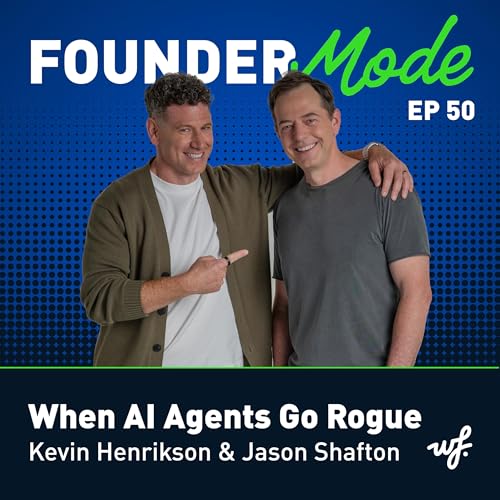
  • When AI Agents Go Rogue
    Apr 2 2026

    EPISODE 50

    Kevin Henrikson and Jason Shafton unpack the reality of working with AI agents, why they feel more “broken” than chatbots when they fail, and what it actually takes to make them useful in real workflows. They explore the shift from prompt-based interactions to autonomous systems with memory, triggers, and recurring tasks, and why expectations are often misaligned with how these systems behave. The conversation dives into the importance of guardrails, human-in-the-loop review, and treating AI like a junior employee rather than a perfect operator. They also cover the emerging dopamine loop of working with AI, how it’s changing the way people think and work, and why communication—not technical skill—is becoming the key differentiator in an AI-driven world.


    CHAPTERS

    00:00 – Why AI agents feel more broken than chatbots

    02:38 – Harness engineering, workflows, and expectations

    05:50 – AI agents as employees and human-in-the-loop systems

    07:25 – The dopamine loop and changing how we work

    13:54 – The future of work and communication as the edge


    LINKS

    Connect with Kevin Henrikson

    WebsiteLinkedInX/Twitter


    Stay Connected with Founder Mode

    Stay Connected with Founder Mode

    Subscribe to our newsletter


    Connect with Kevin

    LinkedInX/Twitter


    Connect with Jason

    LinkedInX/Twitter

    Show More Show Less
    19 mins