• The Man Who Built Modern Soccer in America | Alan Rothenberg
    Jun 22 2026

    With the 2026 FIFA World Cup underway across the United States, Canada and Mexico, there’s no better time to revisit one of the most important conversations we've ever had on Finance of Football.

    Long before MLS, packed soccer-specific stadiums, billion-dollar club valuations, and the arrival of global stars like David Beckham and Lionel Messi, there was Alan Rothenberg.

    As CEO of the 1994 FIFA World Cup, founder of Major League Soccer, former President of U.S. Soccer, and one of the key architects of modern soccer in America, Rothenberg helped transform the sport from a niche interest into one of the fastest-growing sports in the country.

    In this episode, Alan reflects on:

    • How the 1984 Los Angeles Olympics convinced FIFA that America could host the World Cup

    • The strategy behind the groundbreaking 1994 FIFA World Cup

    • Building MLS from scratch

    • The growth of women's soccer and the legacy of the 1999 Women's World Cup

    • Why he believes the World Cup should expand to 64 teams

    • What success looks like for the 2026 FIFA World Cup

    • The future of MLS, media rights, club valuations and soccer investment

    If you've ever wondered how soccer became a major force in the United States, this is the story from the man who helped make it happen.

    #WorldCup2026 #USSoccer #MLS #AlanRothenberg #FinanceOfFootball #FIFAWorldCup #SoccerBusiness #FootballBusiness


    ---


    For more, follow Asli and Michael on Instagram


    Asli - @brefootcontessa

    Michael - @michale.lore


    And follow the show…


    On Instagram - @financeoffootballpod

    On Facebook - /financeoffootball


    ---


    Finance of Football - Nations and Numbers, a Frequency Machine Podcast, is…

    Written, Hosted, and Produced by Asli Pelit and Michael LoRé

    Editing and Sound Design by Ryan Hammond

    Mixing and Mastering by Julian Kwasneski

    Executive Produced by Ryan Hammond, Stacey Book and Avi Glijansky


    ---


    Check out more of Frequency Machine’s podcasts - including Undercover Sports, a show about the wildest sports conspiracy theories, at frequencymachine.com


    See Privacy Policy at https://art19.com/privacy and California Privacy Notice at https://art19.com/privacy#do-not-sell-my-info.

    Show More Show Less
    24 mins
  • Jozy Altidore: USMNT Can Win the 2026 World Cup
    Jun 16 2026

    The 2026 FIFA World Cup is here — and the USMNT has already made a statement.

    In this episode of Finance of Football, Michael is joined by Jozy Altidore, one of the top goal scorers in U.S. soccer history, to break down the pressure, opportunity and expectation around the U.S. men’s national team at a home World Cup.

    After a strong opening performance from the USA, Jozy explains why he believes this team has the talent to make a serious run, how home-field advantage can change a tournament, and why the real legacy of 2026 could be felt for the next 10 to 15 years.

    The conversation also looks at the business and human side of football. With the World Cup expanded to 48 teams and 104 matches, the Club World Cup growing, and the football calendar becoming more crowded than ever, Jozy discusses why player health has to remain central to the conversation.

    Jozy also reflects on representing the United States at the 2010 and 2014 World Cups, preparing for life after football, investing across sports and business, and working as a World Cup analyst for Telemundo.

    From USMNT expectations to player burnout, this episode asks a simple question: how far can the United States really go at its own World Cup?

    ---


    For more, follow Asli and Michael on Instagram


    Asli - @brefootcontessa

    Michael - @michale.lore


    And follow the show…


    On Instagram - @financeoffootballpod

    On Facebook - /financeoffootball


    ---


    Finance of Football - Nations and Numbers, a Frequency Machine Podcast, is…

    Written, Hosted, and Produced by Asli Pelit and Michael LoRé

    Editing and Sound Design by Ryan Hammond

    Mixing and Mastering by Julian Kwasneski

    Executive Produced by Ryan Hammond, Stacey Book and Avi Glijansky


    ---


    Check out more of Frequency Machine’s podcasts - including Undercover Sports, a show about the wildest sports conspiracy theories, at frequencymachine.com


    See Privacy Policy at https://art19.com/privacy and California Privacy Notice at https://art19.com/privacy#do-not-sell-my-info.

    Show More Show Less
    20 mins
  • Why Are 2026 World Cup Tickets So Expensive?
    Jun 8 2026

    Why are 2026 World Cup tickets so expensive?

    With the biggest World Cup in history just days away, FIFA is facing growing criticism over ticket prices, dynamic pricing, seat transparency and the overall fan experience.

    In this episode of Finance of Football, Michael and Asli break down FIFA’s controversial decision to introduce dynamic ticket pricing for the 2026 World Cup — the first time this model has ever been used at the tournament.

    They are joined by Jordy Leiser, co-founder and CEO of Jump, to explain how dynamic pricing actually works, why it has become common in American sports and live entertainment, and why FIFA’s version has created so much frustration among fans.

    The conversation looks at the biggest questions surrounding World Cup tickets right now:

    Why are prices so high?

    Will fans who waited get better deals?

    Why have some ticket categories and seat locations caused backlash?

    Is FIFA protecting itself from the secondary market?

    Could this model work again in Spain, Portugal and Morocco in 2030?

    Jordy also explains why transparency matters so much in ticketing — from hidden fees and unclear seat categories to the trust problem that comes when fans feel like prices are moving without warning.

    Then, in the weekly World Cup update, Michael and Asli discuss two more controversies around the tournament: FIFA’s changing water bottle policy for stadiums in the U.S. and Canada, and reports of World Cup officials, players and team staff facing immigration issues when entering the United States.

    From record FIFA revenue to fan frustration, this episode asks a simple question: has the 2026 World Cup become too expensive for the people it is supposed to bring together?


    ---


    For more, follow Asli and Michael on Instagram


    Asli - @brefootcontessa

    Michael - @michale.lore


    And follow the show…


    On Instagram - @financeoffootballpod

    On Facebook - /financeoffootball


    ---


    Finance of Football - Nations and Numbers, a Frequency Machine Podcast, is…

    Written, Hosted, and Produced by Asli Pelit and Michael LoRé

    Editing and Sound Design by Ryan Hammond

    Mixing and Mastering by Julian Kwasneski

    Executive Produced by Ryan Hammond, Stacey Book and Avi Glijansky


    ---


    Check out more of Frequency Machine’s podcasts - including Undercover Sports, a show about the wildest sports conspiracy theories, at frequencymachine.com


    See Privacy Policy at https://art19.com/privacy and California Privacy Notice at https://art19.com/privacy#do-not-sell-my-info.

    Show More Show Less
    31 mins
  • Home Depot’s Big Bet on Soccer
    Jun 1 2026

    The 2026 FIFA World Cup is almost here — and some of the biggest brands in America are racing to be part of soccer’s biggest moment.

    In this episode of Finance of Football, Michael and Asli look at The Home Depot’s growing investment in the beautiful game, from Arthur Blank’s role in building Atlanta United to the company’s long-running partnerships with MLS, the Mexican national team and U.S. Soccer.

    They are joined by Allison Kolber, Vice President of Integrated Marketing at The Home Depot, to break down why soccer has become such an important part of the brand’s strategy.

    The conversation explores how Home Depot is using the World Cup to reach millennial homeowners, Gen-Z fans, Hispanic audiences and pro customers — and why the tournament creates a rare opportunity to connect soccer, community and home improvement.

    Allison also discusses Home Depot’s campaign with David Beckham, how “Beckham’s Backyard” will come to life during the tournament, and why physical fan activations across the U.S., Canada and Mexico matter so much for sponsors.

    Michael and Asli also ask what happens after the World Cup ends. Can brands keep fans engaged once the final is over? Or will soccer face the usual post-tournament dip?

    Finally, in the weekly World Cup update, they break down FIFA’s new push to punish time-wasting more seriously, including countdowns on goal kicks and throw-ins, and the viral story of New Zealand defender Tim Payne, who became an overnight sensation after an Argentine content creator helped turn him into the least-followed-player-turned-social-media-star of the tournament.

    From Arthur Blank’s soccer empire to Home Depot’s World Cup strategy, this episode asks a simple question: what does it really take to build soccer in America?


    ---


    For more, follow Asli and Michael on Instagram


    Asli - @brefootcontessa

    Michael - @michale.lore


    And follow the show…


    On Instagram - @financeoffootballpod

    On Facebook - /financeoffootball


    ---


    Finance of Football - Nations and Numbers, a Frequency Machine Podcast, is…

    Written, Hosted, and Produced by Asli Pelit and Michael LoRé

    Editing and Sound Design by Ryan Hammond

    Mixing and Mastering by Julian Kwasneski

    Executive Produced by Ryan Hammond, Stacey Book and Avi Glijansky


    ---


    Check out more of Frequency Machine’s podcasts - including Undercover Sports, a show about the wildest sports conspiracy theories, at frequencymachine.com

    See Privacy Policy at https://art19.com/privacy and California Privacy Notice at https://art19.com/privacy#do-not-sell-my-info.

    Show More Show Less
    23 mins
  • Nations & Numbers: Group L — The Financial, Cultural and Commercial Stakes of the 2026 World Cup
    May 28 2026

    In this episode of Nations & Numbers, we break down Group L at the 2026 FIFA World Cup: England, Croatia, Ghana and Panama.

    England enters the tournament with one of the most valuable squads in world football, the power of the Premier League behind it, and the pressure of a nation still waiting for football to truly come home. With stars like Jude Bellingham, Bukayo Saka, Declan Rice and Harry Kane, England has the talent, commercial power and global attention to make a major statement.

    Croatia arrives as one of international football’s most consistent tournament teams. After reaching the 2018 World Cup final and finishing third in 2022, Croatia can no longer be treated as a dark horse. For a small country, its ability to produce elite players and compete on the biggest stage has become one of football’s great modern success stories.

    Ghana brings history, heartbreak and huge African football pride. From the drama of the 2010 World Cup quarterfinal against Uruguay to generations of elite talent moving into Europe’s biggest leagues, Ghana remains one of Africa’s most important football nations. Now, a new generation has the chance to restore the Black Stars on the global stage.

    Panama returns to the World Cup for the second time, and the first since 2018. For a nation of around four million people, qualification is another major moment of visibility and pride. Panama may not have the global superstars of other teams in the group, but its identity, discipline and organization make it a difficult opponent.

    This is what makes Group L so compelling: England brings pressure and Premier League power, Croatia brings proven tournament pedigree, Ghana brings African football history and emotion, and Panama brings national pride and the chance to prove it belongs.

    If you care about the business of football and the real stakes behind the World Cup, this is for you.

    Subscribe for more Nations & Numbers as we break down every group at the 2026 FIFA World Cup.


    ---


    For more, follow Asli and Michael on Instagram


    Asli - @brefootcontessa

    Michael - @michale.lore


    And follow the show…


    On Instagram - @financeoffootballpod

    On Facebook - /financeoffootball


    ---


    Finance of Football - Nations and Numbers, a Frequency Machine Podcast, is…

    Written, Hosted, and Produced by Asli Pelit and Michael LoRé

    Editing and Sound Design by Ryan Hammond

    Mixing and Mastering by Julian Kwasneski

    Executive Produced by Ryan Hammond, Stacey Book and Avi Glijansky


    ---


    Check out more of Frequency Machine’s podcasts - including Undercover Sports, a show about the wildest sports conspiracy theories, at frequencymachine.com


    See Privacy Policy at https://art19.com/privacy and California Privacy Notice at https://art19.com/privacy#do-not-sell-my-info.

    Show More Show Less
    12 mins
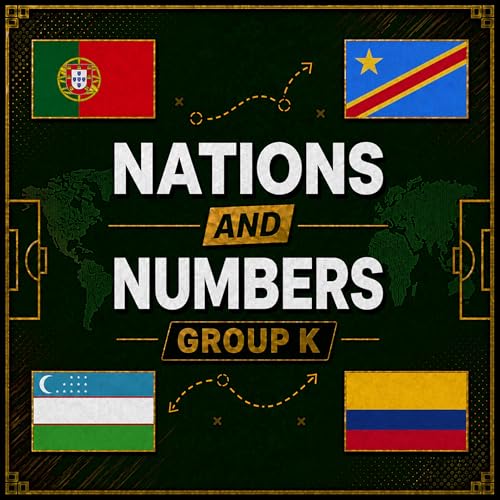
  • Nations & Numbers: Group K — The Financial, Cultural and Commercial Stakes of the 2026 World Cup
    May 27 2026

    In this episode of Nations & Numbers, we break down Group K at the 2026 FIFA World Cup: DR Congo, Portugal, Uzbekistan and Colombia.

    DR Congo returns to the World Cup for the first time since 1974, carrying one of the strongest emotional and financial stories of the expanded tournament. As the poorest country in the 2026 World Cup by GDP per capita, its guaranteed FIFA payout of at least $12.5 million could mean more here than almost anywhere else.

    Portugal arrives with Cristiano Ronaldo, one of the most marketable athletes on the planet, chasing the one major trophy still missing from his career. But Portugal’s story is bigger than Ronaldo. It is also one of world football’s great player development and transfer machines, and a country already looking ahead to co-hosting the 2030 World Cup.

    Uzbekistan makes its first-ever World Cup appearance, giving Central Asia a major moment on football’s biggest stage. For a country that has invested in youth football, infrastructure and national branding, qualification offers money, visibility and soft power.

    Colombia brings passion, talent and drama. With stars like James Rodríguez and Luis Díaz, a huge global fan base and one of South America’s strongest talent pipelines, Colombia could make Group K one of the most entertaining groups of the tournament.

    This is what makes Group K so compelling: DR Congo brings the case for expansion, Portugal brings legacy and commercial power, Uzbekistan brings a new market, and Colombia brings emotion, talent and global fan energy.

    If you care about the business of football and the real stakes behind the World Cup, this is for you.

    Subscribe for more Nations & Numbers as we break down every group at the 2026 FIFA World Cup.

    ---


    For more, follow Asli and Michael on Instagram


    Asli - @brefootcontessa

    Michael - @michale.lore


    And follow the show…


    On Instagram - @financeoffootballpod

    On Facebook - /financeoffootball


    ---


    Finance of Football - Nations and Numbers, a Frequency Machine Podcast, is…

    Written, Hosted, and Produced by Asli Pelit and Michael LoRé

    Editing and Sound Design by Ryan Hammond

    Mixing and Mastering by Julian Kwasneski

    Executive Produced by Ryan Hammond, Stacey Book and Avi Glijansky


    ---


    Check out more of Frequency Machine’s podcasts - including Undercover Sports, a show about the wildest sports conspiracy theories, at frequencymachine.com


    See Privacy Policy at https://art19.com/privacy and California Privacy Notice at https://art19.com/privacy#do-not-sell-my-info.

    Show More Show Less
    14 mins
  • The Richest Match in Football
    May 25 2026

    The Championship playoff final is often called the richest match in football.

    This year, Hull City beat Middlesbrough at Wembley Stadium to win promotion to the Premier League — and unlock roughly $275 million in broadcast and commercial revenue over the next three seasons.

    In this episode of Finance of Football, Michael and Asli break down why promotion to the Premier League is about far more than sporting glory. From TV revenue and parachute payments to global exposure, new sponsors and survival in one of the most competitive leagues in the world, the episode looks at how one result can change the financial future of a club.

    They also explore why promotion and relegation create a level of drama that American sports rarely match, comparing Hull City’s rise with Wrexham’s Hollywood-backed climb through the English football pyramid.

    Then, the episode turns to the UEFA Women’s Champions League final, where Barcelona beat Lyon 4–0 to win their fourth European title in six years and strengthen their place as the dominant force in women’s football.

    Michael and Asli discuss what the result means for Michele Kang’s multi-club ambitions, why UEFA is watching multi-club ownership so closely, and how the financial gap between the men’s and women’s Champions League remains huge — even as the women’s game continues to grow.

    Finally, in the weekly World Cup update, they look at New York’s affordable 2026 World Cup ticket lottery and Iran’s decision to relocate its tournament base from Arizona to Mexico amid rising political tensions.

    From Hull City’s $275 million promotion prize to Barcelona’s women’s football dynasty and FIFA’s accessibility problem, this episode asks a simple question: who really wins when football’s biggest games become financial jackpots?


    ---


    For more, follow Asli and Michael on Instagram


    Asli - @brefootcontessa

    Michael - @michale.lore


    And follow the show…


    On Instagram - @financeoffootballpod

    On Facebook - /financeoffootball


    ---


    Finance of Football - Nations and Numbers, a Frequency Machine Podcast, is…

    Written, Hosted, and Produced by Asli Pelit and Michael LoRé

    Editing and Sound Design by Ryan Hammond

    Mixing and Mastering by Julian Kwasneski

    Executive Produced by Ryan Hammond, Stacey Book and Avi Glijansky


    ---


    Check out more of Frequency Machine’s podcasts - including Undercover Sports, a show about the wildest sports conspiracy theories, at frequencymachine.com


    See Privacy Policy at https://art19.com/privacy and California Privacy Notice at https://art19.com/privacy#do-not-sell-my-info.

    Show More Show Less
    20 mins
  • Nations & Numbers: Group J — The Financial, Cultural and Commercial Stakes of the 2026 World Cup
    May 23 2026

    In this episode of Nations & Numbers, we break down Argentina, Algeria, Austria and Jordan — four nations with very different football identities, but major financial, cultural and commercial stakes at the 2026 FIFA World Cup.

    Argentina enters Group J as the defending World Cup champion and one of the most commercially powerful national teams in football. After Lionel Messi lifted the trophy in Qatar in 2022, Argentina did not just reclaim the game’s biggest prize — it became a global marketing machine. With sponsorship deals expanding across Asia, the Middle East, India, the Americas and especially the United States, the Argentine Football Association has turned World Cup success and Messi’s popularity into major commercial momentum.

    Messi’s move to MLS makes that US connection even bigger. Ahead of a World Cup hosted partly in the United States, Argentina now has a unique bridge into American soccer culture. Whether or not they win again, Argentina already looks like one of the biggest winners of this World Cup cycle.

    Algeria returns with a football history that deserves more attention. As Africa’s largest country by area, with a huge football culture and proud national team identity, Algeria comes into 2026 looking to make its mark. With many players shaped by European football systems and French-Algerian heritage, this team has real potential — and a matchup against Argentina gives them a chance to create one of the defining moments of the group.

    Austria arrives with one of the strangest World Cup histories in the field. There is the glory of 1954, when Austria finished third and played in the highest-scoring match in World Cup history. But there is also the infamous 1982 match against West Germany, a result that helped eliminate Algeria and led FIFA to change the scheduling rules for final group-stage games.

    For Austria, 2026 is a chance to write a new chapter and reshape how the country is remembered on the World Cup stage.

    And then there’s Jordan — one of the most emotional stories in the group. After 40 years of trying, Jordan has finally reached football’s biggest stage. Their qualification is about far more than prize money. It is about visibility, infrastructure, youth development, national pride and changing how Jordanian football is seen across Asia and the wider world.

    This is what makes Group J so compelling —

    the defending champions chasing another era of dominance, an African football nation with major history, a European side trying to rewrite its World Cup identity, and a first-time qualifier with everything to gain.

    If you care about the business of football and the real stakes behind the World Cup, this is for you.

    Subscribe for more Nations & Numbers as we break down every group at the 2026 FIFA World Cup.


    See Privacy Policy at https://art19.com/privacy and California Privacy Notice at https://art19.com/privacy#do-not-sell-my-info.

    Show More Show Less
    12 mins