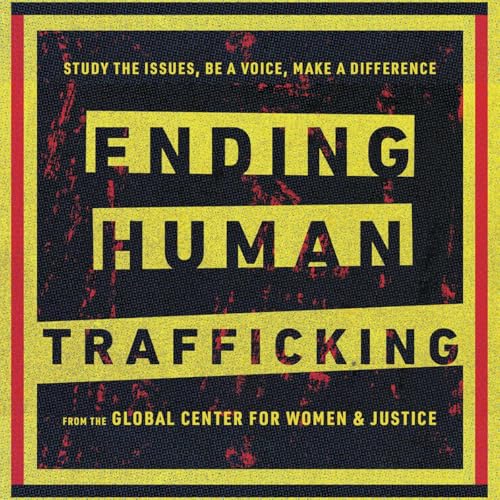
Ending Human Trafficking cover art

Ending Human Trafficking

Ending Human Trafficking

By: Dr. Sandra Morgan
Listen for free

The Global Center for Women and Justice launched the Ending Human Trafficking podcast in April 2011. Our mantra is Study the Issues. Be a voice. Make a difference. We believe that if you do not study first, you may say or do the wrong thing. The National Family and Youth Services Clearinghouse promoted EHT as “a good way to get up to speed on human trafficking”. Our audience includes students, community leaders, and even government leaders. EHT listeners come from all corners of the world, which accomplishes our mission of building a global community that works together to end human exploitation.Ending Human Trafficking Christianity Economics Management Management & Leadership Spirituality
Episodes
  • 372: How Traffickers Use TikTok the Same Way Brands Do
    Jun 1 2026

    Christa Wiens joins Dr. Sandie Morgan as they explore why the answer to online exploitation isn't the perfect parental control — it's helping young people recognize manipulation, build critical thinking skills, and know who they can safely turn to when something feels off.


    About Christa Wiens


    Christa Wiens is the Executive Director of the Central Valley Justice Coalition, a California-based nonprofit focused on preventing human trafficking through education, outreach, and community collaboration. She has spent over a decade in the anti-trafficking field, beginning her career with the Justice Coalition as an Education Coordinator, where she developed and delivered training programs that reached thousands of youth and adults across the Central Valley. She stepped into the Executive Director role in 2022 and has continued to expand the organization's reach and impact.


    Christa is the author of the Understanding Human Trafficking series and has contributed to multiple publications on trafficking awareness and prevention. Her work frequently intersects with faith communities, education systems, and local stakeholders, where she advocates for proactive, trauma-informed approaches and stronger preventive frameworks. She holds a Master of Arts in Ministry, Leadership, and Culture from Fresno Pacific Biblical Seminary.


    Chapters


    Key Points


    • Traffickers have adopted the exact same cross-platform influencer model that legitimate brands use — and parents who don't recognize it are missing how exploitation actually operates online.

    • Looking for the "right app" or "right setting" to protect kids is chasing the wind; what's actually needed are better relational tools for conversation, not better technical controls.

    • Social media platforms are engineered to maximize engagement, which makes our kids the product — and platforms like TikTok deliberately change what they show users the moment they turn 18.

    • The most effective protective posture isn't imposing rules but asking open-ended hypothetical questions ("What would you do if...?") so kids see parents as safe, curious allies rather than authorities who will punish them.

    • Building agency means using the language of "when you make a mistake" rather than "if" — signaling that mistakes are expected, that kids won't be abandoned when they happen, and that they can always come back to a trusted adult.

    • The driver's permit is a powerful analogy for devices: we don't hand teenagers keys and say "best of luck" — we graduate access gradually, narrate the dangers, and teach them to recognize the red flags, like content that makes them feel big, urgent emotions.

    • Youth in foster care and system involvement are especially vulnerable online because they often lack a trusted adult — equipping care providers with conversation tools and connecting youth to resources like NCMEC's Take It Down are critical protective steps.

    • Young people who receive trafficking prevention education report a profound sense of relief — they knew something was off but had no language for it — and once equipped, they become peer educators and advocates in their own communities.


    Resources


    • Central Valley Justice Coalition

    • NCMEC Take It Down

    • National Center for Missing & Exploited Children

    • PACT 2025 Reignite Convening

    Show More Show Less
    30 mins
  • 371: Why Strong Trafficking Laws Still Miss Real Victims
    May 15 2026

    Dr. Heracles Moskoff joins Dr. Sandie Morgan to explore what happens after a country builds the laws, shelters, and partnerships meant to protect people — and why outcomes still depend on whether someone, somewhere, recognizes what others overlook.


    Chapters


    About Dr. Heracles Moskoff


    Dr. Heracles Moskoff serves as Secretary General for Vulnerable Persons and Institutional Protection at Greece's Ministry of Migration and Asylum, a role he assumed in July 2023. He previously served as Special Secretary for the Protection of Unaccompanied Minors (2021–2023), overseeing the implementation of Greece's National Guardianship System and frameworks for the accommodation and protection of unaccompanied children. With over two decades of experience in migration policy, human security, and anti-trafficking efforts, Dr. Moskoff has held roles within Greece's Ministry of Foreign Affairs since 2001, including as Expert Counselor on Human Security. In 2013, he was appointed National Rapporteur on Combating Trafficking in Human Beings, coordinating Greece's National Referral Mechanism and National Action Plan (2018–2022). He represents Greece at the EU, United Nations, Council of Europe, and OSCE. He holds a PhD in Sociology from the London School of Economics.


    Key Points


    • Most countries have robust anti-trafficking legal frameworks, but the real gap is “national ownership” — the capacity of frontline professionals to recognize indicators when victims do not self-identify.

    • Faith communities and faith-based NGOs are essential partners because they reach both potential victims and the demand side at an existential level that law enforcement cannot.

    • Greece's National Emergency Response Mechanism — a 24/7 hotline with mobile units — has helped recover more than 10,000 unaccompanied children over the last five years.

    • A culture of impunity persists worldwide: only a small percentage of victims are identified and only a small percentage of perpetrators face justice; the identification chain has to extend beyond police to medical, migration, and public administration professionals.

    • Trafficking is not only the textbook case — the “gray area” of dirty, difficult, dangerous informal work for unaccompanied minors is its own form of exploitation, often tolerated by enforcement.

    • Consumer demand and corporate supply chains require regulation with real teeth; well-intentioned laws like the California Transparency in Supply Chains Act remain under-enforced, and Greece faces the same gap.

    • A new presidential decree authorizes new departments dedicated to anti-trafficking and gender-based violence, including planned shelters for male victims and victims of forced labor.

    • Survivors of forced criminality carry trauma alongside extraordinary resilience; with proper mental health support, integration can produce what Dr. Moskoff calls “a miracle of integration.”


    Resources


    • Global Center for Women and Justice

    • Greece Ministry of Migration and Asylum

    • Greece National Emergency Response Mechanism (for unaccompanied minors)

    • EU Pact on Migration and Asylum

    • United Nations Convention against Transnational Organized Crime

    • California Transparency in Supply Chains Act

    Show More Show Less
    33 mins
  • 370: Why Mentorship Fails Without Shared Lived Experience
    May 11 2026

    Martha Trujillo joins Dr. Sandie Morgan to ask what changes when communities stop seeing vulnerable youth as problems to be managed and start seeing them as young people in need of support.


    About Martha Trujillo

    Martha Trujillo is the founder of Full Circle Orange County, an organization dedicated to supporting risk-impacted and at-risk students through mentorship, education, and community. Her work is informed by lived experience: she grew up in Orange County and faced significant challenges as a young person, including foster care, gang involvement, expulsion from school, juvenile detention, substance use, and victimization. She now uses her story to guide and empower students facing similar obstacles. Trujillo holds a master’s degree in criminology from UC Irvine and a bachelor’s degree in criminal justice from California State University, Fullerton, and is preparing to pursue a doctorate in education at UC Irvine. Through Full Circle, she practices “diversion through mentorship,” combining workshops, re-entry support, and one-on-one guidance for youth in schools, group homes, and detention centers across Orange County and beyond.


    Chapters

    • (00:00) - Introduction
    • (01:09) - Know More, Do Better and Full Circle Orange County
    • (05:50) - Martha's Journey: Foster Care, Gangs, and Juvenile Hall
    • (12:49) - Feeding Before Teaching: An Approach Built on Lived Experience
    • (15:39) - Why Prevention Must Start Earlier
    • (21:15) - Mentorship, Lived Experience, and Dual Status Kids
    • (27:53) - Hopes for Full Circle and Coming Full Circle


    Key Points

    • Full Circle Orange County’s mission is preventing youth incarceration in adulthood by helping kids be identified early as victims rather than written off as criminals.

    • Martha’s “feeding before teaching” approach — breaking bread with youth before any workshop — builds trust and recognizes the unmet basic needs that often shape kids’ behavior.

    • Lived experience is one of three pillars (alongside academic training and direct work with youth) that shapes how Martha builds rapport with students no one else has been able to reach.

    • Early human trafficking prevention should begin between ages 9 and 14, in language that’s age-appropriate but not avoidant — and not reserved only for kids in poverty-stricken environments.

    • “Dual status” youth (both foster and probation-involved) need support that recognizes them as children first, not as labels — and the juvenile justice system has resources to help them, if we use them well.

    • Mentors who share appropriate pieces of their own story give kids something to relate to; without that connection, real rapport is rarely possible.

    • Survivors going through religious rites of passage may be carrying hidden trauma; faith communities have a vital role in trauma-informed prevention conversations.

    • Coming full circle: Martha was expelled from Nicolas Junior High in eighth grade — and years later returned to receive an honorary promotion certificate alongside its current eighth graders.


    Resources

    • Full Circle Orange County

    • Know More, Do Better (OC Human Trafficking Task Force)

    • Global Center for Women and Justice (Vanguard University)

    • CASA of Orange County

    Show More Show Less
    36 mins
adbl_web_anon_alc_button_suppression_t1
No reviews yet