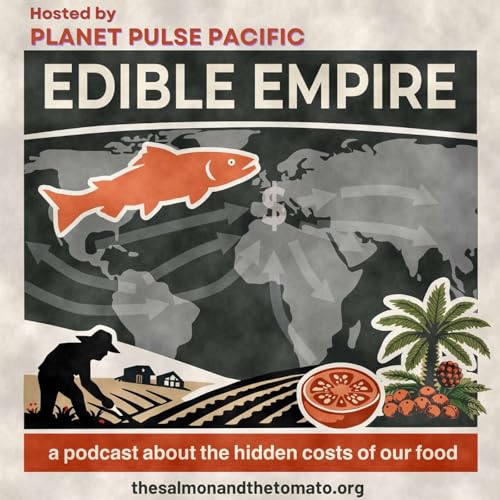
Edible Empire cover art

Edible Empire

Edible Empire

By: Planet Pulse Pacific
Listen for free

Planet Pulse Pacific—your go-to podcast for conversations about people and planet—is proud to host a special series: Edible Empire.


As the climate and global health crises intensify, the need for meaningful change has never been more urgent. This six-episode series brings together leading voices from around the world to explore the concept of food imperialism, uncover the hidden social and environmental costs of what we eat, and examine how we can build a more just and sustainable food system.


Join your hosts, Ben Eitelberg and Emma Strutt, alongside special series co-host Dr Neal Haddaway, as they dive into the complex and often unseen world of food—how it is produced, traded, and consumed across the globe. Kelly Allum edits the series.

© 2026 Edible Empire
Science
Episodes
  • Edible Empire: Prologue
    Jun 28 2026

    Welcome to Edible Empire - hosted by Planet Pulse Pacific, this is a podcast series about the hidden cost of our food. We’re your co-hosts, Neal Haddaway, Benjamin Eitelberg, and Emma Strutt, with Kelly Allum on editing.

    When we talk about food, we tend to focus on recipes, flavours and dinner times. But what we rarely discuss is where our food comes from. And we don’t mean which supermarket - we mean the ingredients that make up our food: where did they come from, who grew the vegetables, picked the fruit and processed the oils? What’s life like for them, and what does their environment look like as a result of what they’re exporting for us to eat?

    From the plantations of the British Empire to the smart agriculture within ultra-modern greenhouses, food has always been a tool of power and of profit. This is a story of how some cultures were dismantled to feed others, and how those empires live on through corporate control - this is a podcast about Food Imperialism. This series explores the complex, often uncomfortable intersection of appetite and authority. We are looking at food imperialism: how the quest for calories and commodities reshaped the map, redefined our identities, and continues to influence who gets to eat, and what, in the twenty-first century.

    In this introductory episode, we introduce the concept of food imperialism and the inspiration for this species series. We discuss some of the upcoming content we’ll be publishing in the coming weeks, along with our exciting, world-leading expert guests.

    Join us for an appetiser!

    Make sure you subscribe so you don’t miss out on the next episode!

    Resources from this episode:

    • https://www.thesalmonandthetomato.org

    To view all the links to the websites and documents, visit the show notes on our website.

    Please support our work and enable us to deliver more content by buying us a coffee or becoming a member of Athletes for Nature.
    Follow us on Instagram and Facebook, subscribe to this podcast, and share this episode with your friends and family.

    Show More Show Less
    39 mins
  • Kal Glanznig - Blue Minds Youth Ocean Leadership
    May 3 2026

    Kal Glanznig is one of Australia’s leading youth ocean and climate champions, a true powerhouse inspiring a new generation of hopeful, action-driven environmental leaders. In the past year alone, he has reached more than 20,000 people through keynote talks, school programs, and Q&A screenings of his documentary Rising Up. Elected in 2024 as the youngest independent Councillor in the Sutherland Shire, he is now driving local climate action through practical and forward-thinking sustainability initiatives.

    Kal first made headlines in high school after delivering a $100,000 solar project that inspired more than 20 schools to follow suit. He went on to co-found Plastic Free Cronulla, contributing to New South Wales’ ban on single-use plastics, and Blue Minds, a national program supporting young Australians with eco-anxiety and environmental leadership. An award-winning speaker, he has also represented Australia in water polo at the Youth World Championships. Kal reminds us that while no one person can change the world alone, the future is still unwritten—and every action we take creates a ripple. Take a listen and feel inspired to be part of that change.

    In this episode, we discuss:

    • Kal’s background in high-level sport and how it sparked his passion for the environment
    • Why meaningful change starts at home, no matter how wicked the problem
    • His documentary Rising Up, including its screening at COP30 in Brazil and its role in sharing Pacific stories
    • Driving change through the ballot box and his journey into local council
    • The importance of genuinely engaging young people, and the powerful perspectives they bring
    • The role of athletes in activism and advocacy
    • Eco-anxiety and its impact on young people, and how Blue Minds is helping build resilience and leadership
    • Key lessons Kal has learned from young people, and his advice for those wanting to make a difference in their communities
    • Why we don’t have to do everything, but we can all do something, starting in our own backyard
    • What’s next for Blue Minds and his upcoming documentary, The Plastic Country

    To view all the links to the websites and documents, visit the show notes on our website.

    Please support our work and enable us to deliver more content by buying us a coffee or becoming a member of Athletes for Nature.
    Follow us on Instagram and Facebook, subscribe to this podcast, and share this episode with your friends and family.

    Show More Show Less
    40 mins
  • Dr Kate Wylie - The Health Hazards of Water Bankruptcy
    Apr 19 2026

    In this episode, we’re joined by Dr Kate Wylie, GP and Executive Director of Doctors for the Environment Australia, and a long-time friend of the show. One of Australia’s leading voices on climate and health, Kate helps us unpack the United Nations’ Global Water Bankruptcy report and what it means for all of us.

    Put simply: we are running out of water. We’re using more than we have in supply, so much that in many places we’re pushing past the point of recovery and can’t repay our debts. Driven by climate change, over-extraction, and pollution, this growing ‘water bankruptcy’ is fuelling food and water insecurity, disease, and deepening global inequities.

    Closer to home, we explore what this looks like in Australia, from the declining Murray-Darling to pressures on the Great Artesian Basin, and why this crisis is as much about public health as it is about the environment.

    A sharp, urgent conversation about one of the defining challenges of our time and the role we all must play in protecting the resource that underpins life itself.

    In this episode, we discuss:

    • Kate’s background and her work at the intersection of human and planetary health
    • The UN’s Global Water Bankruptcy report and Kate’s recent InSight+ article outlining what this means for us in Australia
    • Our unsustainable water use and the industries driving the greatest extraction
    • The deep inequities of water insecurity, with the Global South bearing the greatest burden
    • Key health concerns, including unsafe drinking water, food insecurity, and the mental health effects of drought
    • Rising risks of vector-borne diseases like Malaria, Dengue Fever, and Ross River Virus
    • The dual extremes of drought and flooding, and their impact on food systems and livelihoods
    • Australia’s unique challenges as the driest inhabited continent, and the need for more sustainable agriculture
    • Growing strain on critical systems, from the Murray-Darling Basin to the Great Artesian Basin, and flow-on effects like South Australia’s algal bloom
    • The hidden water and energy costs of modern technology, including AI and cloud computing, and why we can’t ‘tech’ our way out of this
    • The critical role of health professionals in advocating for climate and water security
    • Why climate and environmental health must be embedded in medical education
    • The vital work of Doctors for the Environment Australia and their latest advocacy efforts, including an open letter to Australian governments calling for an end to our dependence on global oil—add your name to the submission here

    To view all the links to the websites and documents, visit the show notes on our website.

    Please support our work and enable us to deliver more content by buying us a coffee or becoming a member of Athletes for Nature.
    Follow us on Instagram and Facebook, subscribe to this podcast, and share this episode with your friends and family.

    Show More Show Less
    44 mins
adbl_web_anon_alc_button_suppression_t1
No reviews yet