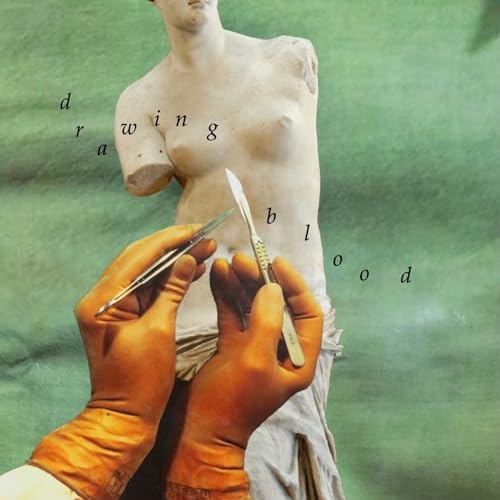
Drawing Blood cover art

Drawing Blood

Drawing Blood

By: Drawing Blood
Listen for free

About this listen

Welcome to Drawing Blood, the podcast about art, science, and the macabre, hosted by Emma Merkling and Christy Slobogin.Emma Merkling and Christy Slobogin Art Science Social Sciences
Episodes
  • Update (and Hello!)
    Feb 19 2026

    You've likely noticed that we've been on bit of a hiatus - but we're still committed to the Drawing Blood project and we're hoping to come back with a new season soon!

    In the meantime, we're on the lookout for someone to help us outfit the pod with new music as we move forward. If that's you, get in touch with us at drawingbloodpodcast@gmail.com.

    Thanks for listening! Keep sharing with your friends and enemies!

    Show More Show Less
    1 min
  • S3 Ep6: Seeing Voices, Margaret Watts Hughes, and the Science of the Invisible
    Sep 30 2024
    Emma and Christy discover Margaret Watts Hughes's beautiful 'voice figures', a series of images made through the direct action of her voice between 1885 and 1904. In this episode, we discuss the earliest sound recordings, scientific 'instruments' (it's a pun), cat pianos, severed ears, occult science, seaweed scrapbooks, women in STEM, logos and the word of God, visualising the invisible, the Little Mermaid, clairvoyant research, 'thought forms' and the death agonies of pigeons, science and feeling, and why sonic media is always already haunted.CLICK HERE TO VIEW THE IMAGES WE DISCUSS, as well as complete show notes, references, and suggestions for further reading.MEDIA DISCUSSEDMargaret Watts Hughes, Impression Figure (c. 1904), courtesy of Cyfarthfa Castle Museum and Art GalleryMargaret Watts Hughes, Tree Form (before 1904)Portrait miniature example: Nicholas Hilliard, Queen Elizabeth I(1572)Anna Atkins, Dictyota Dichotomy (Forkweed) (1848)Illustration from Margaret Watts Hughes, ‘Visible Sound: Voice-Figures’, Century Magazine (1891)Margaret Watts Hughes's eidophoneExample of page from an algae or seaweed scrapbook by Eliza A. Jordan (1848)Georgiana Houghton, Glory Be to God (1864)‘Phonautography of the human voice at a distance’ (lines of recorded sound generated by Scott de Martinville’s ‘phonautograph’, 1857)The graphic method: Étienne-Jules Marey's sphygmograph (a predecessor of modern EKG machines, 1881)Louis Bertrand Castel’s ‘ocular harpsichord’ (1725)Isaac Newton's colour spectrum and musical scale analogy (1675)The cat piano (illustration from La Nature, 1883)The ‘ear phonograph’ of Alexander Graham Bell and Clarence J. Blake (1874), 2018 model by the Science MuseumJan Van Eyck, detail from Annunciation (c. 1434–36)Simone Martini and Lippo Memmi, detail from The Annunciation showing raised gold lettering (1333)Hippolyte Baraduc, two cameraless photographs showing various feelings ('restless desire to have phenomena of the hereafter'; 'mental sadness'), 1894–1913‘The Music of Gounod’, illustration from Annie Besant and Charles Leadbeater's Thought Forms (1901)‘Aspiration to Enfold All’, illustration from Annie Besant and Charles Leadbeater's Thought Forms (1901)‘Radiating Affection’, illustration from Annie Besant and Charles Leadbeater's Thought Forms (1901)‘The Intention to Know’, illustration from Annie Besant and Charles Leadbeater, Thought Forms (1901)Illustration from Annie Besant and Charles Leadbeater's Occult Chemistry (1908)Follow our Twitter @drawingblood_Follow our Blue Sky @drawingbloodpod.bsky.social‘Drawing Blood’ cover art © Emma Merkling, image courtesy of the British Association of Plastic, Reconstructive, and Aesthetic SurgeonsAll audio content © Emma Merkling and Christy SloboginIntro music: ‘There Will Be Blood’ by Kim Petras, © BunHead Records 2019. We’re still trying to get hold of permissions for this song – Kim Petras text us back!!
    Show More Show Less
    58 mins
  • S3 Ep5: David Cronenberg's 'Crimes of the Future', Surgery, and Performance Art
    Aug 31 2024
    Emma and Christy watch David Cronenberg’s 2022 film Crimes of the Future, exploring the themes of this work while also connecting to some of the director’s earlier movies. In this episode, we discuss the fears and the pleasures of the human body and cutting into it; surgery as sex; Cronenbergian body horror; the monstrous as art; being and becoming cyborgs; evolution and pain; technology as prosthesis; the posthuman; contemporary performance art (good and bad); the cosmetic gaze; the body as text; and meaning making.CLICK HERE TO VIEW THE IMAGES WE DISCUSS, as well as complete show notes, references, and suggestions for further reading.MEDIA DISCUSSEDDavid Cronenberg, dir., Crimes of the Future (2022)First scene with boy playing on beach, cruise ship overturned in waterSaul Tenser in the Orchid BedTVs showing ‘BODY IS REALITY’ during Saul and Caprice’s performanceScuttling, insect-like bureaucrats of the National Organ RegistryBureaucrat of the National Organ Registry telling Saul that ‘surgery is new sex’David Cronenberg, dir., Crash (1996)Saul Tenser in the BreakFaster ChairSaul Tenser’s facial expression at the end of the filmGian Lorenzo Bernini, The Ecstasy of Saint Theresa (1652)David Cronenberg, dir., Videodrome (1983)The hand-gun in VideodromeDavid Cronenberg, dir., The Fly (1986)Odile (decorative surgery) performance artKlinek (ear man) performance artORLAN, The Reincarnation of Saint Orlan (1990-1993)Stelarc, Ear on Arm (2007 - )The Swan reality show (2004)The autopsy scene Follow our Twitter @drawingblood_Follow our Blue Sky @drawingbloodpod.bsky.social‘Drawing Blood’ cover art © Emma Merkling, image courtesy of the British Association of Plastic, Reconstructive, and Aesthetic SurgeonsAll audio content © Emma Merkling and Christy SloboginIntro music: ‘There Will Be Blood’ by Kim Petras, © BunHead Records 2019. We’re still trying to get hold of permissions for this song – Kim Petras text us back!!
    Show More Show Less
    1 hr and 4 mins
No reviews yet