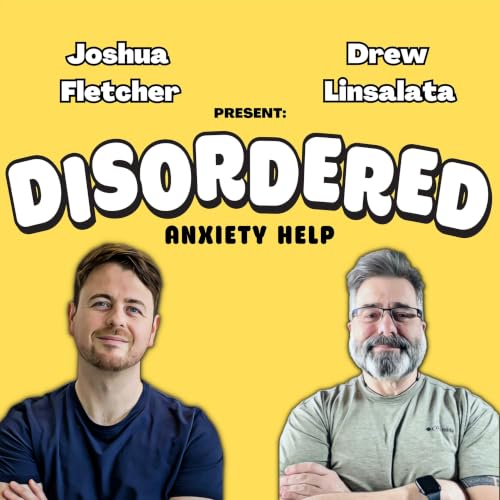
Disordered: Anxiety Help cover art

Disordered: Anxiety Help

Disordered: Anxiety Help

By: Josh Fletcher and Drew Linsalata
Listen for free

Summary

Disordered is the podcast that delivers real, evidence-based, actionable talk about anxiety disorders and anxiety recovery in a kind, compassionate, community-oriented environment. Josh Fletcher is a qualified psychotherapist in the UK. Drew Linsalata is a therapist practicing under supervision in the US. They're both bestselling authors in the anxiety and mental health space. Josh and Drew are funny, friendly, and they have a knack for combining lived experience, formal training, and professional experience in an encouraging, inspiring, and compassionate mental health message.Josh Fletcher and Drew Linsalata Hygiene & Healthy Living Psychology Psychology & Mental Health
Episodes
  • Taboo OCD Themes (Episode 155)
    May 15 2026

    OCD is a difficult condition to navigate, but it becomes significantly more challenging when obsessions center on taboo topics. Themes involving harm, pedophilia (pOCD), sexual orientation (HOCD), or moral and religious failure often carry a heavy burden of shame. This shame frequently drives people into silence, preventing them from seeking the help they need.


    ---

    Want to talk about this episode with Drew, Josh, and other members of the Disordered community that share your struggle?

    https://disordered.fm/community

    ---

    In this episode, Drew is joined by Jess Marriner, an OCD specialist based in the UK. They discuss why the human brain can latch onto these specific themes and why having a "taboo" thought does not reflect your character or your actual desires.

    Key Topics Discussed:

    • The Nature of Taboo Thoughts: Recognizing that intrusive thoughts about harm or socially unacceptable acts are common mental occurrences and do not make you a dangerous person.

    • The Role of Shame: How the socially unacceptable nature of these themes feeds the OCD cycle and keeps sufferers isolated.

    • Common Compulsions: Identifying sneaky mental rituals like reassurance seeking, thought neutralizing, and "testing" to see if a thought feels true.

    • Exposure and Response Prevention (ERP): How to approach treatment by leaning into the discomfort and uncertainty rather than fighting the content of the thoughts.

    • The Goal of Recovery: Moving from a state of constant panic and checking to a place where thoughts are seen as irrelevant mental noise.

    If you are struggling with taboo obsessions, this conversation highlights that you are not alone and that recovery is possible through evidence-based approaches like ERP and acceptance-based strategies.

    ---

    The Disordered Guide to Health Anxiety is now available. If you're struggling with health anxiety, this book is for you.

    ---

    Struggling with worry and rumination that you feel you can't stop or control? Check out ⁠⁠⁠⁠⁠⁠⁠⁠⁠⁠⁠⁠⁠⁠⁠⁠⁠⁠⁠⁠⁠⁠⁠⁠⁠⁠⁠⁠⁠⁠⁠⁠⁠⁠⁠⁠⁠⁠⁠⁠⁠⁠⁠Worry and Rumination Explained⁠⁠⁠⁠⁠⁠⁠⁠⁠⁠⁠⁠⁠⁠⁠⁠⁠⁠⁠⁠⁠⁠⁠⁠⁠⁠⁠⁠⁠⁠⁠⁠⁠⁠⁠⁠⁠⁠⁠⁠⁠⁠⁠, a two hour pre-recorded workshop produced by Josh and Drew. The workshop takes a deep dive into the mechanics of worrying and ruminating, offering some helpful ways to approach the seemingly unsolvable problem of trying to solve seemingly unsolvable problems.

    -----

    Want to ask us questions, share your wins, or get more information about Josh, Drew, and the Disordered podcast? Send us an email or leave a voicemail on our website.

    Show More Show Less
    47 mins
  • Anxiety Recovery: When You're Trying To "Win" (Episode 154)
    May 1 2026

    In this episode, Josh and Drew discuss a common hurdle in anxiety recovery: the desire to "win" against your anxiety. For many, especially those with perfectionist tendencies, anxiety is viewed as an adversary that has taken something away. This leads to a constant, habitual checking to see if the anxiety is gone, which inadvertently keeps you stuck in a cycle of monitoring and frustration.

    ---

    Want to talk about this episode with us and interact with others that are sharing your experience?

    https://disordered.fm/community

    ---

    We look at why defining recovery as a "win" can be counterproductive.

    • The Lack of Closure: Unlike a sports match, there is no final bell or celebration when you recover. Recovery often just peters out until you realize you haven't thought about how you feel in weeks.

    • Examination Compulsions: When you are hell-bent on winning, you might find yourself checking how you feel 50 times a day. Because anxiety involves a doubt response, even a "good" check is often met with more doubt, leading to increased frustration.

    • The Perfectionist Hurdle: Perfectionists often want to get recovery "exactly right," looking for a certificate or absolute proof that the battle is over.

    We explore the idea that true progress isn't measured by the absence of symptoms, but by your willingness to experience them.

    • Surrender vs. Resistance: While "winning" implies a fight, recovery is found in surrender—not to the anxiety, but to the reality of the moment.

    • Functional Impact: We discuss measuring success by how much you are living your life, regardless of how you feel. If an adrenaline spike used to stop you for a week and now it only stops you for an hour, that is progress.

    • The Paradox of Recovery: You know you are winning when you stop asking if you are winning.

    We share inspiring stories from our community members who practiced these principles.

    • The 5K Race: A listener shares how she completed a 5K and set a personal best despite dealing with stomach cramps and the urge to stop.

    • The London Trip: A community member discusses traveling to London and using the tube while experiencing high anxiety and physical sensations, choosing to lean into the discomfort to attend an important event.

    • The Wedding Day: A past caller shares her experience of getting married while navigating Relationship OCD (ROCD), proving that you can have a beautiful, meaningful day even when your internal experience is difficult.

    Ultimately, the win isn't when the anxiety leaves; the win is when it doesn't matter that it's there.

    ---

    The Disordered Guide to Health Anxiety is now available. If you're struggling with health anxiety, this book is for you.

    ---

    Struggling with worry and rumination that you feel you can't stop or control? Check out ⁠⁠⁠⁠⁠⁠⁠⁠⁠⁠⁠⁠⁠⁠⁠⁠⁠⁠⁠⁠⁠⁠⁠⁠⁠⁠⁠⁠⁠⁠⁠⁠⁠⁠⁠⁠⁠⁠⁠⁠⁠⁠⁠Worry and Rumination Explained⁠⁠⁠⁠⁠⁠⁠⁠⁠⁠⁠⁠⁠⁠⁠⁠⁠⁠⁠⁠⁠⁠⁠⁠⁠⁠⁠⁠⁠⁠⁠⁠⁠⁠⁠⁠⁠⁠⁠⁠⁠⁠⁠, a two hour pre-recorded workshop produced by Josh and Drew. The workshop takes a deep dive into the mechanics of worrying and ruminating, offering some helpful ways to approach the seemingly unsolvable problem of trying to solve seemingly unsolvable problems.

    -----

    Want to ask us questions, share your wins, or get more information about Josh, Drew, and the Disordered podcast? Send us an email or leave a voicemail on our website.

    Show More Show Less
    42 mins
  • Let Me Tell You How I Feel (Episode 153)
    Apr 24 2026

    Let's start with a success story from the UK. While being medically monitored for four hours, our listener realized how much attention she was giving to her physical symptoms. Her story highlights the difference between noticing a sensation and compulsively monitoring it.

    --

    Want to talk about this episode and interact with others that share your experience in a supportive and encouraging environment? Check the Disordered Community space:

    https://disordered.fm/community

    --

    Which leads us to a conversation about the urge to ALWAYS talk about how you feel - either out loud or silently in an internal dialogue.

    We discuss the "telling compulsion," which is a common behavior for those struggling with anxiety and OCD. This is the urge to immediately report every physical sensation or intrusive thought to someone else.

    • The Safety Seek: Telling others how you feel is often a safety behavior used to gain temporary reassurance.

    • The "Problem Shared" Myth: While talking about emotions is generally seen as healthy, in the context of an anxiety disorder, it can become a repetitive loop that keeps the brain in a state of high alert.

    • Internal Monitoring: You don't have to say it out loud for it to be a compulsion. Constantly checking in with yourself and asking "how do I feel now?" is the internal version of the same behavior.

    Conventional wisdom suggests you should always express your feelings. However, for someone with an anxiety disorder, focusing intensely on every "buzz" in the head or "jelly leg" sensation actually reinforces the idea that these feelings are dangerous.

    • Therapeutic Missteps: We acknowledge that even therapists are sometimes trained to push clients to "probe" and "feel more deeply" into sensations that are actually just symptoms of a misfiring threat response.

    • The Goal of Discernment: Recovery involves learning when it is productive to talk about an emotion (like anger from a fight with a partner) and when it is better to disengage from a physical anxiety symptom.

    A few key principles you may bring with you from this episode:

    • Labeling Feelings: People often wrap every emotion in the label of "anxiety." You are allowed to feel angry, sad, or even happy without it being a "symptom" that needs to be reported.

    • Psychological Flexibility: Recovery is about learning to be with difficult internal experiences rather than trying to control or prevent them.

    • The Amygdala: Constantly talking about your anxiety to seek relief keeps your threat response turned on.

    ---

    The Disordered Guide to Health Anxiety is now available. If you're struggling with health anxiety, this book is for you.

    ---

    Struggling with worry and rumination that you feel you can't stop or control? Check out ⁠⁠⁠⁠⁠⁠⁠⁠⁠⁠⁠⁠⁠⁠⁠⁠⁠⁠⁠⁠⁠⁠⁠⁠⁠⁠⁠⁠⁠⁠⁠⁠⁠⁠⁠⁠⁠⁠⁠⁠⁠⁠⁠Worry and Rumination Explained⁠⁠⁠⁠⁠⁠⁠⁠⁠⁠⁠⁠⁠⁠⁠⁠⁠⁠⁠⁠⁠⁠⁠⁠⁠⁠⁠⁠⁠⁠⁠⁠⁠⁠⁠⁠⁠⁠⁠⁠⁠⁠⁠, a two hour pre-recorded workshop produced by Josh and Drew. The workshop takes a deep dive into the mechanics of worrying and ruminating, offering some helpful ways to approach the seemingly unsolvable problem of trying to solve seemingly unsolvable problems.

    -----

    Want to ask us questions, share your wins, or get more information about Josh, Drew, and the Disordered podcast? Send us an email or leave a voicemail on our website.

    Show More Show Less
    40 mins
adbl_web_anon_alc_button_suppression_c
All stars
Most relevant
One of the best podcasts about disordered anxiety I've ever listened to.

thank you

Wow. Just wow.

Something went wrong. Please try again in a few minutes.

Matter or fact, sensible, calming podcast which feels on your side, offering practical, realistic and evidence-based approaches to help with problems. Powerful, funny, joyous at times, never not interesting. Love
It. It’s added to the toolbox of help for me. Thanks!

So important!

Something went wrong. Please try again in a few minutes.

love this podcast really informative and helps turn something that is very scary into something that really isn't! education on anxiety makes it so much easier to understand and handle. These guys are fantastic! Thankyou josh and drew!

amazing podcast

Something went wrong. Please try again in a few minutes.

These two truly understand severe anxiety and they make me belly laugh, which is just what you need when you're going through an anxious period. I love that they're educational without being condescending, and they celebrate big wins (which may seem tiny to others).

Best anxiety podcast

Something went wrong. Please try again in a few minutes.