Episodes

  • Scope and Tails: Inside Small Animal Endoscopy
    May 13 2026

    In this episode of Diagnostic Tails, hosts Dr. Amy Armentrout and Dr. Lon Hays introduce the role of endoscopy in veterinary medicine and how it expands diagnostic and treatment options for referring veterinarians. Joined by technician Mia, they share insights from a recent hands-on training course and what this new capability means for patient care.

    They break down how endoscopy allows for minimally invasive foreign body removal, targeted biopsies, and more efficient diagnostics — often under a single anesthetic event. The conversation also highlights the importance of teamwork between veterinarians and technicians, especially when performing advanced procedures.

    You’ll learn:

    • When endoscopy is the right choice for foreign body removal
    • How endoscopy allows for targeted gastric and intestinal biopsies
    • Why minimally invasive procedures improve recovery and efficiency
    • The role of endoscopy in diagnosing GI disease and cancer
    • How combining diagnostics under one anesthetic benefits patients and clients
    • The importance of technician support and teamwork in advanced procedures
    • How referral centers can provide faster access to specialized care

    Whether it’s retrieving a foreign object or getting answers in a chronic GI case, this episode reinforces one core idea: endoscopy is a practical, efficient tool that helps veterinarians get answers faster — with less invasiveness for the patient.

    Timestamps:

    00:00 - Podcast Intro and Hosts welcome listeners

    02:01 - Introducing Mia, a technician at Animal Imaging

    02:41 - Lon shares background – 25+ years in a small animal private practice in Dallas

    03:46 - Announcement: Animal Imaging will be offering endoscopic procedures

    05:43 - Mia’s excitement about foreign body cases – “I wanna see what they ate”

    06:17 - Endoscopy compared to a claw machine

    09:19 - Mia’s personal highlights from the course - hanging with Dr. Hayes’ wife

    14:42 - Mia’s highlights from the course from a technician standpoint

    16:09 - Importance of the technician’s role in endoscopy and other procedures

    23:18 - New CT imaging package announcement: bilateral elbows and shoulders

    24:16 - CT of elbows and shoulders give you more information than x-ray.

    26:04 - Closing – thank you and excitement about the CT offering.

    Key Takeaways:

    • Endoscopy is a minimally invasive tool for both diagnosis and treatment
    • Ideal for removing gastric foreign bodies before they progress further in the GI tract
    • Allows for targeted biopsies of the stomach and proximal small intestine
    • Improves efficiency by combining diagnostics under a single anesthetic event
    • Helps deliver faster answers and quicker turnaround for referring veterinarians
    • Strong technician support is essential — endoscopy is a true team procedure
    • Proper equipment care and handling are critical to protect investment and ensure performance
    • Expands what referral centers can offer without requiring full hospitalization
    • Provides an additional option when specialty centers have long wait times

    Animal Imaging Veterinary Radiology Specialists

    https://animalimaging.net/

    (972) 869-2180

    info@animalimaging.net

    Facebook https://www.facebook.com/AnimalImaging/

    Linked In https://www.linkedin.com/company/animalimaging

    Instagram https://www.instagram.com/animalimaging/?hl=en

    Show More Show Less
    26 mins
  • Byte-Sized Tails
    Apr 17 2026
    In this episode of Diagnostic Tails, hosts Dr. Amy Armentrout and Dr. Lon Hays explore how technology is impacting modern veterinary practice — from cybersecurity and data protection to the growing role of artificial intelligence.They break down the real risks practices face today, including ransomware, data loss, and privacy concerns, while also highlighting how AI is already improving efficiency in areas like medical records, communication, and workflow.This episode is designed for veterinarians and practice owners who want a clear, practical understanding of how to protect their practice and thoughtfully integrate new technology.You’ll learn:Why cybersecurity matters for every veterinary practiceHow backups and monitoring protect against data lossRisks of using AI tools with sensitive informationWhere AI is already improving efficiency in practiceWhy AI won’t replace clinical expertiseHow technology can help reduce workload and burnoutWhether you’re just starting to explore AI or already using digital tools in your practice, this episode reinforces one core idea: smart use of technology supports better care — it doesn’t replace it.Timestamps:00:00 - Podcast Intro00:31 - Meet The Hosts01:10 - John The IT Guru02:59 - Cybersecurity Basics03:49 - Monitoring And Threats05:00 - Backups And Ransomware06:52 - Storage And Archiving08:14 - Privacy In Vet Records09:23 - AI As A Data Risk12:56 - AI In Imaging Future14:20 - Jobs Efficiency And Cost17:05 - AI Scribes For Records18:09 - AI Scribes Save Time18:52 - Efficiency Against Burnout19:51 - Probabilistic AI Explained21:00 - Vet Data Challenges21:59 - Everyday AI Starting Points22:58 - Faster Lab Result Messaging23:54 - IoT Wearables For Animals26:20 - Drones And Remote Herd Care27:04 - Integration And Security Fears28:34 - Bias And Human Oversight29:12 - Self Driving Tech Lessons30:32 - Regulation Jobs And Costs33:19 - In House AI For Privacy34:00 - Closing Thoughts And FarewellKey Takeaways1. Cybersecurity Is No Longer Optional in Veterinary MedicineVeterinary practices are increasingly targeted by ransomware and data breaches.Continuous monitoring, secure networks, and offsite, protected backups are essential safeguards.2. Data Protection Extends Beyond Medical RecordsClient and patient data—including high-value animals—must be protected for privacy and security reasons.Even seemingly harmless tools (like free AI platforms) can unintentionally expose sensitive information.3. AI Is Already Improving Efficiency in PracticeAI tools can assist with medical record documentation, email communication, and workflow automation.These tools reduce administrative burden and help combat veterinary burnout.4. AI in Diagnostics Is Advancing—But Not Replacing CliniciansAI is being developed to assist with radiology and imaging interpretation.However, variability, bias, and lack of full clinical context mean human expertise remains essential.5. Veterinary Medicine Faces Unique Challenges with AIUnlike human healthcare, veterinary medicine lacks standardized data systems and large shared datasets, slowing AI development.6. The Future Includes Real-Time Patient MonitoringEmerging technologies (wearables, implants, IoT devices) will allow continuous tracking of vital signs and health trends.These tools could improve early detection, triage, and preventative care.7. Technology Will Change Roles—Not Eliminate the Need for ExpertiseAI will make skilled professionals more efficient and effective, not obsolete.The greatest value will remain with those who can interpret, contextualize, and act on information.8. Implementation Requires Strategy, Not Just AdoptionPractices must be intentional about how and where they use AI, balancing efficiency with data security and accuracy.Paid, secure platforms are preferable over free tools when handling sensitive data.Animal Imaging Veterinary Radiology Specialistshttps://animalimaging.net/(972) 869-2180info@animalimaging.netFacebook https://www.facebook.com/AnimalImaging/Linked In https://www.linkedin.com/company/animalimagingInstagram https://www.instagram.com/animalimaging/?hl=en
    Show More Show Less
    35 mins
  • Deciphering the Clues: Good History Leads to Better Imaging
    Mar 11 2026
    In this episode of Diagnostic Tails: Animal Imaging Uncovered, Dr. Amy Armentrout and Dr. Lon Hays explore one of the most overlooked - but critical - elements of veterinary diagnostics: the patient history.While advanced imaging technologies like MRI, CT, and nuclear scintigraphy provide powerful diagnostic tools, they are only as effective as the context surrounding them. A clear, accurate patient history helps veterinarians and radiologists interpret images correctly, choose the right imaging modality, and ultimately arrive at a more accurate diagnosis.Through real clinical cases – from nerve sheath tumors and congenital urinary abnormalities to thyroid disease and anesthesia complications – Dr. Armentrout and Dr. Hays illustrate how incomplete or misleading histories can delay answers, complicate procedures, or even lead to imaging the wrong anatomical region.They also discuss how trends in bloodwork, subtle behavioral changes, and long-term medical records can reveal patterns that a single snapshot cannot. Whether it’s a limping dog, a weight-losing cat, or a horse with mysterious lameness, the story behind the patient often holds the key to solving the diagnostic puzzle.The episode closes with practical advice for veterinarians and pet owners alike: better histories lead to better diagnoses, safer procedures, and better outcomes for animals.Time Stamps:00:00 - Introduction to Diagnostic Tales podcast and the importance of veterinary imaging01:02 - Why accurate patient history is crucial for radiologists in referral practices02:22 - How to provide helpful medical records without overwhelming information03:43 - The importance of including previous diagnostic images with referrals07:02 - Case example: How detailed palpation findings improve MRI interpretations07:42 - Brachial plexus tumors: Easy to miss in early stages of lameness10:13 - Why age and timeline information matters for diagnostic accuracy13:20 - Case study: French Bulldog with chronic urinary issues and ectopic ureter16:33 - Anesthesia complications: Critical history that almost got missed18:58 - Metal implants and MRI limitations you need to know about24:17 - Stress-related complications during I-131 thyroid treatment27:42 - Communication breakdown: When everyone confirms the wrong imaging locationKey Takeaways1. Imaging Alone Doesn’t Tell the Whole StoryDiagnostic imaging is powerful, but interpretation relies heavily on clinical context. A clear patient history helps radiologists understand what they are looking for.2. Clear, Concise Histories Are Essential for Referral CasesReferral imaging centers often meet a patient for the first time on the day of the procedure. The referral notes and records may be the only clinical history available.3. Too Little Information Can Be as Problematic as Too MuchClinicians frequently see two extremes: minimal information or hundreds of pages of records. The ideal history is focused, chronological, and relevant to the case.4. Trends Over Time Reveal Critical PatternsSerial bloodwork and longitudinal records help veterinarians identify disease progression. A single lab value is a snapshot—but multiple data points reveal the trajectory of disease.5. Age and Onset Matter in Diagnosing DiseaseKnowing whether a condition appeared suddenly, gradually, or since birth can help differentiate congenital conditions, degenerative diseases, or acute injuries.6. Missing History Can Complicate Anesthesia or ImagingUndisclosed medical events—such as previous anesthetic complications or implanted metal—can significantly impact imaging plans and patient safety.Animal Imaging Veterinary Radiology Specialistshttps://animalimaging.net/(972) 869-2180info@animalimaging.netFacebook https://www.facebook.com/AnimalImaging/Linked In https://www.linkedin.com/company/animalimagingInstagram https://www.instagram.com/animalimaging/?hl=en
    Show More Show Less
    31 mins
  • No More Blind Spots: Smart Use of MRI and CT in General Practice
    Feb 11 2026

    In this episode of Diagnostic Tails, hosts Dr. Amy Armentrout and Dr. Lon Hays break down how advanced imaging fits into everyday veterinary practice — not just specialty or referral medicine.

    Using real clinical cases, they explain when radiographs fall short, how to choose between CT, MRI, and nuclear scintigraphy, and why advanced diagnostics often lead to faster answers, clearer treatment plans, and better patient outcomes.

    This episode is designed for general practitioners managing challenging lameness, neurologic, and internal medicine cases, and for anyone who wants to better understand how modern veterinary imaging supports accurate diagnosis without unnecessary delays.


    You’ll learn:

    1. When to escalate from radiographs to CT or MRI
    2. How bone scans help localize elusive lameness
    3. Why MRI is ideal for neurologic and soft tissue disease
    4. When CT is faster, more efficient, and cost-effective
    5. Common misconceptions around cost, anesthesia, and accessibility
    6. How advanced imaging supports — not replaces — the referring veterinarian
    7. Why annual bloodwork and trend tracking improve long-term diagnostics


    Whether you’re managing an unresolved limp, intermittent neurologic signs, or vague GI disease, this episode reinforces one core idea: advanced imaging is an extension of your practice — and a powerful diagnostic ally.


    Time Stamps:

    00:00 – Welcome to Diagnostic Tails

    00:45 – The goal of the episode: using advanced imaging in everyday practice

    01:15 – When radiographs don’t give answers: the limping Labrador scenario

    02:00 – Bone scans as a localization tool before CT or MRI

    02:40 – Case study: bilateral forelimb lameness and the “wrong problem” trap

    04:15 – How bone scan + CT led to a definitive elbow dysplasia diagnosis

    05:00 – Why advanced imaging improves treatment planning

    06:00 – Why general practitioners underutilize advanced imaging

    06:45 – Animal Imaging as an extension of the referring veterinarian

    07:30 – Turnaround times and what reports include

    08:15 – Host introductions and clinical backgrounds

    09:30 – MRI misconceptions: “above my pay grade” and referral myths

    10:45 – How MRI works (in practical, real-world terms)

    12:30 – Why MRI studies take time — and why size matters

    15:00 – CT vs MRI: choosing the right modality

    18:15 – Case example: bicipital bursitis diagnosed via MRI

    20:00 – Neurologic cases where MRI truly shines

    Animal Imaging Veterinary Radiology Specialists

    https://animalimaging.net/

    (972) 869-2180

    info@animalimaging.net

    Facebook https://www.facebook.com/AnimalImaging/

    Linked In https://www.linkedin.com/company/animalimaging

    Instagram https://www.instagram.com/animalimaging

    Show More Show Less
    41 mins
  • Paws & Perspective: Debunking the “Veterinary Scam” Myth
    Jan 21 2026

    In this episode of Diagnostic Tails: Animal Imaging Uncovered, Dr. Amy Armentrout and Dr. Lon Hays address growing public mistrust toward veterinarians following a high-profile media interview that portrayed veterinary medicine as profit-driven, cartel-controlled, and harmful to pets.

    Drawing on decades of real-world clinical experience, the doctors unpack the true drivers behind rising veterinary costs, including medical inflation, shared supply chains with human medicine, staffing realities, and the crushing burden of veterinary education debt. They explain why comparisons to human healthcare costs are often misleading, how private equity can both help and harm depending on structure, and why veterinarians are leaving the profession at alarming rates.

    The episode also explores telemedicine limitations, the misunderstood value of hands-on physical exams, the emotional toll placed on veterinarians by public misinformation, and the danger of narratives that suggest veterinarians are “in it for the money.” The conversation closes with practical, preventative guidance for pet owners and a call for empathy, realism, and partnership in modern veterinary care.

    Key Takeaways

    1. Rising Veterinary Costs Reflect Medical Inflation

    1. Veterinary medicine relies on the same drugs, equipment, and suppliers as human healthcare.
    2. Costs have risen approximately 42% since 2019, largely due to supply chain inflation and limited buying power for independent clinics.

    2. Veterinarians Are Not Overcompensated

    1. The average veterinarian salary (~$125,000) must be weighed against $185,000–$250,000+ in student debt.
    2. Veterinarians earn significantly less than physicians with comparable training length and responsibility.

    3. Burnout Is Driving the Veterinary Shortage

    1. The shortage is caused largely by attrition, not lack of graduates.
    2. Long hours, emotional strain, online harassment, and financial pressure are forcing veterinarians out of the field.
    3. Veterinarians have one of the highest suicide rates of any profession.

    4. Telemedicine Has Real Limits in Veterinary Care

    1. Veterinary medicine is deeply tactile and observational—touch, smell, sound, and movement matter.
    2. Telemedicine is most effective within an existing veterinarian-client-patient relationship, not as a replacement for exams.

    5. Private Equity Is Complex, Not Inherently Harmful

    1. While not without flaws, responsible private equity can improve benefits, staffing stability, and access to advanced care.
    2. Many veterinarians no longer want to own practices, and PE can provide sustainable transition options.

    6. Preventative Care Extends Life and Improves Quality

    Show More Show Less
    43 mins
  • Perfectly Positioned: How Culture Is Made
    Jan 14 2026

    In this episode of Diagnostic Tails: Animal Imaging's Uncovered, Dr. Amy Armentrout, Dr. Lon Hays, and veterinary technician Mia Loredo pull back the curtain on what truly makes Animal Imaging different: culture as a clinical strategy.

    Through real stories, humor, and hard-earned insight, the team explains how a people-first workplace directly supports better diagnostics, stronger clinical decision-making, and improved patient outcomes. From technician-led case ownership and cross-training across modalities to tackling high-risk imaging cases others turn away, this conversation highlights how trust, education, and psychological safety elevate veterinary medicine.

    They also address the emotional weight of referral-level imaging, the realities of high-stakes anesthesia, and why fun, boundaries, and shared values are not “extras” but essential tools for longevity in veterinary medicine. The result is a candid, thoughtful look at how intentional culture fuels excellence in advanced veterinary imaging.

    Episode Timestamps

    00:00 – 01:15

    Welcome

    01:15 – 03:00

    Purpose, mission, and why employees come first at Animal Imaging

    03:00 – 05:00

    Technician autonomy, case ownership, and shared leadership on the floor

    05:00 – 07:30

    Trust, teamwork, and running multiple imaging modalities under pressure

    07:30 – 09:45

    Cross-training, education, and building a resilient, highly skilled team

    09:45 – 12:30

    Low turnover, hiring for values, and why culture is treated as a business model

    12:30 – 15:30

    Referral-level medicine: complex anesthesia, unstable patients, and high-risk imaging

    15:30 – 17:45

    Taking on cases others won’t—and why answers matter more than comfort

    17:45 – 20:30

    Social media, humor, and giving the team creative ownership beyond the clinic

    20:30 – 23:45

    Mental health in veterinary medicine and the role of levity and boundaries

    23:45 – 26:30

    Advice for leaders: education, trust, and avoiding micromanagement

    26:30 – 29:30

    Retention, growth paths, and supporting team members as they advance

    29:30 – 32:55

    Tail-end tips: revisiting core values, communication styles, and leading with care

    Key Takeaways

    Culture drives clinical outcomes

    • When technicians are trusted, educated, and supported, decision-making improves—and so does patient care.

    Technician autonomy matters

    • Allowing techs to lead cases, manage modalities, and make real-time decisions builds confidence and excellence.

    Hire for values, train for skills

    • Technical skills can be taught; integrity, curiosity, and teamwork cannot.

    Advanced imaging requires trust

    • High-risk anesthesia and unstable patients demand strong communication and shared responsibility.

    Education fuels retention

    • Investing in CE and implementing what staff bring back keeps teams engaged and growing.

    Fun is not frivolous

    • Appropriate humor and connection are essential coping tools in a field that regularly delivers hard news.

    Leadership is about letting go

    • Micromanagement erodes culture; trust and accountability sustain it.

    Animal Imaging Veterinary Radiology Specialists

    https://animalimaging.net/

    (972)...

    Show More Show Less
    33 mins
  • It Takes a Team: The Realities of Veterinary Referrals
    Dec 17 2025
    In this episode of Diagnostic Tails, Dr. Amy Armentrout, Dr. Lon Hays, and veterinary technician Hannah pull back the curtain on how referral systems really work and why effective communication between clinics and specialty teams directly impacts patient care.From scheduling a CT or thyroid scan to managing urgent same-day cases, the Animal Imaging team explains how they act as an extension of general practice, supporting veterinarians with timely diagnostics while protecting client relationships. You’ll learn what makes a complete referral form, how to avoid common stumbling blocks, and why a simple phone call can save valuable time for pets, owners, and practitioners alike.Blending humor, relatable stories, and practical guidance, this conversation reveals the often-unseen systems that keep advanced veterinary imaging running smoothly.Timestamps & Highlights[00:00:00] Welcome to Diagnostic Tails – introducing the focus on real-world imaging stories and advanced technologies.[00:01:00] Meet the hosts and guest Hannah; quick background on Animal Imaging’s role as a referral-only diagnostic center.[00:02:45] Dr. Hays’ journey from small-animal practice owner to imaging expert.[00:04:00] Why Animal Imaging only accepts cases through veterinarian referrals and how that protects continuity of care.[00:05:00] Step-by-step: how to submit a referral through the online portal or by phone/fax for equine and small-animal cases.[00:06:30] The technician’s role in reviewing records, verifying lab work, and prepping for approval.[00:09:00] Common issues: missing lab work, unclear case details, and how better info speeds up scheduling.[00:11:00] Importance of clear communication when patients are under anesthesia—why rapid doctor-to-doctor contact matters.[00:13:00] The challenge of reaching busy general practitioners and tips for training front-desk staff to route calls.[00:15:30] How to streamline medical records—send only relevant, recent information to prevent delays.[00:17:30] Notable red flags: heart murmurs, kidney disease, and behavioral notes that affect anesthesia plans.[00:19:30] Time-sensitive procedures like thyroid scans—why punctuality is critical when handling nuclear medicine.[00:21:00] The balance between client education and respecting the referring veterinarian’s relationship.[00:22:30] Handling urgent cases and same-day scheduling—how direct communication ensures fast care.[00:24:00] Funny and “lost in translation” moments from referral forms—when “spicy” cats, “tummies,” and “grumpy old ladies” show up on submissions.[00:26:00] Why temperament and owner notes help create safer, smoother imaging days.[00:28:00] Emergency examples—how picking up the phone leads to faster solutions.[00:31:00] Encouraging veterinarians to understand all imaging options—from MRIs to bone scans.[00:32:00] The importance of recent bloodwork and chest x-rays before anesthesia—and what happens when results reveal surprises.[00:33:30] Balancing affordability with advanced care—why Animal Imaging works to keep costs competitive.[00:36:00] Storytime: unexpected foreign bodies and the “miracle dog” Darby’s imaging surprise.[00:37:20] Closing invitation: students, technicians, and veterinarians are welcome to tour the facility and learn about imaging careers.Key TakeawaysReferrals Protect Patients & Practices Animal Imaging is referral-only to maintain continuity of care, ensuring diagnostics support—not replace—primary veterinarians.Communication Is Critical When time matters, a quick phone call between doctors can mean same-day answers instead of costly delays.Efficiency Through Collaboration Clear instructions, pre-visit sedation plans (for spicy cats!), and timely arrival are key for successful procedures, especially with nuclear medicine.Smart Record Sharing Send concise, relevant notes—no grooming histories or decades of visit logs. Highlight murmurs, chronic disease, and temperament notes upfront.Safety & Quality First Anesthesia protocols are customized based on health status, breed, and current diagnostics. Recent chest films and lab results prevent complications.Continuous Learning Animal Imaging welcomes students and professionals to observe, train, and understand how imaging supports modern veterinary medicine.Resources & MentionsAnimal Imaging – Referral-only diagnostic facility in Irving, TX offering MRI, CT, nuclear scintigraphy, fluoroscopy, ultrasound, and hyperthyroid therapy.👉 animalimaging.netSafety Tips for Referring Clinics:Provide 30-day-old or newer lab results.Send three-view chest radiographs before anesthesia.Use accurate temperament notes for safer handling.Contact via phone for urgent or complex cases.Animal Imaging Veterinary Radiology Specialistshttps://animalimaging.net/(972) 869-2180info@animalimaging.netFacebook https://www.facebook.com/AnimalImaging/Linked In https://www.linkedin.com/company/animalimagingInstagram https://...
    Show More Show Less
    38 mins
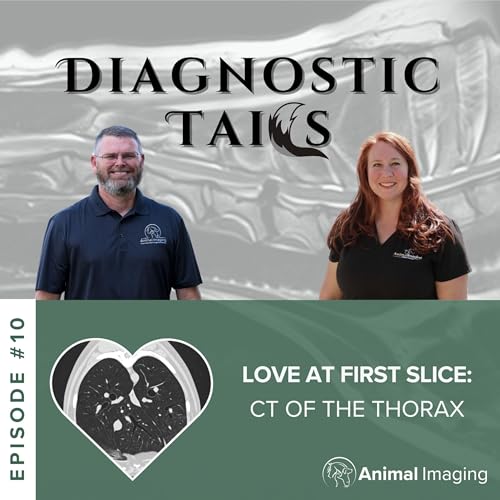
  • Love At First Slice: CT of the Thorax
    Nov 19 2025

    In this episode of Diagnostic Tails, Dr. Amy Armentrout and Dr. Lon Hays break down the power of CT in small-animal medicine, spotlighting why CT consistently outperforms radiographs - especially for detecting pulmonary nodules, planning oncology cases, and guiding complex procedures. They explore when sedation is enough, when anesthesia is required, and how contrast, breath-holds, and modern fan-beam technology elevate diagnostic accuracy.

    The conversation moves through real cases including Sancho’s hidden metastatic disease, a CT-guided lung mass aspirate, a young dog with a vascular anomaly, and an inventive urethral stricture study - illustrating how CT changes outcomes, improves surgical planning, and saves patients from unnecessary procedures. They wrap with a practical comparison of CT vs. MRI and clear guidance on choosing the right modality for the right case.

    EPISODE HIGHLIGHTS:

    00:00–01:00 — Intro to thoracic CT & why it’s a go-to modality.

    01:00–02:30 — CT advantages: speed, clarity, and value over radiographs.

    03:30–05:15 — Sedation vs. anesthesia, contrast use, and why breath-holds matter.

    05:15–06:30 — Fan-beam vs. cone-beam CT: what’s the difference?

    07:00–09:15Case 1: Sancho - clean X-rays, but CT reveals multiple pulmonary nodules.

    10:12–11:25Case 2: Snickers - CT-guided lung mass aspirate and why ultrasound can’t reach it.

    11:58–12:35Case 3: Persistent Right Aortic Arch - diagnosing a congenital vascular anomaly.

    15:00–15:57Case 4: Urethral stricture - creative retrograde contrast CT for surgical planning.

    16:15–17:40 — Why thoracic CT should accompany most soft-tissue studies.

    18:00–18:45 — Big-dog abdomen workups: when CT beats ultrasound.

    19:20–22:10 — CT vs. MRI: which modality to choose and when.

    23:26–24:30 — Final takeaways + call for clinicians to consult the imaging team.

    KEY TAKEAWAYS:

    • CT provides far greater detail than radiographs, especially for pulmonary, abdominal, and oncologic cases.
    • Small nodules and subtle abnormalities are frequently invisible on X-ray but obvious on CT.
    • Cone-beam CT has its place (dentistry/skull) but cannot replace fan-beam CT for thorax or abdomen.
    • CT-guided aspirates offer precise, safe sampling for challenging masses surrounded by air.
    • 3D reconstructions and vascular studies improve surgical planning and owner decision-making.
    • For elbows, carpi, and below-stifle issues → CT excels; for shoulders, hips, and neuro → MRI is preferred.
    • Adding a thoracic CT when evaluating masses is cost-effective and often case-changing.

    Animal Imaging Veterinary Radiology Specialists: https://animalimaging.net/

    (972) 869-2180 info@animalimaging.net

    Facebook: https://www.facebook.com/AnimalImaging/

    Linked In: https://www.linkedin.com/company/animalimaging

    Instagram: https://www.instagram.com/animalimaging/?hl=en

    Show More Show Less
    25 mins