Episodes

  • I Live for Eventing — But I Live for the Horses More | With 5* Eventer Matt Brown and FEI Dressage Rider Cecily Clark
    May 24 2026

    What if the problem in equestrian sport isn't the riders who make the headlines, but the culture that produced them?

    In December, five-star eventer Matt Brown and FEI dressage rider Cecily Clark posted an open letter to the equestrian world. It struck a nerve — thousands of reactions and a flood of private messages from people who'd felt the same unease but thought they were the only one.

    In this episode, the husband-and-wife team behind East West Training Stables sit down with Karen and Meta to talk about what it really costs to compete at the top, and why Matt describes being named an Olympic alternate as one of the lowest moments of his career. Together they move the conversation away from singling out individuals and toward something harder to look at: the culture we've built around competition, and the things we've simply grown to accept.

    Along the way they explore the horses who've gone quiet in the warm-up ring — shut down, chins to their chests — the education gap that leaves even professionals unsure how a horse actually sees the world, and why choosing the slower, kinder path so often feels like failure long before it feels like progress.

    An honest, generous conversation about welfare, culture, and change — and why none of us needs to be perfect to start trying to do better.

    📩 Read the open letter that started it all

    Show More Show Less
    56 mins
  • The Stories We Inherit About Risk in Racing | Jessie McCarthy on Welfare and Social Licence
    May 5 2026

    "It's in their constitution to be injured."

    "We've bred them to be like this."

    Both of these came up in the same conversation — and the paradox sitting between them is one of the patterns Jessie McCarthy's research surfaces about how racing talks to itself about risk.

    In this week's episode, Karen and Meta sit down with Jessie McCarthy, a final-year veterinary student at the University of Surrey, with a Master's in Animal Welfare, Ethics and Law from the University of Glasgow. Her recently published paper, co-authored with Euan Bennett and Heather Cameron-Whytock, takes a less common approach to social licence in racing: rather than starting from outside the sport, she interviewed twelve insiders about how they perceive the risks horses face, and the language they reach for when things go wrong.

    What emerges is a quietly revealing portrait of a sport in conversation with itself. Risk often gets reframed as a communication problem rather than a welfare one.

    Responsibility gets dispersed across the sport — until, as Jessie's research shows, it often quietly settles on the horses themselves. Their fragility. Their nature. Their breeding.

    But of course — we bred them.

    In this conversation, we explore:

    • Why the words we reach for ("accident," "incident," "adverse event") shape what we believe is possible
    • How tradition and identity in the horse world can act as a brake on reform
    • Pin firing, generational change, and what the next generation of equine vets is choosing differently
    • Why a horse's welfare may be shaped less by race day than by the other 360 days
    • The question of equine consent — and why only one of twelve stakeholders raised it
    • And, offered any wish in the world, Jessie's is gloriously simple: more turnout, more friends, more forage

    A thoughtful, generous conversation with a young vet whose research invites the horse world — insiders and outsiders alike — to reflect on the stories we've inherited.

    🎧 Subscribe and share with someone who loves horses.

    🌐 changingrein.com.au

    📧 team@changingrein.com.au

    #ChangingRein #EquineWelfare #SocialLicence #Racing

    Show More Show Less
    48 mins
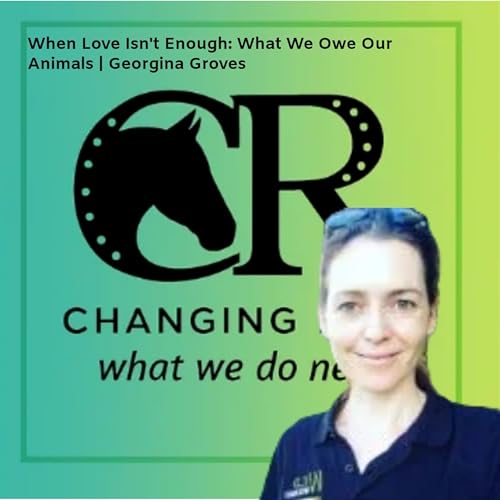
  • When Love Isn't Enough: What We Owe Our Animals
    Apr 18 2026

    We love our animals. But is that enough?

    Captive animal welfare specialist Georgina Groves joins Karen and Meta for a conversation about the uncomfortable gap between what we know about animal welfare and what we actually do.

    Georgina's work takes her into some of the world's most under-resourced zoos — but the parallels she draws for horse people are striking. Stables that haven't meaningfully changed in a century. Animals who've forgotten how to be their own species. A health-centric idea of care that protects the body while quietly constraining the life.

    This is an episode about welfare washing, moral duty, and the difference between caring for an animal and caring about one.

    Featuring the story of four bears who had to relearn how to be bears — and what that might mean for the horses in our care.

    🎧 Listen in, then join the conversation.

    Guest: Georgina Groves, captive animal welfare specialist and co-founder of Wild Welfare

    Hosts: Dr Karen Luke and Meta Osborne

    GEORGINA'S LINKEDIN POSTLINK TO WILD WELFARE

    Show More Show Less
    47 mins
  • S6 E5 "But My Horse Is Well Cared For" and Other Stories We Tell Ourselves | Erica Cheung
    Mar 28 2026

    Erica Cheung is a horse owner, mixed-practice (including equine) vet clinic co-owner, and PhD candidate living in rural central Alberta, Canada. She obtained a Bachelor of Science from the University of Alberta, a Master of Science in clinical animal behaviour, and is currently studying under the supervision of Professor Daniel Mills and Dr. Beth Ventura for her PhD at the University of Lincoln, UK. She has lectured at the University of Alberta on One Health, animal behaviour and welfare. Her PhD work is focused on the sociocultural factors that may influence how performance horses are trained and managed.


    Show More Show Less
    53 mins
  • The Dressage Rule That Shocked Us - Rein Releases are Penalised
    Mar 21 2026

    What happens when you look — really look — at how dressage is judged?

    In this episode of Changing Rein, PhD researcher Cristina Wilkins shares a finding that genuinely surprised us: the Dressage Judging Guidelines mention the requirement to maintain contact 37 times — and visible rein releases are penalised. The longer the release, the greater the penalty.

    For anyone trained in learning theory, that's a confronting discovery. Horses learn through pressure and release. So what happens when the release never comes?

    Using extraordinary high-speed photography from fine artist Crispin Johansson — capturing up to 60 frames per second during competition — Cristina and her research team have been able to examine entire dressage tests frame by frame. What they're seeing raises important questions about the gap between what we say good training looks like and what the rules actually reward.

    This conversation also explores how equipment like tight nosebands and even artificial foaming agents can mask signs of horse discomfort, and also introduces the concept of hypersensitisation - a possible explanation for why horses continue to perform even without the release that ethical training principles require.

    This isn't about blame. It's about looking more closely at what's happening and asking whether the rules we ride by match the welfare outcomes we all want.

    Guest: Cristina Wilkins — PhD candidate (University of New England), equitation science researcher, and co-author of multiple peer-reviewed papers on horse welfare.

    Hosts: Dr Karen Luke & Meta Osborne

    Show More Show Less
    28 mins
  • S6 E4 Under Pressure: Rein Contact, Blood Rules and Who's Really in Charge - a conversation with Cristina Wilkins
    Mar 19 2026

    In this episode, we're joined by Cristina Wilkins to explore some fascinating - and important - questions emerging from elite equestrian sport. Drawing on her recent article in Horses and People magazine, Cristina walks us through the revised FEI blood rule in show jumping and what it signals about the direction of welfare policy at the top level. From there, we get curious about what new photographic evidence is revealing: that some elite riders may not be releasing rein pressure the way classical training principles suggest they should. So what does that mean for the horse? And could it help explain why we're seeing signs of hypersensitisation in the mouth and flanks? Cristina helps us connect the dots between training technique, sensory experience, and competitive performance - and asks the kind of questions that can help all of us become more thoughtful horsemen and women.


    Cristina Wilkins

    Cristina Wilkins is a PhD candidate at the University of New England (UNE), Australia, researching the One Welfare outcomes of human-horse interactions. Her work in exploring how equipment-related pressures affect equine welfare led to an invited presentation to the FEI Veterinary Committee earlier this year. Cristina collaborates with leading welfare scientists on practical tools for assessment, including the Mellorater app, and she developed UNE’s online course Applying the Five Domains Model to the Welfare Assessment of Sport and Recreation Horses. A former international eventing competitor, coach, official, and long-time editor of Horses and People magazine, Cristina combines academic research with deep industry experience. Her science communication and advocacy have supported welfare initiatives across equestrian and racing organisations. She served on the ISES Council (2011–2019) and is a co-author of The 2020 Five Domains Model: Including Human–Animal Interactions in Assessments of Animal Welfare. Cristina lives in Queensland, Australia.

    Show More Show Less
    1 hr and 19 mins
  • S6 E3: Every Breath They Take - Inside the Innate Health Assessment with Prof Dan O'Neill
    Mar 8 2026

    The Innate Health Assessment tool developed by Prof Dan O'Neill and a team from the Royal Veterinary College has been described as revolutionary. In a podcast dedicated to the sustainability of horse sport from a welfare perspective, why are we talking about flat-faced dogs? Because we humans do things to and with animals in our lives that are not always in the animals' best interests, and breeding dogs for extreme conformation is one of those things. The IHA is designed to encourage responsible breeding of dogs so that future generations can lead full and happy lives, free from pain and discomfort.


    Dr Dan O’Neill

    Professor of Companion Animal Epidemiology, RVC

    MVB BSc(Hons) GPCert(SAP) GPCert(FelP) GPCert(Derm) GPCert(B&PS) PGCertVetEd FHEA MSc(VetEpi) PhD FRCVS

    Following 22 years in general (mainly small animal) veterinary practice, Dan moved across to academia in 2009 to gain a PhD at the RVC developing VetCompass to harness the power of veterinary clinical records to understand companion animal health at scale.

    He has remained at the RVC and co-leads the VetCompass™ Programme. With over 185 peer-reviewed papers, he also co-authored the books ‘Breed Predispositions to Disease in Dogs and Catsand Health and Welfare of Brachycephalic (Flat-faced) Companion Animals’. He is a founding member of the UK Brachycephalic Working Group, the UK Legal Advisory Group on Extreme Conformation in Dogs and the International Collaborative on Extreme Conformation in Dogs.

    Dan was awarded a Fellowship of the Royal College of Veterinary Surgeons in 2018, the BSAVA Blaine Award for Advancement of Small Animal Science in 2019, the International Canine Health Award from the Kennel Club Charitable Trust in 2021, the UK All Party Parliamentary Group ‘Phillippa Robinson Dog Welfare Award’ in 2024 and the RCVS Impact Award in 2025.

    In this conversation, Dan O'Neill discusses his journey from general veterinary practice to academia, highlighting the impact of the 'Pedigree Dogs Exposed' documentary on his career pivot. He introduces Vet Compass, a research initiative aimed at improving animal health through data collection and analysis and the provision of evidence-based support for veterinary practices. The discussion delves into the challenges of traditional veterinary practices, the importance of evidence-based medicine, and the role of human perceptions in animal welfare. O'Neill emphasizes the need for a shift in thinking towards innate health in animals, advocating for a more humane approach to breeding and care.

    NOTE: The original Pedigree Dogs Exposed BBC documentary from 2008 that was the lightbulb moment for Dan is no longer available but its follow-up Pedigree Dogs Exposed: Three Years On is available on Prime Video.


    Show More Show Less
    1 hr and 4 mins
  • S6 E2: A View From the Bridge - A conversation with Lucinda Creighton
    Feb 25 2026

    Lucinda Creighton truly bridges two worlds - a former member of the Irish Parliament and a Government Minister with responsibility for European affairs, she also served on the board of Horse Sport Ireland, the governing body for equestrian sport in Ireland.


    Lucinda grew up in Co Mayo, Ireland as a self-professed 'pony-mad kid'. In this episode we discuss her journey into public service, the dynamics of power and her experiences in the Irish Parliament (Dáil) and government. The conversation explores the importance of building relationships in any type of governance and the connection between politics and the horse industry. We also discuss the evolution of education in horse welfare, and the challenges faced by governing bodies like Horse Sport Ireland. The episode emphasizes the need for respect and engagement with the horse industry's stakeholders, the impact of corporate governance, and the significance of animal welfare as a political concern. Lucinda expresses her wish for better governance that values the voices of those who care for horses, highlighting the importance of community involvement and awareness in the equestrian world.

    Show More Show Less
    57 mins