• Decision Ownership Maps — Cut Approval Loops in One Workshop
    Jul 3 2026
    Many organisations mistake governance for bureaucracy: unclear decision rights stall delivery, spawn rework, and turn simple requests into months-long sagas. This episode presents Decision Ownership Maps — a one-page, outcome-focused artefact you can create in a 90-minute workshop that stops approval loops and makes decisions actionable. I explain the map’s fields, how it ties specific decisions to artefacts (requirements, data contracts, release gates), and three crisp differences from RACI and decision-flag approaches so this isn’t just “more process.” You’ll hear a de-identified consulting example where the map halved review cycles and learn three measurable metrics to track (reopened tickets, review rounds, time-to-decision). I’ll read the template aloud, give a lean workshop recipe, and set simple maintenance and escalation rules. Practical, non-theoretical, and immediately usable—designed for leaders, product managers, consultants, and IT professionals who need faster alignment between strategy and delivery.

    Become a supporter of this podcast: https://www.spreaker.com/podcast/business-it-it-business--6867401/support.

    To continue the conversation, follow Mirko Peters on LinkedIn, where more insights and real-world examples are shared from both business and IT perspectives.
    Show More Show Less
    10 mins
  • Ownership Debt: Who Owns Decisions After Go-Live?
    Jul 3 2026
    Too many organisations treat decisions like one-off events: specified during a project then left unmanaged after go-live. The result is 'ownership debt' — decisions with no clear owner, dissolving accountability into fragile systems, recurring rework, and hidden costs. In this episode Mirko Peters explains how unclear decision ownership amplifies technical debt and business risk, why it happens (project handovers, incentives, and governance gaps), and how to design for responsibility across the lifecycle. Through a generalized consulting example Mirko shows the typical missteps that leave features orphaned and roadmaps inconsistent, then gives concrete patterns to reassign ownership, create lightweight decision records, and align incentives between product, operations and architecture. Listeners will get practical guidance they can apply in the next week: how to name owners, set review cadences, and make small governance changes that stop ownership debt from compounding. This is for leaders, architects and delivery managers who want decisions to survive beyond the slide deck.

    Become a supporter of this podcast: https://www.spreaker.com/podcast/business-it-it-business--6867401/support.

    To continue the conversation, follow Mirko Peters on LinkedIn, where more insights and real-world examples are shared from both business and IT perspectives.
    Show More Show Less
    10 mins
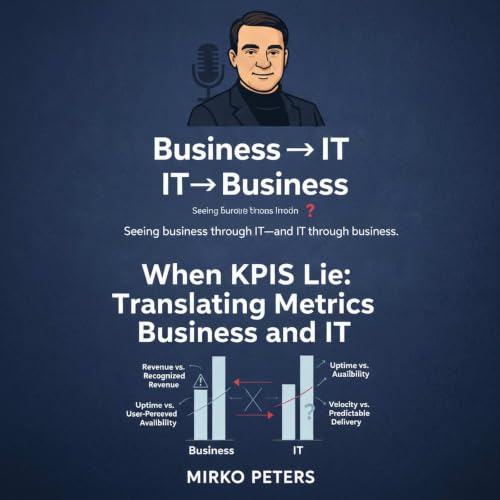
  • When KPIs Lie: Translating Metrics Between Business and IT
    Jul 2 2026
    Most organizations measure success with KPIs, yet business and IT often mean different things by the same metric. This episode unpacks why dashboards that look aligned can hide fatal misunderstandings: revenue vs recognized revenue, "uptime" vs user-perceived availability, velocity vs predictable delivery. I’ll show how language, unit mismatch, and aggregation choices bend decisions toward the wrong trade-offs, and why measurement gaps amplify at scale. Using a generalized consulting case, we examine a product team that chased "faster delivery" metrics and ended up increasing rework and customer churn. The goal is practical: give leaders and technologists a repeatable checklist to translate business intent into technical measures, expose false signals, and design metrics that reduce ambiguity. Expect clear rules for naming, ownership, sampling, and escalation—no vendor hype, just concrete steps to make your KPIs actually drive the outcomes you want.

    Become a supporter of this podcast: https://www.spreaker.com/podcast/business-it-it-business--6867401/support.

    To continue the conversation, follow Mirko Peters on LinkedIn, where more insights and real-world examples are shared from both business and IT perspectives.
    Show More Show Less
    9 mins
  • Invisible Maintenance: The Quiet Engine of Business Value
    Jul 1 2026
    Start with this image: a team doubles feature output but customer issues grow by 40% over a year because steady maintenance was ignored. This episode reframes maintenance as intentional investment, not shameful overhead. I open with a short microcase, then translate what business leaders typically assume and what IT actually faces, using concrete metrics—percent of sprint capacity spent on unplanned work, mean time to repair (MTTR), and cost-to-change over time—to make maintenance measurable. You get practical phrases and two sharp soundbites to provoke discussion, a simple 10-minute worksheet prompt to map steady-state costs, and a generalized consulting example that shows the decision sequence turning launches into chronic firefighting. Final takeaways give business leaders simple budget language and IT owners a negotiation script to secure predictable funding. Listeners leave with clear, doable actions to make maintenance visible, fundable, and a source of preserved options rather than a surprise tax. Remember to subscribe and leave a review to support the show.

    Become a supporter of this podcast: https://www.spreaker.com/podcast/business-it-it-business--6867401/support.

    To continue the conversation, follow Mirko Peters on LinkedIn, where more insights and real-world examples are shared from both business and IT perspectives.
    Show More Show Less
    9 mins
  • Shadow SaaS: The Quiet Tax of Business-Led Purchases
    Jun 30 2026
    Business teams buy software to move faster, solve immediate pain, or avoid red tape. IT watches those purchases multiply and wonders why the enterprise looks like a patchwork of tools that don’t talk to each other. In this episode Mirko Peters walks through the anatomy of business-led SaaS procurement—what business expects, what IT experiences, and why both sides are partly right. Using a consulting lens (no vendor cheerleading), Mirko explains how unmanaged SaaS becomes technical and operational debt: duplicated data, fragmented identity, shadow integrations, compliance blind spots, and brittle processes. You’ll get clear signals to spot dangerous patterns early, pragmatic alignment tactics that don’t smother business autonomy, and a lightweight governance approach that reduces risk without reintroducing the slow approvals business tried to escape. Practical, direct, and grounded in real consulting experience for leaders, consultants, and IT professionals who want less drama and better outcomes.

    Become a supporter of this podcast: https://www.spreaker.com/podcast/business-it-it-business--6867401/support.

    To continue the conversation, follow Mirko Peters on LinkedIn, where more insights and real-world examples are shared from both business and IT perspectives.
    Show More Show Less
    9 mins
  • Feature Flags vs Decision Flags: When Business Indecision Becomes Technical Debt
    Jun 29 2026
    Many organizations use feature flags to decouple deployment from release. But when flags become a way to delay decisions, avoid ownership, or pile temporary work on long-term code paths, they stop being a delivery tool and become 'decision flags'—a source of technical debt, coordination friction, and stalled business outcomes. In this episode Mirko Peters explains the difference between feature flags used correctly and flags that mask unresolved governance. He walks through the business motivations that produce decision flags, the technical realities that magnify their cost, a typical consulting example where flags turned into a maintenance nightmare, and pragmatic rules to prevent that drift. Listeners will get clear guardrails: who decides when a flag is temporary, how to measure and time its lifecycle, and simple governance patterns that keep flags lean, visible, and reversible. Practical, jargon-free, and immediately usable across product, IT, and leadership.

    Become a supporter of this podcast: https://www.spreaker.com/podcast/business-it-it-business--6867401/support.

    To continue the conversation, follow Mirko Peters on LinkedIn, where more insights and real-world examples are shared from both business and IT perspectives.
    Show More Show Less
    9 mins
  • Release Policies as Strategy: How Deployment Rhythms Shape Business Behavior
    Jun 27 2026
    Deployment policies (release windows, hotfix rules, rollback expectations, blackout periods) are usually treated as operational detail. In reality they are business levers: they influence launch timing, bundling decisions, sales promotions, regulatory compliance and even incentive design. In this episode Mirko Peters breaks down how seemingly technical policies become implicit governance for the organization, creating predictable behaviors and invisible costs. You’ll get a practical translation of business needs into deployment constraints, and the reverse: how technical realities should shape realistic business commitments. Through a clear, consultant-style monologue Mirko explains common misunderstandings, highlights a recurring project failure pattern, and gives concrete, low-friction steps both leaders and engineers can adopt to align release policy with business strategy without slowing the organization to a crawl.

    Become a supporter of this podcast: https://www.spreaker.com/podcast/business-it-it-business--6867401/support.

    To continue the conversation, follow Mirko Peters on LinkedIn, where more insights and real-world examples are shared from both business and IT perspectives.
    Show More Show Less
    9 mins
  • The Quiet Tax of Backward Compatibility
    Jun 26 2026
    Every organization that evolves software pays a quiet tax: the cost of keeping old behaviors, integrations and expectations working while you move forward. In this episode Mirko Peters unpacks backward compatibility as a business problem, not just a technical nuisance. You’ll get a clear view of what business leaders unknowingly promise when they demand ‘no disruption’, and why engineers push back when asked to change defaults or remove legacy paths. Through a generalized consulting example Mirko shows how compatibility decisions shift costs across teams, inflate roadmaps, and erode agility if left implicit. The episode closes with practical rules for making compatibility explicit: how to classify compatibility types, assign owners, price the option to break, and communicate trade-offs to stakeholders. No vendor hype, no theoretical frameworks — just clear actions teams can use to stop compatibility from silently bankrupting future choices.

    Become a supporter of this podcast: https://www.spreaker.com/podcast/business-it-it-business--6867401/support.

    To continue the conversation, follow Mirko Peters on LinkedIn, where more insights and real-world examples are shared from both business and IT perspectives.
    Show More Show Less
    9 mins