• Microbial Engineering for Industrial Bioremediation and Resource Recovery
    May 25 2026

    This episode outlines a transformative shift in industrial wastewater management, moving from simple pollutant removal to a circular bioeconomy model. It highlights how engineered microbial systems, such as specialized bacterial strains and algal-bacterial granules, can efficiently break down recalcitrant contaminants while recovering valuable nutrients. By integrating hybrid technologies like electro-biological coupling and AI-driven optimization, these processes overcome the limitations of traditional treatments, such as high energy costs and excessive waste. These advancements allow sectors like petrochemicals and food processing to turn environmental liabilities into resource-generating biorefineries. Ultimately, the source emphasizes that the future of the industry lies in predictive biomanufacturing and the extraction of value-added outputs from waste streams.


    #Science#Bioprocess #ScaleUp and #TechTransfer,#Industrial #Microbiology,#MetabolicEngineering and #SystemsBiology,#Bioprocessing,#MicrobialFermentation,#Bio-manufacturing,#Industrial #Biotechnology,#Fermentation Engineering,#ProcessDevelopment,#Microbiology,#Biochemistry,#Biochemical Engineering, #Applied #MicrobialPhysiology, #Microbial #ProcessEngineering, #Upstream #BioprocessDevelopment, #Downstream Processing and #Purification,#CellCulture and #MicrobialSystems Engineering, #Bioreaction #Enzymes, #Biocatalyst #scientific #Scientist #Research

    Show More Show Less
    26 mins
  • Scalable Antibiotic-Free Industrial Fermentation of 1,3-Propanediol
    May 22 2026

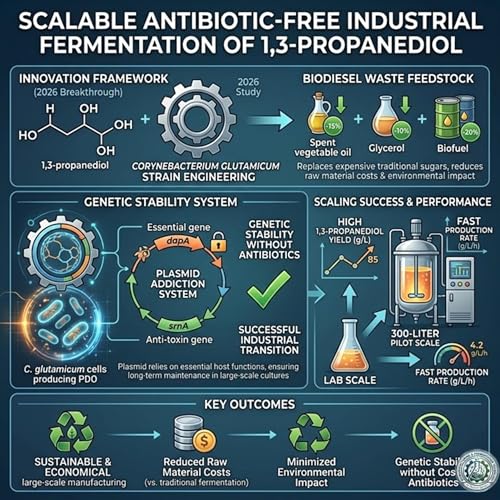
    In this episode, A 2026 study details a breakthrough in the industrial production of 1,3-propanediol, a versatile chemical used in cosmetics and polyesters. By engineering a robust strain of Corynebacterium glutamicum, researchers achieved high yields using biodiesel waste instead of expensive traditional sugars. This method is particularly significant because it utilizes a plasmid addiction system, allowing for genetic stability without the need for costly antibiotics. Success at the 300-liter pilot scale proves that this process can maintain high efficiency and speed in real-world manufacturing environments. Ultimately, this innovation offers a sustainable and economical path for large-scale biochemical manufacturing by reducing raw material costs and environmental impact.


    #Science#Bioprocess #ScaleUp and #TechTransfer,#Industrial #Microbiology,#MetabolicEngineering and #SystemsBiology,#Bioprocessing,#MicrobialFermentation,#Bio-manufacturing,#Industrial #Biotechnology,#Fermentation Engineering,#ProcessDevelopment,#Microbiology,#Biochemistry,#Biochemical Engineering, #Applied #MicrobialPhysiology, #Microbial #ProcessEngineering, #Upstream #BioprocessDevelopment, #Downstream Processing and #Purification,#CellCulture and #MicrobialSystems Engineering, #Bioreaction #Enzymes, #Biocatalyst #scientific #Scientist #Research


    Show More Show Less
    23 mins
  • Real-Time Adaptive Strategies for Robust Scale-Up
    May 15 2026

    Industrial fermentation continues to suffer from high batch variability, overfeeding-induced byproducts (e.g., acetate), underfeeding starvation, and manual induction decisions. Three 2024–2026 papers from Bioprocess and Biosystems Engineering, Biotechnology Progress, and Process Biochemistry introduce practical control innovations with strong pilot pathways: a Bayesian observer that dynamically estimates specific substrate uptake rate (q_S) as a live state with adaptability parameter (λ) using particle filtering on PAT data (OUR, etc.) for tighter fed-batch feeding in E. coli, overcoming limitations of static Monod kinetics; multivariate PAT (inline OD + PIMS) enabling fully hands-free, threshold-based induction from inoculation to harvest for reduced variability and higher OEE in recombinant protein processes; and OUR-guided dynamic nitrogen feeding in Streptomyces to optimize secondary metabolite production in viscous filamentous cultures without precursor waste or toxicity. The Bayesian uptake framework emerges as the most scalable platform technology for digital twins and higher-density operations, offering 15–25% COG reduction at 10,000 L scale, while all three innovations can be piloted within 12–24 months using standard fermenters and existing sensors. Together, they shift bioprocessing from operator-dependent art toward predictable, high-yield engineering, accelerating commercial scale-up in alternative proteins, enzymes, and sustainable chemicals."


    #Science#Bioprocess #ScaleUp and #TechTransfer,#Industrial #Microbiology,#MetabolicEngineering and #SystemsBiology,#Bioprocessing,#MicrobialFermentation,#Bio-manufacturing,#Industrial #Biotechnology,#Fermentation Engineering,#ProcessDevelopment,#Microbiology,#Biochemistry,#Biochemical Engineering, #Applied #MicrobialPhysiology, #Microbial #ProcessEngineering, #Upstream #BioprocessDevelopment, #Downstream Processing and #Purification,#CellCulture and #MicrobialSystems Engineering, #Bioreaction #Enzymes, #Biocatalyst #scientific #Scientist #Research


    Show More Show Less
    5 mins
  • The Programmable Vaccine: mRNA Engineering and Industrial Strategy
    May 13 2026

    This episode explores the transformative shift in vaccinology from traditional biological production to a programmable, information-based approach using mRNA technology. By utilizing lipid nanoparticles to deliver genetic blueprints directly into human cells, this platform bypasses the need for complex cell cultures and significantly accelerates manufacturing timelines. The source details the engineering breakthroughs required to ensure safety and stability, while comparing the advantages of mRNA against older methods and emerging formats like self-amplifying RNA. Industrially, the technology is presented as a modular chassis that can be rapidly retooled for infectious diseases, oncology, and autoimmune therapies. Ultimately, the author frames mRNA as a general-purpose medical operating system that is redefining the global bioeconomy and pharmaceutical infrastructure.


    #Vaccine #mRNA #Science#Bioprocess #ScaleUp and #TechTransfer,#Industrial #Microbiology,#MetabolicEngineering and #SystemsBiology,#Bioprocessing,#MicrobialFermentation,#Bio-manufacturing,#Industrial #Biotechnology,#Fermentation Engineering,#ProcessDevelopment,#Microbiology,#Biochemistry,#Biochemical Engineering, #Applied #MicrobialPhysiology, #Microbial #ProcessEngineering, #Upstream #BioprocessDevelopment, #Downstream Processing and #Purification,#CellCulture and #MicrobialSystems Engineering, #Bioreaction #Enzymes, #Biocatalyst #scientific #Scientist #Research

    Show More Show Less
    25 mins
  • Engineering Putrescine Beyond Toxicity: Rewiring E. coli into a High-Performance Bio-Diamine Factory
    May 11 2026

    The latest advances in microbial putrescine biosynthesis signal a major transition in industrial metabolic engineering, where diamines are emerging as credible bio-based alternatives to petrochemical monomers in polyamide and specialty chemical manufacturing. Through systems-level metabolic rewiring of Escherichia coli, researchers achieved a record 72.7 g/L putrescine titer from glucose with industrially meaningful productivity, demonstrating that polyamine toxicity is no longer a fixed biological limitation but an engineerable parameter. Beyond pathway amplification, the work highlights the importance of coordinated flux balancing, stress management, and export engineering in transforming a tightly regulated metabolite into a scalable fermentation product. More importantly, this study reframes microbial diamines from academic curiosities into strategically investable manufacturing platforms capable of challenging fossil-derived nylon intermediates, while exposing the next critical frontier: downstream recovery, yield optimization, and large-scale process robustness for commercial deployment.


    #Science#Bioprocess #ScaleUp and #TechTransfer,#Industrial #Microbiology,#MetabolicEngineering and #SystemsBiology,#Bioprocessing,#MicrobialFermentation,#Bio-manufacturing,#Industrial #Biotechnology,#Fermentation Engineering,#ProcessDevelopment,#Microbiology,#Biochemistry,#Biochemical Engineering, #Applied #MicrobialPhysiology, #Microbial #ProcessEngineering, #Upstream #BioprocessDevelopment, #Downstream Processing and #Purification,#CellCulture and #MicrobialSystems Engineering, #Bioreaction #Enzymes, #Biocatalyst #scientific #Scientist #Research


    Show More Show Less
    17 mins
  • Reprogramming Resin Chemistry. Streptomyces as a Living Chiral Factory for Abietic Acid Diversification
    May 8 2026

    This study demonstrates the use of Streptomyces as a whole-cell biocatalyst to selectively oxidize abietic acid into multiple structurally distinct derivatives. By leveraging native oxidative enzymes, the platform achieves regio- and stereoselective functionalization of a challenging diterpenoid substrate, expanding its chemical diversity beyond the reach of conventional synthesis. The work establishes a practical biotransformation approach using pre-grown cultures, addressing key constraints such as substrate hydrophobicity and cellular toxicity. Although not yet optimized for industrial productivity, the study confirms the feasibility of generating diverse, well-defined products from a low-cost renewable feedstock. This positions abietic acid as a viable starting material for high-value applications in pharmaceuticals and specialty chemicals, while highlighting a scalable “resin-to-scaffold” strategy for future biocatalysis-driven innovation.


    #Science#Bioprocess #Chemistry #ScaleUp and #TechTransfer,#Industrial #Microbiology,#MetabolicEngineering and #SystemsBiology,#Bioprocessing,#MicrobialFermentation,#Bio-manufacturing,#Industrial #Biotechnology,#Fermentation Engineering,#ProcessDevelopment,#Microbiology,#Biochemistry,#Biochemical Engineering, #Applied #MicrobialPhysiology, #Microbial #ProcessEngineering, #Upstream #BioprocessDevelopment, #Downstream Processing and #Purification,#CellCulture and #MicrobialSystems Engineering, #Bioreaction #Enzymes, #Biocatalyst #scientific #Scientist #Research


    Show More Show Less
    9 mins
  • Model-Driven Pulse Feeding Unlocks High-Yield PHB in Cupriavidus necator
    May 6 2026

    This study presents a compelling advancement in sustainable biopolymer production by demonstrating how cassava-derived dextrose can be efficiently converted into polyhydroxybutyrate (PHB) through a model-informed fed-batch strategy. By integrating genome-scale flux balance analysis with precisely timed pulse-feeding regimes, the authors shift Cupriavidus necator metabolism from biomass growth toward enhanced carbon storage. The work reveals that late-stage, carbon-only feeding under nitrogen-limited conditions significantly boosts PHB accumulation, achieving up to ~50% of cell dry weight, compared to substantially lower yields under growth-favoring regimes. This approach transforms fed-batch fermentation from an empirical process into a predictive, controllable system, enabling deliberate optimization of intracellular carbon flux. From an industrial perspective, the strategy reduces substrate wastage, improves polymer yield, and simplifies downstream processing, thereby strengthening process economics. Coupled with the use of low-cost cassava feedstocks, this framework offers a scalable and regionally adaptable pathway toward commercially viable, biodegradable plastics. Moreover, the integration of digital modeling with fermentation operations establishes a transferable blueprint for next-generation biomanufacturing platforms, with strong implications for startup innovation, IP development, and global deployment in emerging bioeconomies.


    #Science#Bioprocess #ScaleUp and #TechTransfer,#Industrial #Microbiology,#MetabolicEngineering and #SystemsBiology,#Bioprocessing,#MicrobialFermentation,#Bio-manufacturing,#Industrial #Biotechnology,#Fermentation Engineering,#ProcessDevelopment,#Microbiology,#Biochemistry,#Biochemical Engineering, #Applied #MicrobialPhysiology, #Microbial #ProcessEngineering, #Upstream #BioprocessDevelopment, #Downstream Processing and #Purification,#CellCulture and #MicrobialSystems Engineering, #Bioreaction #Enzymes, #Biocatalyst #scientific #Scientist #Research


    Show More Show Less
    11 mins
  • Engineering Heme at Scale: The Bacillus subtilis Chassis
    May 4 2026

    In this episode we discuss the results of Researchers who have successfully engineered the bacteria Bacillus subtilis to serve as a highly efficient production host for active hemoglobins and myoglobins. By utilizing a sophisticated "push–restrain–pull–block" strategy, scientists optimized the internal metabolic pathways to significantly increase the supply of heme, a critical cofactor for these proteins. This systematic overhaul resulted in record-breaking production levels for plant-based and animal-based proteins, achieving concentrations of approximately one gram per liter. The choice of this specific microbe is strategically important because it is considered food-grade, making it an ideal candidate for manufacturing ingredients for meat alternatives. Ultimately, this work demonstrates how precision fermentation can be used to improve the color, flavor, and sensory qualities of sustainable food products through advanced metabolic engineering.


    #Science#Bioprocess #ScaleUp and #TechTransfer,#Industrial #Microbiology,#MetabolicEngineering and #SystemsBiology,#Bioprocessing,#MicrobialFermentation,#Bio-manufacturing,#Industrial #Biotechnology,#Fermentation Engineering,#ProcessDevelopment,#Microbiology,#Biochemistry,#Biochemical Engineering, #Applied #MicrobialPhysiology, #Microbial #ProcessEngineering, #Upstream #BioprocessDevelopment, #Downstream Processing and #Purification,#CellCulture and #MicrobialSystems Engineering, #Bioreaction #Enzymes, #Biocatalyst #scientific #Scientist #Research


    Show More Show Less
    7 mins