Beatles Rewind Podcast cover art

Beatles Rewind Podcast

Beatles Rewind Podcast

By: Steve Weber and Cassandra
Listen for free

About this listen

Beatles. All day, every day. Eight Days a Week !!!

beatlesrewind.substack.comSteve Weber
Music
Episodes
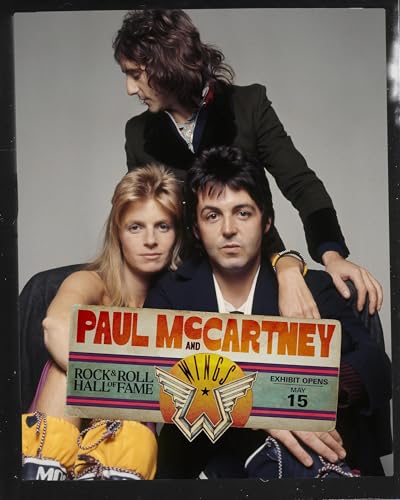
  • Rock Hall of Fame Unveiling McCartney & Wings Exhibition 🎸
    Feb 20 2026
    The Rock and Roll Hall of Fame will debut “Paul McCartney and Wings” on May 15th, 2026—the first major museum exhibition dedicated to exploring Wings’ decade-long journey from 1970 through 1981. It’s about damn time. For years, Wings has been treated as rock history’s awkward stepchild: too successful to ignore, too uncool to celebrate properly, forever overshadowed by what came before. This exhibition, featuring never-before-displayed artifacts from Paul’s personal archives, handwritten lyrics, instruments from recording sessions, and previously unseen photography, finally gives Wings the serious institutional recognition the band earned but rarely received.Here’s the context younger fans might not know: Wings dominated 1970s commercial radio with seven top 10 hits including “Band on the Run,” “Listen to What the Man Said,” “Silly Love Songs,” and “With a Little Luck.” This wasn’t Paul desperately clinging to relevance—this was a legitimate juggernaut that sold millions of albums and filled stadiums. The exhibition traces this arc of reinvention, from Paul’s self-titled 1970 debut through Wings’ formation to the band’s 1981 dissolution. 🏆The timing couldn’t be better. Morgan Neville’s documentary Man on the Run will debut February 27th on Amazon Prime Video. The documentary focuses on Wings’ 1970s ascension, particularly the dramatic Lagos sessions that produced Band on the Run—one of the craziest near-disasters in rock history.Obviously, Paul looks back at Wings’ run with great fondness, recently telling Rolling Stone:Starting from scratch after the Beatles felt crazy at times. There were some very difficult moments, and I often questioned my decision. But as we got better I thought, ‘OK, this is really good.’ We proved Wings could be a really good band.”Why This Exhibition Actually MattersThe Rock Hall promises “the most extensive collection of items from Paul’s personal archives to be made accessible to the public,” including instruments, stage clothing, handwritten lyrics, original artwork, and tour memorabilia. Paul’s exhibition is taking over the space previously occupied by “Bon Jovi: Forever” which closed recently after a two-year run at the Cleveland museum.But what makes this significant isn’t just the artifacts themselves—it’s what they represent about who gets credit for defining the 1970s sound.After the Beatles’ breakup, the narrative stuck for decades that John Lennon had been the major creative force behind the Beatles, and Paul was the lightweight, dragging his untalented wife around. Never mind Wings’ album sales. Never mind Band on the Run is legitimately brilliant. Never mind “Live and Let Die” became one of the decade’s most iconic performances. The critical consensus dismissed Wings as inconsequential, and that judgment persisted for forty years.This exhibition challenges that narrative not through argument but evidence: the handwritten lyrics demonstrating Paul’s craft, the instruments that created those massive hits, the tour memorabilia from sold-out stadium shows. You can’t examine Wings’ creative output and commercial success while maintaining this was some vanity project. This was a major band that defined a significant chunk of 1970s rock, whether critics admitted it or not. Any objective critic who looks back at Paul’s body of solo work has to concede this: he was prolific, successful, and on the whole, pretty darned good. 🎯Paul was inducted into the Rock Hall twice: as a Beatle in 1988 and as a solo artist in 1999. Wings has not been inducted separately.What Happened in Lagos (A Masterpiece Made from Chaos)In 1973, McCartney’s first three Wings albums had received brutal critical reception, and the pressure to deliver something great was existential. Paul’s solution: record in Lagos, Nigeria—partly for tax advantages, partly to immerse himself in a different musical culture. Then everything went sideways. 🌍Just before sessions began, guitarist Henry McCullough and drummer Denny Seiwell quit, leaving McCartney with only Linda and guitarist Denny Laine. The skeletal lineup forced Paul to play nearly every instrument himself. Shortly after arriving, Paul and Linda were mugged at knifepoint—the thieves stole his notebooks of lyrics and demo tapes, meaning Paul had to reconstruct everything from memory. The studio equipment malfunctioned constantly. The heat was unbearable. Nigerian musician Fela Kuti publicly accused him of cultural appropriation. Political unrest simmered throughout the city. 🌡️The smart move would’ve been abandoning the project and flying home. Instead, Paul sweated through his clothes playing bass, then drums, then piano, then guitars, overdubbing parts until the album took shape. Band on the Run topped charts worldwide, won a Grammy, and silenced critics who’d written him off. Sometimes the best revenge is a triple-platinum album that ...
    Show More Show Less
    17 mins
  • How The Beatles Outgrew Their House Photographer
    Feb 19 2026
    Robert Freeman took perhaps the most iconic photograph in music history when he snapped a picture of the Beatles in a hotel hallway in 1963. The half-shadowed faces on With the Beatles became the visual template for what a serious rock band should look like. Before Freeman, album covers were just headshots of people grinning like they were posing for yearbook photos. After Freeman, darkness and moodiness were aspirational. 📸The Man Who Made Them Look Like ArtistsFreeman’s run as the Beatles’ house photographer lasted from 1963 to 1966, during which he shot five consecutive album covers and established a visual language for the band that was as important as George Martin’s production. Then, just as suddenly as he’d arrived, he was gone. Replaced by an illustrator for Revolver, sidelined entirely for Sgt. Pepper, and never brought back into the fold even as the Beatles continued releasing albums through 1970. What happened? Short answer: the Beatles outgrew him. The longer answer is more interesting. When Freeman first met the Beatles in August 1963, they were still wearing matching suits and had yet to crack America. He was a jazz photographer who’d worked with John Coltrane and understood how to make musicians look serious rather than approachable. The setup for With the Beatles was deceptively simple: four faces emerging from darkness, half-lit, wearing black turtlenecks, no smiles. It looked like album covers for French existentialist films, not pop music. 🖤In a tribute he wrote when Freeman died in 2019, Paul McCartney recalled:People often think that the cover shot for Meet The Beatles of our foreheads in half shadow was a carefully arranged studio shot. In fact, it was taken quite quickly by Robert in the corridor of a hotel we were staying in where natural light came from the windows at the end of the corridor.The effect was transformative. Manager Brian Epstein had spent months trying to make the Beatles look clean-cut and non-threatening to parents. Freeman made them look like they didn’t care what your parents thought. The cover became so influential that every band for the next three years tried to replicate it—the Stones, the Kinks, the Who all attempted variations on the moody-faces-emerging-from-darkness template. Freeman had accidentally invented the visual vocabulary of rock credibility.For A Hard Day’s Night in 1964, Freeman gave them the grid of faces—five images each, twenty portraits total, showing different expressions. It was playful without being childish, artistic without being pretentious. The album was the soundtrack to their first film, and Freeman’s cover made it clear this wasn’t just a cash-grab movie tie-in. This was Art. 🎬Then came Beatles for Sale in late 1964, and Freeman did something unexpected: he made them look sad. Shot in autumnal Hyde Park, the four Beatles stare at the camera with tired, slightly melancholic expressions. They’d spent 1964 being chased around the world by screaming fans, and Freeman captured what that exhaustion looked like. No other pop band at the time would have allowed a cover that suggested they were anything less than thrilled to be famous. The Beatles did, because Freeman made it look cool. 🍂The Beginning of the EndHelp! in 1965 should have been the warning sign. Freeman shot the cover—the four Beatles in ski clothes spelling out a message in semaphore flag positions. Except they’re not actually spelling “HELP.” Freeman arranged them for visual composition rather than accuracy, and the actual semaphore reads something like “NUJV.” When this was pointed out, everyone shrugged. It looked good, and that was what mattered. But the willingness to prioritize aesthetics over meaning was very Freeman, and increasingly not very Beatles. 🎿By Rubber Soul in December 1965, the relationship was starting to show cracks. The famous stretched, distorted faces on the cover were actually an accident. McCartney recalled:His normal practice was to use a slide projector and project the photos he’d taken onto a piece of white cardboard which was exactly album sized, thus giving us an accurate idea of how the finished product would look. During his viewing session the card, which had been propped up on a small table, fell backwards, giving the photograph a ‘stretched’ look. Instead of simply putting the card upright again, we became excited at the idea of this new version of his photograph. … Because the album was titled Rubber Soul, we felt that the image fitted perfectly.It became one of the most recognizable album covers of the sixties, but it also revealed something important: the Beatles were now making aesthetic decisions themselves rather than deferring to their photographer. Freeman was still technically in charge, but the band was increasingly directing the vision. 🎸The cover also showed the absolute limit of what Freeman could do with photography. He could make them look moody, playful, ...
    Show More Show Less
    14 mins
  • "I Want a Divorce": The Day John Lennon Quit the Beatles
    Feb 18 2026
    September 8, 1969. The album is finished. Abbey Road won’t be released for another three weeks, but the four Beatles are gathered at their Apple offices on Savile Row for a meeting that should be celebratory. It isn’t. John Lennon has a proposal, and it’s less “let’s talk about the next record” and more “I want a divorce.” 💔What John actually proposes is an “equal rights” system—a radical restructuring that would strip Paul McCartney of his de facto leadership role and give George Harrison equal footing in the band’s creative hierarchy. It’s the kind of demand you make when you’ve already checked out but haven’t figured out how to say it yet. Also, John dismisses the Side Two medley as “junk,” insisting his songs be grouped together on one side, away from Paul’s “granny music.” The album they’ve just finished—the one that will become their most cohesive statement—was apparently built on shifting sand. 🎸Fragments Held Together By TapeThe medley—Paul’s vision for a continuous, symphonic suite closing Side Two—was born out of necessity as much as ambition. They had fragments, half-songs. Ideas that couldn’t quite stand on their own. Paul, still thinking in Sgt. Pepper terms, saw an opportunity: stitch them together into something that sounds purposeful, a mini-opera that makes the listener forget they’re hearing musical scraps held together by George Martin’s production wizardry and sheer force of will. 🎵John wasn’t buying it. By mid-1969, he’s deep in his Plastic Ono phase—raw, unvarnished, confessional. He wants statements, not puzzles. “I Want You (She’s So Heavy)” is eight minutes of primal heaviness that builds and builds until it just stops, like someone cut the tape with scissors. That’s the aesthetic John is after: brutal honesty, not baroque arrangements. The medley feels like a cop-out to him, a way for Paul to hide weak songwriting behind clever editing. The artistic split between them isn’t just about the medley—it’s about two fundamentally incompatible visions of what the Beatles should be in 1969. The medley becomes a metaphor for the band itself: bits and pieces held together by tape and the collective pretense that everything’s fine. 🎭George’s Quiet RevolutionWhile John and Paul are fighting over whether to tape fragments together or let them stand alone, George walks in with “Something” and “Here Comes the Sun”—the two best songs on the album, and it’s not particularly close. Frank Sinatra will call “Something” the greatest love song ever written. George wrote it about Pattie Boyd, though by this point their marriage is quietly falling apart, just like everything else. ☀️Paul’s dismissive comment during the sessions—that George’s songs “weren’t that good” until now—is both an admission and an insult. George has been delivering quality material since Revolver, but Paul’s finally willing to acknowledge it right as the band is disintegrating. The timing is not lost on George, whose newfound confidence (and his deepening friendship with Eric Clapton) makes him considerably less willing to sit quietly while John and Paul argue about sequencing. He’s been a sideman long enough. The walkout mentality from the Get Back sessions in January—when George quit for five days—is still simmering. If they’re going to treat him like a hired hand, he can go be a star somewhere else. 🌟The Accident That Defined The Ending“The Long One”—the original trial edit of the medley—runs about 15 minutes and contains a 20-second problem. Paul had placed “Her Majesty” between “Mean Mr. Mustard” and “Polythene Pam,” but it ruins the transition. The key is wrong, the mood is wrong, the whole thing just doesn’t work. Paul’s solution is simple: throw it away. 🗑️Except you can’t just throw away a Beatles recording. Junior engineer John Kurlander, following the rule that nothing gets erased, splices “Her Majesty” onto the end of the reel instead of tossing it. And then something serendipitous happens: they forget it’s there. When the next engineer plays back the reel, “Her Majesty” pops up after the final chord of “The End” with that weird crashing note at the beginning (the last chord of “Mean Mr. Mustard” that it was originally spliced after). Paul hears it, loves the accidental quality of it, and decides to leave it. The “hidden track” that defines Abbey Road’s ending—23 seconds of solo Paul that feels like an afterthought or a secret—exists because a junior engineer refused to follow orders. Sometimes the best decisions are made by accident. 🎲Communicating Through Instruments“The End” contains one of the rarest moments in late-period Beatles history: John, Paul, and George trading guitar solos in a single take, each getting two bars to say something before handing it off to the next guy. For one brief moment, the ...
    Show More Show Less
    11 mins
No reviews yet