Episodes

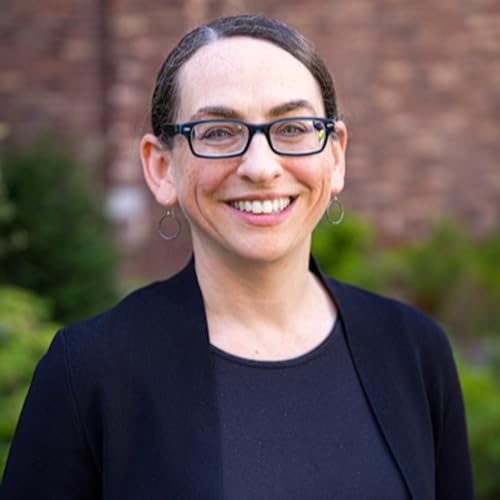
  • How Does Light Reveal Our Origins?- Professor Robert A. Simcoe
    Jun 22 2026

    Professor Robert Simcoe is the Director of the MIT Kavli Institute for Astrophysics and Space Research, and one of the world's leading astrophysicists on spectroscopy and the early universe.

    In this episode of Astrophysics for All, Rob explains how astronomers use light to study the first stars and galaxies that formed after the Big Bang. He shares why he likes to say that "if a picture is worth a thousand words, then a spectrum is worth a thousand pictures," and reveals how a beam of starlight can tell us about the composition, motion, and history of objects billions of light-years away.

    We also discuss what it's like to design and build cutting-edge astronomical instruments, the excitement of detecting photons that have travelled for over 13 billion years, and how telescopes allow us to look back in time and uncover the universe's origin story.

    Show More Show Less
    27 mins
  • Finding the Missing Matter Between Galaxies - Isabel Medlock
    Jun 22 2026

    How do you study something you can't see?

    In this episode, Yale astronomy PhD candidate Isabel Medlock explains how astronomers use powerful computer simulations and mysterious fast radio bursts to investigate the invisible universe. We discuss the cosmic web, the search for the universe's missing matter, and how scientists can effectively "rebuild" the cosmos inside a computer to understand how it evolved over billions of years.

    We also chat about life as a computational cosmologist, the importance of making science accessible, and what advice Isa would give to students hoping to pursue astrophysics themselves.

    Show More Show Less
    19 mins
  • Reading the Fossil Record of the Milky Way - Dr Jesse van de Sande
    Jun 19 2026

    Are galaxies truly eternal, or do they have lifecycles just like living things?

    In this episode of Astrophysics for All, I speak with Dr Jesse van de Sande, astrophysicist and lecturer at UNSW, about how galaxies form, evolve, and eventually stop producing new stars. We explore the idea of "zombie galaxies," the future collision between the Milky Way and Andromeda, and how astronomers use the motions of stars to reconstruct events that occurred billions of years ago.

    Jesse also explains how cutting-edge techniques such as integral field spectroscopy allow researchers to map galaxies in unprecedented detail, and shares insights into life as a professional astrophysicist.

    Show More Show Less
    22 mins
  • Why Finding Life Is Harder Than We Thought - Professor Sara Seager
    Jun 3 2026

    Professor Sara Seager is one of the world's leading exoplanet scientists and a professor of planetary science and physics at the Massachusetts Institute of Technology. Her research has helped shape the modern search for planets beyond our Solar System and the quest to discover life elsewhere in the universe.

    In this episode of Astrophysics for All, Professor Seager discusses how astronomers use spectroscopy to study exoplanet atmospheres, what scientists mean by a "biosignature", and why proving the existence of extraterrestrial life is far more difficult than many people realise. She also explains the science behind Project Starshade, reflects on the revolutionary impact of the James Webb Space Telescope, and shares why Venus has re-emerged as one of the most intriguing worlds in our Solar System.

    Along the way, Professor Seager offers valuable advice for students interested in astrophysics and STEM, discussing confidence, curiosity, and the importance of building connections throughout your scientific journey.

    Show More Show Less
    22 mins
  • The Smallest Galaxies Hold the Biggest Clues - Professor Marla Geha
    May 24 2026

    In this episode of Astrophysics for All, I’m joined by Professor Marla Geha, Professor of Astronomy and Physics at Yale University and an award-winning educator whose research focuses on dwarf galaxies and dark matter.

    We explore how some of the faintest and smallest galaxies in the universe could help answer some of cosmology’s biggest questions. Professor Geha explains how astronomers detect invisible dark matter through the motion of stars, why dwarf galaxies are so important for understanding galaxy formation, and how modern digital sky surveys are transforming astronomy.

    Show More Show Less
    24 mins
  • Awe, Exoplanets, and the Future of Astronomy - Dr. Emma Cain Louden
    May 24 2026

    Astronomy has long captivated human curiosity, but how can it reshape our lives and communities? Dr. Emma Cain Louden is a passionate astrophysicist with a PhD from Yale University, and serves as the president of Slooh, a platform that democratises access to astronomy by allowing people around the world to use remotely operated telescopes. Her work bridges the gap between complex scientific concepts and relatable experiences, making astronomy relevant to a wider audience.

    Show More Show Less
    23 mins
  • The Biggest Thing We Can’t See: Dark Matter - Professor Céline Bœhm
    May 3 2026

    In this episode of Astrophysics for All, I’m joined by Professor Céline Bœhm, an astroparticle physicist and Professor of Particle Physics at the University of Sydney, whose research focuses on dark matter and the fundamental structure of the universe.

    Although we can’t see dark matter directly, it makes up most of the matter in the universe. So how do we know it exists — and why has it been so difficult to detect?

    In this conversation, we explore how scientists use galaxies, the cosmic microwave background, and particle physics to piece together clues about dark matter’s nature. We also discuss how theorists and experimentalists work together, what makes dark matter such a challenging problem, and what discovering it could mean for our understanding of the universe.

    Professor Bœhm also shares her journey into astrophysics and her advice for students interested in exploring physics at the intersection of the very small and the very large.

    Show More Show Less
    19 mins
  • Where Should We Look for Life in the Universe? - Dr Ben Montet
    Apr 4 2026

    Dr Ben Montet is a Scientia Associate Professor at UNSW Sydney. He completed his PhD in astrophysics at Caltech and was a Carl Sagan Fellow at the University of Chicago. Dr Montet is a leading exoplanet researcher who uses data from missions like NASA’s Kepler and TESS to discover and study planets beyond our Solar System, uncovering the diversity of planetary systems across our galaxy.

    In our conversation, we explore how astronomers detect planets using tiny dips in starlight, and how missions like Kepler and TESS have revolutionised exoplanet discovery. We also discuss his research on a “hot Jupiter” that revealed a hidden companion planet, challenging current models of planetary systems.

    We then look at how stars influence whether life is possible, from flares to magnetic activity, and how machine learning is helping uncover new discoveries in massive datasets. Finally, Dr Montet shares his journey into astronomy and advice for students, emphasising curiosity, coding, and taking initiative early.

    Show More Show Less
    21 mins