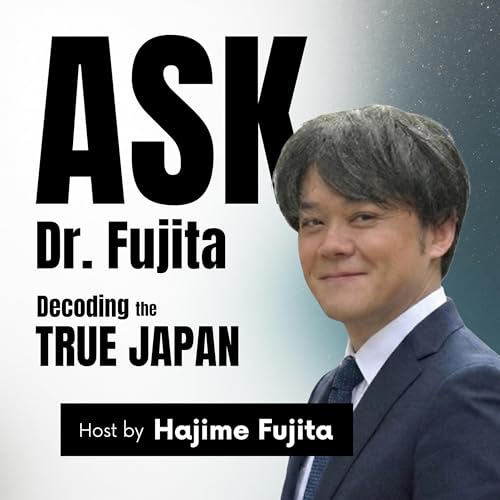
Ask Dr. Fujita - Decoding the True JAPAN! cover art

Ask Dr. Fujita - Decoding the True JAPAN!

Ask Dr. Fujita - Decoding the True JAPAN!

By: Hajime Fujita Ph.D.
Listen for free

About this listen

Stop Sightseeing. Start Reverse-Engineering. Tired of clichés? Welcome to "Decoding Japan with Dr. Fujita." Hosted by Dr. Hajime Fujita, a Tokyo-based AI Consultant with a Ph.D. in Machine Learning, this podcast treats Japanese society as a highly optimized operating system. For the intellectually ambitious, Japan is an encrypted black box. Dr. Fujita applies systems architecture to decode its "True Japan" logic—from the Omakase algorithm to invisible business protocols. New episodes every Tue & Fri. Subscribe to upgrade your mental model of the G7’s most enigmatic nation.Hajime Fujita, Ph.D. Social Sciences
Episodes
  • The Master Password "Sumimasen": Why Japanese Apologize to Say Thank You
    Feb 10 2026

    [Introduction] If you only learn one word before visiting Japan, make it "Sumimasen." It translates to "I'm sorry," but Japanese people use it to order food, ask for help, and even to say "Thank you." Why do Japanese people apologize when receiving a gift? In this episode, Dr. Fujita decodes this "Master Password" to Japanese society. Discover why this single word acts as a "Swiss Army Knife" for communication and how it functions as a social lubricant to prevent friction in a high-context culture.


    [What You'll Learn]

    • The Swiss Army Knife: How "Sumimasen" functions as Apology, Attention, and Gratitude simultaneously.
    • The Logic of Debt: Why Japanese people focus on the "cost" you incurred for them rather than the benefit they received.
    • Etymology Revealed: The literal meaning of "It is not finished" and how it expresses deep respect.
    • The "Ping" Command: Using "Sumimasen" to signal non-aggression and avoid "Meiwaku" (nuisance).
    • A Critical Warning: Why saying "Sumimasen" during an accident is a social ritual, not an admission of legal liability.


    [About the Podcast] Dr. Fujita, an AI Consultant based in Tokyo, analyzes the logic behind Japanese business and culture. This isn't a sightseeing guide—it's an intellectual journey to decode the "True Japan."


    [Topics] Sumimasen, Japanese Language, Japan Travel, Etiquette, Apology, Gratitude, Meiwaku, Japanese Culture, Communication, Linguistics, Social Psychology

    Show More Show Less
    6 mins
  • #10 The 7-Minute Miracle: Decoding the Shinkansen's F1 Pit Stop
    Feb 6 2026

    [Introduction] The Shinkansen is famous for being the world's fastest train, but did you know its most impressive performance happens when it's stopped? At Tokyo Station, the cleaning team known as "TESSEI" has only 7 minutes to perfectly reset an entire train. Dr. Fujita decodes this "7-Minute Miracle," analyzing how an F1 pit-stop mentality, hidden technology, and a "cast member" mindset turned a cleaning job into a world-class hospitality show.


    [What You'll Learn]

    • The "F1 Pit Stop" Method: How "Motion Economy" allows staff to clean 100 seats in seconds.
    • The "Magic Wand": The hidden sensor technology used to detect invisible moisture on seats.
    • Zen Design: Why aligning window blinds to the millimeter eliminates "visual noise" for passengers.
    • From Cleaners to Cast: How rebranding the job definition ignited a culture of "Kaizen" (improvement) and pride.
    • The Final Bow: The ritual of respect that earns applause from international travelers.


    [About the Podcast] Dr. Fujita, an AI Consultant based in Tokyo, analyzes the logic behind Japanese business and culture. This isn't a sightseeing guide—it's an intellectual journey to decode the "True Japan."


    [Topics] Shinkansen, Bullet Train, TESSEI, 7-Minute Miracle, Kaizen, Omotenashi, Japanese Culture, Efficiency, Tokyo Station, Humanware, Motion Economy

    Show More Show Less
    6 mins
  • #9 The Vending Machine Empire: Why Japan Has 4 Million Safes on the Street
    Feb 3 2026

    [Introduction] In most countries, vending machines are locked in cages to prevent theft. In Japan, over 4 million of them sit unguarded on street corners, functioning as "safes" filled with cash and products. Why aren't they vandalized? Dr. Fujita decodes the "Vending Machine Empire," revealing how these glowing boxes serve as monuments to public safety, eco-friendly engineering marvels, and critical disaster infrastructure that saves lives during earthquakes.


    [What You'll Learn]

    • Monuments of Peace: Why the existence of unguarded machines acts as a visible index of Japan's public safety.
    • Hot & Cold Magic: The "Heat Pump" technology that allows hot corn soup and cold cola to exist side-by-side.
    • The Frozen Revolution: How you can now buy restaurant-quality ramen, dumplings, and even sashimi 24/7.
    • The "Atari" System: The gamification of shopping where you can win a free drink via a digital roulette.
    • Guardians of the Street: How machines automatically unlock to provide free food and water during natural disasters.


    [About the Podcast] Dr. Fujita, an AI Consultant based in Tokyo, analyzes the logic behind Japanese business and culture. This isn't a sightseeing guide—it's an intellectual journey to decode the "True Japan."


    [Topics] Vending Machines, Jidohanbaiki, Japan Travel, Public Safety, Technology, Heat Pump, Cashless Payment, Disaster Infrastructure, Corn Soup, Ramen, Japanese Culture

    Show More Show Less
    6 mins
No reviews yet