• Wolf: Loyalty, Instinct and the Wisdom of Community
    Jun 14 2026

    Send us Fan Mail

    Wolves don’t just hunt. They teach, remember, negotiate, mourn, and somehow still get reduced to a fairy-tale villain. We’re flipping that script with a fast-moving tour through real wolf behavior, wolf pack dynamics, and the surprising science of how wolves communicate mostly without sound, using nuanced facial expression and body language to keep social bonds strong and pups learning.

    We also revisit the hard history that shaped today’s wolf conservation debate: the early 1900s push toward extermination, the conflict with livestock and agriculture, and why wolves learned to fear humans. From there, we follow the modern comeback, including Yellowstone wolf reintroduction and what a successful species recovery can look like when protections hold. Along the way we talk about neophobia, how packs reduce bloodshed through ritualized conflict, how elders pass on “territory secrets,” and why stories of wolves caring for the injured and grieving their dead challenge what we assume about wild predators.

    Then the lens widens to ecology and adaptation: wolves as ecosystem engineers influencing prey movement, vegetation regrowth, and even riverbanks through trophic cascades. We get into weather scents, den design, hunt failure rates and learning, long-distance tracking, and the winter teamwork that keeps packs alive. The closing idea is personal: the wolf as a model for independence with connection, creativity with loyalty, and trusting instinct without losing the pack.

    If this reshapes how you see wolves, subscribe, share the episode with a friend in your "pack" and leave a review so more listeners can find it.

    • Email any questions to info@animalssacredwisdom.com
    • Visit us at @AnimalsSacredWisdom on Youtube

    Listen to what the natural world has been saying all along!

    Show More Show Less
    14 mins
  • Deer: Strength in Softness
    Jun 9 2026

    Send us Fan Mail

    What can deer teach us about awareness, gentleness, survival, and adaptation? In this episode of Animals Sacred Wisdom, we explore deer behavior, deer symbolism, wildlife biology, and the spiritual meaning of deer through science, observation, and personal experience.

    Deer look gentle, but their design is pure survival engineering and it is full of surprises. I break down the deer “superpowers” most people never notice: wide-angle vision, strong night sight, ultraviolet light perception, and the tradeoff of weaker depth perception. We also get into their athletic edge, including huge leaps, fast swimming, and how hollow winter hair increases buoyancy like a natural life jacket. From there, we move into the parts that feel almost unbelievable until you see the logic. A buck’s antlers can grow at an astonishing rate, and that growth can pull calcium from the body.

    I also share the moment that confused me for years: seeing a doe show up with a tiny fawn, then later seeing her alone. The answer is a brilliant protection strategy, because newborn fawns have almost no scent and mothers hide them in separate spots while staying away to avoid drawing predators.

    Then we tackle a topic that matters for anyone who loves wildlife: what to feed deer and what not to feed them. I explain why “deer corn” is not a helpful staple, how it can disrupt a deer’s specialized digestion, and what better alternatives look like, from native plantings to regulated supplemental feed where allowed.

    We close with the bigger question behind “overpopulation,” plus the spiritual and cultural symbolism of deer and a simple ethical line I live by: Compassion is an Action. We coexist and deer has many lessons for us.

    If this gave you a new way to see deer and your role in their habitat, subscribe, share the episode, and leave a review so more people can find it.

    • Email any questions to info@animalssacredwisdom.com
    • Visit us at @AnimalsSacredWisdom on Youtube

    Listen to what the natural world has been saying all along!

    Show More Show Less
    14 mins
  • Owl: Seeing What Others Miss
    Jun 4 2026

    Send us Fan Mail

    Owls feel familiar until you look closely, and then everything gets weird in the best way. I’m Carol Butler, and I’m unpacking the surprising owl facts most of us never learn: owls don’t have round “eyeballs,” their eyes are tube-shaped and fixed in place, and they make up for it with an incredible 270-degree neck rotation. The real magic isn’t supposed wisdom, it’s perception built for darkness, precision, and patience.

    We dig into the anatomy that turns owls into expert nighttime hunters, including asymmetrical ears that create “3D hearing,” silent flight powered by serrated feathers, and the unexpected evolutionary trade-off of having almost no sense of smell. We also clear up common myths, like the rumor that an owl can carry off a 20-pound dog or a baby, and we explore why not all owls hoot. From barn owl screeches to saw-whet calls that sound like a whetstone, owl vocalizations are a whole world of their own.

    Then we zoom out to the bigger story: owl habitat, adaptability, and the hard truth that humans are one of their greatest threats through habitat destruction, car strikes, and rodenticides. Finally, we connect owl symbolism and spiritual meaning to real life, using the owl as a reminder to filter distractions, notice hidden truths, and move through uncertain seasons by trusting discernment. If you’ve ever heard an owl and never seen it, what did it bring up for you?

    Subscribe, share this with a friend who loves nature, and leave a review so more listeners can find the show. What’s the most unforgettable owl moment you’ve had?

    • Email any questions to info@animalssacredwisdom.com
    • Visit us at @AnimalsSacredWisdom on Youtube

    Listen to what the natural world has been saying all along!

    Show More Show Less
    14 mins
  • Fire Horse: Why Animal Symbols Still Shape Us
    May 30 2026

    Send us Fan Mail

    A Fire Horse year comes around once every 60 years, and that rarity is exactly why people have treated it like a signal flare for change. I’m Carol Butler, and I’m exploring the Fire Horse not as a test of whether Chinese astrology “works,” but as a window into something more human and more timeless: our need to use animals as symbols for personality, fear, courage, and transformation.

    We walk through how the Chinese zodiac measures time through the lunar calendar, pairing 12 animals with five elements to create a repeating 60-year cycle. From there, the story gets surprisingly real. The Fire Horse carries a complicated cultural history, including stigma that affected women born in 1966 and even contributed to a drop in births that year. It’s a stark reminder that symbolism isn’t just decorative, it can influence family choices, traditions, and social expectations. How will you meet change?

    Then we get practical and personal. The Horse stands for freedom, movement, independence, and vitality, and Fire adds passion, bold action, and intensity. That energy can be a gift when you need momentum, but it can also tip into rushing, burnout, or change without direction. The question I keep coming back to isn’t whether change will arrive, but how consciously we’ll meet it, especially as we look ahead to 2026 and what a “Fire Horse” mindset asks of us.

    If this kind of animal symbolism and inner work resonates, subscribe to Animal Sacred Wisdom, share the episode with a friend, and leave a review so more listeners can find the show.

    • Email any questions to info@animalssacredwisdom.com
    • Visit us at @AnimalsSacredWisdom on Youtube

    Listen to what the natural world has been saying all along!

    Show More Show Less
    10 mins
  • THE HAWK: When Life Quietly Asks You To Change
    May 23 2026

    Send us Fan Mail

    Something keeps showing up when you’re on the edge of change, and it doesn’t feel random anymore. For me, it’s hawks. Not as a mystical guarantee, not as a doctrine, but as a repeated nudge toward awareness and perspective when my life is quietly outgrowing itself. If you’ve been seeing the same pattern again and again, this conversation gives you a grounded way to work with it without forcing a supernatural story.

    I dig into what makes hawks so fascinating in the first place: their unmatched vision, precision, and ability to rise with the currents instead of fighting them. That biology becomes a practical metaphor for personal transformation, mindfulness, and decision-making. When you’re too close to a problem, you lose the wider view. When you’re reacting to everything below, you burn energy and miss the moment when clarity finally arrives.

    Then I share a true roadside rescue that still sits in my chest years later, not because it felt “magical,” but because life paused long enough for me to pay attention. A stunned hawk, a stranger who knows exactly what to do, a quick chain of help, and a quiet aftermath that feels like a reminder: awakening doesn’t always arrive dramatically. Sometimes it repeats until you notice.

    If you’re navigating a life transition, feeling restless, or sensing a pull toward something bigger, press play and listen for what your own awareness is trying to say. Subscribe, share with a friend who’s at a crossroads, and leave a review so more people can find Animal Sacred Wisdom.

    • Email any questions to info@animalssacredwisdom.com
    • Visit us at @AnimalsSacredWisdom on Youtube

    Listen to what the natural world has been saying all along!

    Show More Show Less
    15 mins
  • Butterfly: Hidden Biology And Deeper Meaning
    May 17 2026

    Send us Fan Mail

    A butterfly can appear without warning, without sound, and still hit you like a turning point. That quiet impact is where we begin, because so many of us remember the first time we truly noticed a butterfly and the feeling that stayed afterward. I’m Carol Butler, and I’m exploring why those moments can feel like reflections, not random background details, and what the butterfly might be pointing to in your own life.

    We move from symbolism into science, because the biology is part of the message. Butterflies are cold-blooded and need warmth to fly, their color is often an illusion created by light on tiny scales, and their senses reach beyond what humans can see. We also look at their survival strategies, from storing toxins to tasting with their feet, and how these details reshape the “pretty” stereotype into something tougher, smarter, and more intentional.

    Then we step inside the chrysalis where the real mystery lives: the caterpillar dissolves and reorganizes into a new form, yet research and storytelling suggest something can carry forward. I share an experiment-style story about learned smell avoidance that appears to persist from caterpillar to butterfly, even raising the possibility of memory across generations, and we sit with the deeper human questions this brings up. We also unpack a cautionary tale about “helping” a butterfly too soon, and why struggle is sometimes the very thing that makes flight possible.

    If you’ve been changing, grieving, starting over, or outgrowing an old self, this conversation offers language and grounding for the process, blending butterfly metamorphosis, transformation, nature connection, and nervous system calm into one thread. Subscribe, share the show with someone who loves the natural world, and leave a review, then tell me: if you see a butterfly today, what in you is changing?

    • Email any questions to info@animalssacredwisdom.com
    • Visit us at @AnimalsSacredWisdom on Youtube

    Listen to what the natural world has been saying all along!

    Show More Show Less
    13 mins
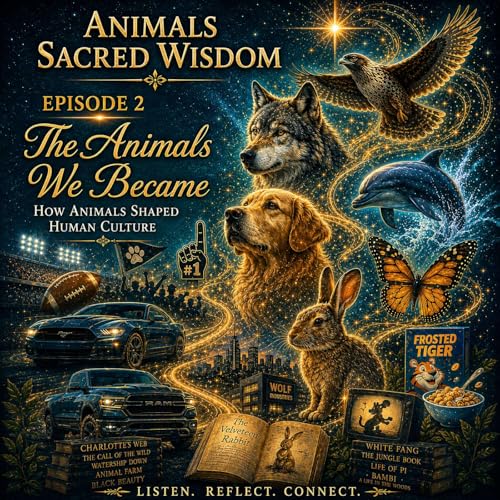
  • Animals We Became: How Humans Borrow Animal Powers
    May 10 2026

    Send us Fan Mail

    Animals are so stitched into modern life that we barely see them. We drive a Bronco, cheer for the Panthers, read stories packed with rabbits and bears, and describe people as wolves, hawks, or lions without pausing to ask why that language lands so fast in our minds. Learning to think about how animal attributes impact our perceptions about ourselves and what we chose to be in our lives is revealing.

    We pull on that thread and it keeps going. We talk about animal symbolism in car and truck names and how a single animal can communicate ruggedness, speed, luxury, strength, or agility in seconds. We look at sports teams and mascots as identity shorthand, then zoom out to cartoons, books, dances, and the way pop culture turns animals into lifelong emotional reference points. Along the way, we connect these everyday examples to older roots in mythology and sacred traditions, including the reflective lens of animal medicine cards and what many people describe as animal totems or spirit animal themes.

    The turning point is personal: if animals are already part of how we think and describe our own instincts, fears, and hopes, what does it mean when a specific animal keeps showing up in your real, lived experience? Not as a logo or a character, but as a pattern you can’t ignore. Press play, listen closely, and then tell us what animal you’ve been noticing lately. If you enjoyed the show, follow Animal Sacred Wisdom, share it with a friend who loves nature, and leave a review so more listeners can find it.

    • Email any questions to info@animalssacredwisdom.com
    • Visit us at @AnimalsSacredWisdom on Youtube

    Listen to what the natural world has been saying all along!

    Show More Show Less
    9 mins
  • The Rabbit: Why They Matter More Than You Think
    May 4 2026

    Send us Fan Mail

    Welcome to a weekly podcast. Animals are everywhere in our lives - yet we rarely stop to think about them. In this foundational episode of Animals Sacred Wisdom, I explore a simple but powerful idea: what if animals are not background to human life, but part of the experience of it?

    Certain animals appear more than once in your life. Intentional, just passing through or are we part of something we don't understand yet?

    I once thought rabbits were fragile until I learned how they live and survive being prey to almost every animal and humans. Rabbits get up every morning and with courage venture forth without dread.

    By the way, carrots are not a favorite food...high in sugar and basically hard to come by.

    Hares are not rabbits. Let's talk about the difference even in where they go to bed and the size and speed differences are incredible.

    Down the rabbit hole is literally true for most rabbits as they build extraordinary social tunnels underground.

    Rabbits are capable of producing over 1,000 descendants in 18 months. Find out what else they do (I'm smiling).

    Rabbits teach so many things but one important thing to take away is they teach to play in joy.

    Other cultures value rabbits and revere them and I'm going to share why.

    Seeing a rabbit will remind you that it's time for self-reflection, to move past your fears, to expect new beginnings.

    Through observation, reflection and research, this episode invites you to begin noticing animals differently - without requiring belief, only awareness.

    Because sometimes the most important shift begins with simply paying attention.


    • Email any questions to info@animalssacredwisdom.com
    • Visit us at @AnimalsSacredWisdom on Youtube

    Listen to what the natural world has been saying all along!

    Show More Show Less
    16 mins