Episodes

  • Winka Dubbeldam: Architecture and hybridity.
    Jun 18 2026

    What if buildings could free themselves – or be freed by their architects – of the stricture of type, of discrete identity, of typology? What might happen if, for example, a school and a house - schoolness and houseness – were hybridized? What if building and non-building, even, were wedded? Might this, perhaps, offer a way to negotiate, heal even, the nature-architecture divide?

    This is not pompous and pretentious speculation, but the proposal of Winka Dubbeldam, founder-director of Archi-Tectonics and director and CEO of the Southern California Institute of Architecture (SCI-Arc), in her recent edited book, Monsters and Mutants: Explorations in the Architecture-Nature Continuum, published by Park Books in 2025, and featuring essays by Winka, Justin Korhammer, Thom Mayne, Carlo Ratti and Mette Ramsgaard Thomsen. It is also the modus operandi of her and Justin Korhammer’s New York, Los Angles and Hangzhou practice, Archi-Tectonics.

    Winka and I talk all this, and intriguing and inspiring it is. For new conditions, we probably need new typologies and a taxonomy agile enough to meet a swiftly tilting planet.

    Here is Winka at work and university. The book is linked above.

    If you want and can, please support the A is for Architecture Podcast by listening in and sharing it, or by either subscribing on Patreon or making a gift via Buy Me a Coffee.

    +

    Music credits: Bruno Gillick

    Image credit: Hybrid Stadium & Concert Hall, by SFAP.

    Show More Show Less
    53 mins
  • Paul Knox: London, heritage and capital.
    Jun 11 2026

    In this episode of the A is for Architecture Podcast, I spoke with Paul Knox, University Distinguished Professor at Virginia Tech, about his 2025 book, Lost London: From Crystal Palace to Heston Airport, a History in 25 Missing Buildings, published by Yale University Press in April this year.

    Lost London’s provocative move is to insist that ordinary buildings — a pub in Poplar, a roadhouse on a bypass, a block of council flats in Hackney — deserve the same analytical attention as a Wren church or a Robert Adam terrace. As one perhaps should expect from an urban geographer, this pushes back against the exquisite art-historical approach, which treats buildings as art objects and thereby frames architectural history around consecrated geniuses and great buildings. It is a seductive approach, for sure, but perhaps troubling in a different way. If everything means something to someone, how can we knock anything down at all?

    Paul is not much online, the lucky fella. You can find him on Grokipedia though. The book is linked above.

    If you want and can, please support the A is for Architecture Podcast by listening in and sharing it, or by either subscribing on Patreon or making a gift via Buy Me a Coffee.

    +

    Music credits: Bruno Gillick

    Image credit: London Metropolitan Archives – Colombia Road Market.

    Show More Show Less
    1 hr and 6 mins
  • Vanessa Grossman: Architecture and the communists.
    Jun 4 2026

    In this episode of the A is for Architecture Podcast, I spoke to architect and historian, Vanessa Grossman, Assistant Professor of Architecture at the University of Pennsylvania’s Weitzman School of Design, about her 2024 book, A Concrete Alliance: Communism and Modern Architecture in Postwar France, published by Yale University Press.

    Sampling only the most tantalizing soupçon of the book’s ideas, Vanessa and I discuss the relationship between the French Communist Party and postwar modernist architects, and how for them concrete served not just as a symbol of avant-garde taste but also political commitment. Architects like Oscar Niemeyer, Renée Gailhoustet, Paul Chemetov and Patrick Bouchain, and the networks of actors and actants, programs and artefacts that were activated to deliver social housing and cultural and working spaces in communist municipalities across France, as a means of delivering, ultimately, a countersociety of architects that sought to put a new vision of modernism to work towards a better version France’s nascent Fifth Republic.

    Vanessa can be found at work here and she’s on the socials too; the book is linked above.

    If you want and can, please support the A is for Architecture Podcast by listening in and sharing it, or by either subscribing on Patreon or making a gift via Buy Me a Coffee.

    +

    Music credits: Bruno Gillick

    Image credit: Jean Biaugeaud, showing the hall of the Raspail housing tower by Renée Gailhoustet, 1968.

    Show More Show Less
    1 hr and 9 mins
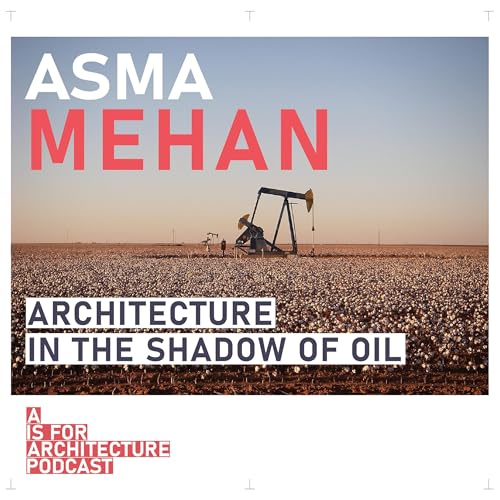
  • Asma Mehan: Architecture in the shadow of oil.
    May 28 2026

    In the latest episode of the A is for Architecture Podcast, I spoke to architect and scholar, Asma Mehan, Assistant Professor at the Huckabee College of Architecture, Texas Tech University and director of the Architectural Humanities and Urbanism Lab (AHU_Lab), about her edited volume, After Oil: A Comparative Analysis of Oil Heritage, Urban Transformations, and Resilience Paradigms, published by Springer in 2025.

    In our conversation, Asma speaks about the close link between modern architecture, urbanism and the extraction, production and consumption of oil, what Peter Droege, I think, termed Fossil City.

    Asama – and the book – however, are concerned now with the next thing: as economies look to shift away from their reliance on oil, what should and can we do with oil’s infrastructure?

    So intrinsic to the making of the present human condition, indeed to the social and cultural making of the last 120 years, are we not obliged to consider it a repository of history, like any other significant material culture? And nothing has been more important than oil, for sure, except perhaps the wars for it, so doesn’t it deserve some sort of memorialisation too?

    Asma can be found at work here; the book is linked above.

    If you want and can, please support the A is for Architecture Podcast by listening in and sharing it, or by either subscribing on Patreon or making a gift via Buy Me a Coffee.

    +

    Music credits: Bruno Gillick

    Image credit: Wikimedia. Pumpjack east of Andrews, TX (2009) by Zorin09.

    Show More Show Less
    46 mins
  • Leslie Kern: Resisting gentrification.
    May 21 2026

    In this episode of the A is for Architecture Podcast, I spoke to scholar, activist, author and feminist totem, Leslie Kern, about Gentrification is Inevitable and Other Lies, which she published with Verso in 2022. In Leslie and my conversation we speak broadly about her work and approach, some themes from the book, and how resistance is not just necessary, but possible too.

    in 1964 Ruth Glass, in her introduction to London: Aspects of Change, named the phenomenon: ‘One by one, many of the working class quarters of London have been invaded by the middle classes—upper and lower. Shabby, ‘modest mews and cottages—two rooms up and two down—have been taken over, when their leases have expired, and have become elegant, expensive residences. […] Once this process of ‘gentrification’ starts in a district, it goes on rapidly until all or most of the original working class occupiers are displaced, and the whole social character of the district is changed […] The invasion has since spread.’

    Glass implied that what is presented as urban improvement is in fact a reassertion of class hierarchy in spatial form. In recent years things have moved on, away from what might be seen as an evolutionary process of cultural and economic enrichment , where artists, bohemians, thinkers and web designers find space for their creative praxis. Now the market makes it, and the government spends its taxes to make it more likely to occur.

    Leslie can be found on her website, linked above, as is the book.

    If you want and can, please support the A is for Architecture Podcast by listening in and sharing it, or by either subscribing via links in the podcast description.

    +

    Music credits: Bruno Gillick

    Image credit: Ambrose Gillick.

    Show More Show Less
    59 mins
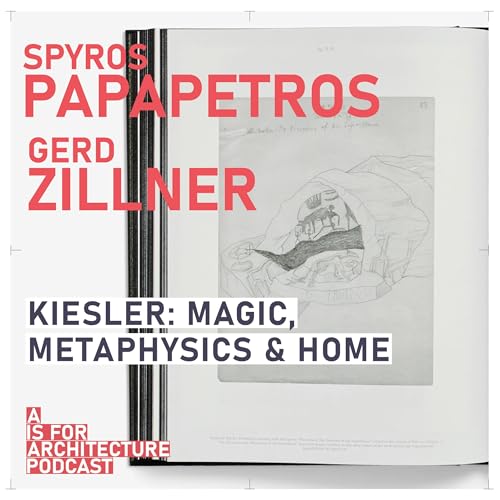
  • Spyros Papapetros and Gerd Zillner: Kiesler: magic, metaphysics and home.
    May 14 2026

    Frederick Kiesler was an Austrian-American architect, artist and theorist who, born at the tail end of the nineteenth century, bore witness to the irresistible rise of modernism in architecture and alongside it, the pyrrhic victory of amoral, individuated thinking, revealed so starkly in the mania of colonialism and the horrors of its implosion in the first half of the twentieth century.

    In this episode of the A is for Architecture Podcast, I spoke with Spyros Papapetros, Associate Professor of Architecture at Princeton University, and Gerd Zillner, Director of the Frederick and Lillian Kiesler Private Foundation, Vienna, about the great man, and particularly about his hitherto unpublished opus, Magic Architecture: The Story of Human Housing, compiled between 1944–1946 and now published for the first time by MIT Press.

    Conceived as a Neo-Vitruvian treatise, and an implicit rival to Le Corbusier's Vers une Architecture from 1923, at the heart of the book is Kiesler's central concept of magic architecture which rejected the functionalism and efficiency of Corb, Buckminster Fuller, and modern planning. Instead, Kiesler proposed an alternative history of housing grounded in magic, ritual, dream, and the integration of animal instinct with human creativity, arguing that the deepest purpose of architecture is not physical shelter but spiritual and psychological protection — the creation of dwellings that answer humanity's fundamental fears, desires, and sense of the unknown. So, prescient indeed.

    If you want and can, please support the A is for Architecture Podcast by listening in and sharing it, or by either subscribing on Patreon or making a gift via Buy Me a Coffee.

    Show More Show Less
    1 hr and 9 mins
  • Beatriz Colomina: Architecture as disease and cure.
    May 7 2026

    Bellerophon, son of Poseidon and Eurynome, slew the Chimera and, full of hubris, believed he had a rightful place on Mount Olympus among the gods and set off there on his winged horse, Pegasus. Zeus did not like this and sent a gadfly to sting Pegasus, which threw Bellerophon, who fell back to Earth and died.

    The story of modernism has maybe been a little tinged by hubris too. We have defeated all the monsters, presented an architecture and urbanism which proclaims it will do away with social and pathological ills, if only we would let it, and thus deserves a place among the deities. But perhaps, as covid showed, modernism has somewhat over-played its hand. The monsters got amongst us again.

    In this episode of the A is for Architecture Podcast - the 200th - I spoke to the great architectural historian and theorist, Beatriz Colomina, Howard Crosby Butler Professor of the History of Architecture at Princeton University, about some small parts of the recently published book, Sick Architecture, which she edited with Nick Axel, Guillermo S. Arsuaga and e-flux Architecture and published with MIT Press. In the book, 35 essays from around the world present ways architecture has both engaged with sickness as illness, but also as structure, logic and motivation.

    If you want and can, please support the A is for Architecture Podcast by listening in and sharing it, or by either subscribing on Patreon or making a gift via Buy Me a Coffee.

    +

    Music credits: ⁠Bruno Gillick

    Image credit: Borja Sanchez-Trillo/Comunidad de Madrid via Getty Images.

    Show More Show Less
    56 mins
  • Hilde Heynen & Lucía Pérez-Moreno: Feminist ecologies and architecture.
    Apr 30 2026

    If one were to be the sort of inelegant person to point such things out, one might point out that despite all the egalitarian rhetoric, we still live in an architectural culture that cultivates dominance, not in the sense of dominion as rooted in domus, home, but in the dual senses of control and territory. The star architects we are assured we must look to, the big, bold, challenging buildings they erect, condition folk to see a casual way of acting act relative to ecologies, economies, cultures and justice as normative, ideal, something to believe in.

    In this episode of the A is for Architecture Podcast, I spoke to Professor Hilde Heynen professor of architectural theory at the Katholieke Universiteit Leuven, and Professor Lucia Pérez-Moreno, Professor of History and Theory of Architecture at the University of Zaragoza in Spain.

    Together, Hilde and Lucia have gathered together a number of Hilde’s most significant essays in a new book, Architecture & Feminist Critical Theory: Selected Writings by Hilde Heynen, published by Leuven University Press in 2025 and which tracks an evolving position, which emerges out of critical theory into feminist theory and latterly towards an environmental justice, but always proposing another way of seeing things in search of another path, one that is subtle, integrated, just and with just a little less man character energy.

    Hilde is on LinkedIn can be found at work, Lucia does do the socials and can be found on Instagram and on LinkedIn. The book is linked above.

    +

    Music credits: ⁠Bruno Gillick

    Image credit: Source: Sibyl Moholy-Nagy, Matrix of Man.

    Show More Show Less
    1 hr and 10 mins