• He quit Stripe and hit $10M ARR in 4 years—with $0 marketing spend. | Anurag Goel, Founder of Render
    Jun 29 2026

    Anurag was employee #8 at Stripe, set for life and free to do anything next. Instead he spent a year and a half hunting for a problem worth decades of his life. He chose to build a product to make it simple for developers to ship apps, going head-to-head with AWS.

    In this episode, Anurag breaks down how he hit $10M ARR in 4 years with zero marketing spend, why refusing to launch a free tier was his most expensive mistake, and how putting engineers on customer support rotations quietly shaped the entire product roadmap.

    Why You Should Listen

    • Why you don't have real product market fit until your users sell the product for you.
    • How a sub-2-minute setup turned developers into a word-of-mouth machine.
    • Why skipping a free tier for years was his most expensive mistake.
    • How engineers doing support on rotation built the roadmap—and 6M+ developers.

    Keywords startup podcast, startup podcast for founders, product market fit, finding pmf, developer tools, cloud infrastructure, PaaS, Render, word of mouth growth, product-led growth, AI infrastructure, Stripe


    Chapters

    • 00:00:00 Intro
    • 00:01:44 The Moment of True Product Market Fit
    • 00:04:14 The #1 Driver of Word of Mouth
    • 00:13:25 Why He Left Stripe to Build Render
    • 00:23:48 Why AWS Would Never Build This
    • 00:30:33 $10M ARR With No Marketing Spend
    • 00:36:43 Engineers as the Support Team
    • 00:42:19 Riding the AI Boom

    Send me a message to let me know what you think!

    Show More Show Less
    48 mins
  • He shut down his last startup and gave the money back—then hit $1M ARR in 6 months. | George, Founder of Monk
    Jun 22 2026

    George had to wind down his last startup and give investors their money back. He went deep into the valley of despair, certain he'd missed his window to build something big. Then he met a co-founder, decided to start over, and started selling.

    In this episode, George breaks down how a customer signed a $36K pilot off nothing but a Loom and a one-pager, how cold email took him from zero to $1M ARR with no sales team, and why a "seven out of ten" is the most dangerous hire you can make.

    Why You Should Listen

    • How a customer signed a $36K pilot after a single Loom and zero calls.
    • Why he gave the money back on his last startup—and what "follow your energy" really means.
    • How cold outbound email built his first $1M ARR with no sales team.
    • Why a "seven out of ten" is the most dangerous hire you can make.

    Keywords startup podcast, startup podcast for founders, product market fit, finding pmf, fintech, accounts receivable automation, AI agents, cold outbound email, B2B SaaS, Series A fundraising, services as software


    Chapters

    • 00:00:00 Intro
    • 00:01:39 The Moment of True Product Market Fit
    • 00:03:33 Shutting Down a Small-Market Startup
    • 00:07:44 Picking Fintech From Five Ideas
    • 00:17:12 From Black Box to Full App
    • 00:24:47 $1M ARR on Cold Email Alone
    • 00:36:11 Why a "Seven" Is the Most Dangerous Hire
    • 00:42:15 Compressing a $25M Series A

    Send me a message to let me know what you think!

    Show More Show Less
    46 mins
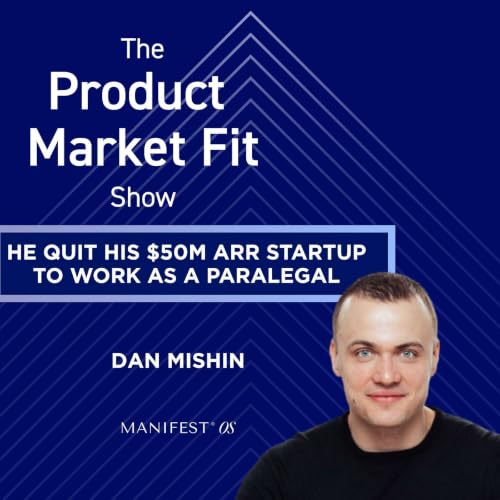
  • He quit his $50M ARR startup to work as a paralegal—then raised a $60M Series A. | Dan Mishin, Founder of Manifest
    Jun 15 2026

    Dan founded and scaled a $50M ARR, SoftBank-backed startup—and could've stayed to make tens of millions. Instead, he handed it to his chief of staff and started from scratch. He wanted something bigger. He took an entry-level paralegal job to learn everything about law hands on. Then he built Manifest, which just raised a $60M Series A.

    In this episode, Dan breaks down why he did intake calls for 1,000 legal clients before building anything, how free Slack communities turned Fortune 500 HR managers into buyers without a dollar of ads, and why he refused to sell software to law firms even when investors told him he was crazy.

    Why You Should Listen

    • How 2 months working as a paralegal beat years of customer discovery.
    • How free Slack communities turned Fortune 500 HR managers into clients.
    • Why earned media compounds like an asset while paid ads burn like an expense.
    • Why impact is the best driver for starting startups.

    Keywords startup podcast, startup podcast for founders, product market fit, finding pmf, legal tech, legal AI, AI-native law firm, immigration law, services as software, community-led growth, earned media, customer discovery, Dan Mishin, Manifest


    Chapters

    • 00:00:00 Intro
    • 00:06:34 Walking Away from $50M ARR
    • 00:13:12 Why Immigration Law Has AI Leverage
    • 00:18:01 The AI-Native Law Firm Model
    • 00:21:49 1,000 Intake Calls Before Building Anything
    • 00:30:21 Turning Free Communities Into Buyers
    • 00:37:20 Earned Media That Compounds

    Send me a message to let me know what you think!

    Show More Show Less
    43 mins
  • He churned 100% of his revenue on purpose—then grew 10x to $2M ARR in under 12 months. | Ali Khokhar, Founder of Amigo AI
    Jun 8 2026

    Ali quit his job a few months after ChatGPT launched, convinced AI would eat labor marketplaces like Upwork. With no co-founder and no code, he collected $12K from real customers—using a faked demo and a cloned voice. Then he pitched 100 VCs in 10 days and got 47 straight 'no's.

    In this episode, Ali breaks down how he banked $12K in revenue before writing a single line of code, how a $20/month Slack community drove Amigo's first $1M in ARR, and why he churned every existing customer to go all-in on $100K+ healthcare enterprise deals.

    Why You Should Listen

    • Why validation only counts when dollars exchange hands.
    • How a $20/month paid community turned into $1M in ARR.
    • Why he refunded every customer and churned 100% of his revenue.
    • Why founders must sell the first $2M themselves before hiring an AE.

    Keywords startup podcast, startup podcast for founders, product market fit, finding pmf, AI agents, healthcare AI, enterprise sales, pre-seed fundraising, community-led growth, customer validation, pivot, Amigo AI

    Chapters

    • 00:00:00 Intro
    • 00:08:37 From Upwork to Starting Amigo
    • 00:13:30 $12K in Revenue Before Writing Code
    • 00:23:24 Pitching 100 VCs in 10 Days
    • 00:30:20 47 No's—Then FOMO Took Over
    • 00:37:12 The $20/Month Community Behind the First $1M
    • 00:45:47 Churning 100% of Revenue on Purpose
    • 00:01:49 The Moment of True Product Market Fit

    Send me a message to let me know what you think!

    Show More Show Less
    53 mins
  • He hit $1M ARR by sending 500,000 cold emails—then raised a $25M Series A in 6 days. | Mark Hughes, Co-Founder of Solidroad
    Jun 1 2026

    Mark was running a startup out of a tiny annex office in Dublin with zero product usage. Then one customer turned it on and overnight he saw usage spike to thousands of simulations. He got to $1M ARR 100% through outbound, by sending 500,000 cold emails. A few months ago he closed a $25M Series A.

    In this episode, Mark breaks down the pivot from sales roleplay to customer support that unlocked his first real traction, the cold outbound playbook that took him to $1M ARR (500K emails, 250 meetings, 40 customers), and why doorstepping customers in Utah is what drove his net revenue retention to 186%.

    Why You Should Listen

    • Exactly how to use a cold outbound strategy to hit $1M ARR.
    • Why getting on 56 flights last year to visit customers led to 186% NRR.
    • How he closed a $25M Series A in just 6 days.

    Keywords startup podcast, startup podcast for founders, product market fit, finding pmf, AI startup, customer support, cold outbound, Y Combinator, Series A, enterprise sales, SaaS, Solid Road


    Chapters

    • 00:00:00 Intro
    • 00:06:10 The Pivot From Sales to Customer Support
    • 00:12:54 Why Moving to SF Changed Everything
    • 00:22:34 Cold Outbound to $1M ARR
    • 00:32:47 Doorstepping Customers for 186% NRR
    • 00:39:17 Closing a $25M Series A in 6 Days

    Send me a message to let me know what you think!

    Show More Show Less
    43 mins
  • Q1 2026 w/Carta: What you need to raise a Series A. | Peter Walker, Head of Insights at Carta
    May 25 2026

    The AI boom is making founders feel like the market is wide open, but the data tells a sharper story: valuations are up, round sizes are bigger, and the bar to “count” in a top-tier fund’s Monday meeting keeps rising. We sit down with Peter to translate Q1 2026 venture capital trends into founder reality, from seed-stage pricing distortions driven by AI infrastructure to the quieter pressure building across the rest of the startup market.

    We get specific on early-stage fundraising benchmarks and why Series A now looks riskier than many people assume. Median Series A valuations have climbed close to 2x in a few years, while typical raises jumped from roughly $8M to $10M to $13M to $15M. That changes everything: ownership targets, follow-on costs, and the outcome math that pushes investors (and founders) toward “decacorn-plus” expectations. If you are pitching $100M ARR as the endgame, you may already be behind.

    Then we zoom out to the forces shaping who wins: Bay Area gravity, a real valuation gap versus other hubs, and practical tactics like visiting the Bay to capture network effects without uprooting your life. We also dig into defensibility in AI application startups, where building is faster but competition is fiercer, plus the rise of smaller teams and solo founders, and what that means for hiring, equity, and motivation on early teams.


    Chapters

    • 00:00:00 LLM Hype And Bubble Warning
    • 00:02:13 Five Stars Then We Begin
    • 00:03:02 Seed Prices Spike In AI Infra
    • 00:07:10 2026 Benchmarks For Pre-Seed To A
    • 00:09:36 Series A Doubles And Exit Math
    • 00:12:54 Bay Area Gravity And Valuation Gap
    • 00:18:22 Defensibility Gets Harder In AI Apps
    • 00:23:22 Smaller Teams Solo Founders Talent Shifts
    • 00:35:20 VC Fund Shakeout And Final Share Ask

    Send me a message to let me know what you think!

    Show More Show Less
    38 mins
  • How to get a VC (like me) to wire you $2M in under 2 weeks (the FOMO playbook) | Solo Episode
    May 18 2026

    I meet 1,000+ founders every year. Most are bad at fundraising.

    I also interview 100+ of the world's best founders on my podcast each year. Most are incredible at fundraising.

    One raised $14M in 17 days. another was 3x oversubscribed on a $3M round. another closed a seed in hours from a single X post. All are first-time, unproven founders.

    They don't waste time becoming "friends" with VCs. They have a business to build. They treat fundraising for what it is: a process where you manufacture FOMO as fast as possible, take the money, and move on.

    This video breaks down the 4 steps the best fundraisers use to raise fast. The same 4 steps taught at YC and 500 Startups (where i went). The same 4 steps you can run on thousands of VCs worldwide to close $2-3M in weeks not months.

    Why You Should Listen

    • Why you need to reach out to 50 VCs on the same day just to end up with three term sheets.
    • How to engineer intro blurbs that make VCs feel like they're already late to the game.
    • Why setting fake deadlines is the fastest way to destroy all your credibility with investors.
    • How one founder raised $3M in five weeks by starting with a $1.5M target and driving FOMO.

    Keywords startup podcast, startup podcast for founders, product market fit, finding pmf, fundraising, raising a seed round, VC pitch, FOMO, startup fundraising playbook, term sheets, investor meetings, Pablo Srugo, venture capital

    Chapters

    • 00:00:00 Intro
    • 00:01:30 Step 1: Build a List of 50 Qualified VCs
    • 00:06:00 Step 2: Engineer the Intros
    • 00:14:00 Step 3: Compress the Timeline
    • 00:20:00 Step 4: Manufacture FOMO
    • 00:26:00 Three Rules to Never Break

    Send me a message to let me know what you think!

    Show More Show Less
    22 mins
  • Coinbase's ex-CPO bet on AI agents before ChatGPT—now he's closing 7-figure Fortune 500 deals. | Surojit Chatterjee, Founder of Ema
    May 11 2026

    Surojit spent 14 years at Google building mobile ads into a $100B+ business and then took Coinbase public as Chief Product Officer in 2021. In early 2023, before "agent" was even a word in AI papers, he started Ema in stealth—betting on a future where teams of AI agents would replace the "human glue" inside Fortune 500s.

    In this episode, Surojit breaks down how a Hitachi deployment across 55,000 employees became Ema's true PMF moment, why he spent the first year obsessed with SOC 2, ISO 42001, and air-gapped architecture before chasing revenue, and why one client just cut their HR team from 1,000 people to 550 by automating 65,000 monthly job changes.

    Why You Should Listen

    • Why true PMF is when your average salesperson can sell the product without you in the room.
    • How a single Hitachi deployment unlocked credibility for every Fortune 500 deal that followed.
    • Why a cold email—not a warm intro—turned into Ema's largest partner today.
    • How partnering with PwC and KPMG became a faster wedge into the C-suite than any conference.

    Keywords startup podcast, startup podcast for founders, product market fit, finding pmf, AI agents, enterprise AI, AI employees, Fortune 500 sales, Surojit Chatterjee, Ema, agentic AI, enterprise software


    Chapters

    • 00:00:00 Intro
    • 00:02:00 Hitachi Was the PMF Moment
    • 00:04:10 What Ema Actually Does
    • 00:11:48 From Coinbase to a Pre-ChatGPT Bet
    • 00:28:48 The Cold Email That Won a Top Partner
    • 00:30:52 Small Dinners Beat Massive Conferences
    • 00:36:11 The Moment of True Product Market Fit

    Send me a message to let me know what you think!

    Show More Show Less
    37 mins