

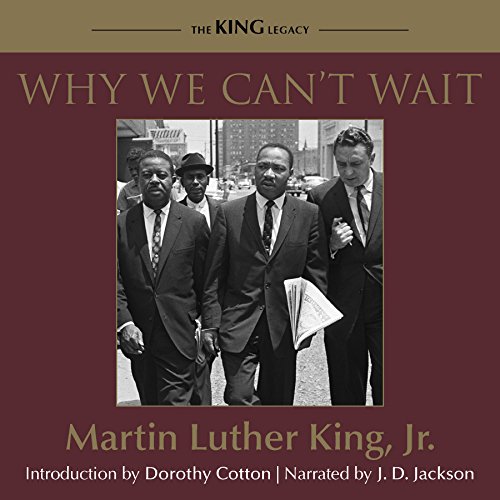
Why We Can't Wait
Ürünler eklenemedi
Üzgünüz, sepetiniz kapasiteye ulaştığı için bu ürünü ekleyemedik.
Sepete ekleme başarısız oldu.
Lütfen daha sonra tekrar deneyin
İstek Listesine ekleme başarısız oldu.
Lütfen daha sonra tekrar deneyin
İstek listesinden kaldırma başarısız oldu.
Lütfen daha sonra tekrar deneyin
Kütüphaneye ekleme başarısız oldu
Lütfen tekrar deneyin
Podcast takip edilemedi
Podcast takibi bırakma başarısız oldu.
Standard'ı 30 gün ücretsiz edinin
Deneme süresinden sonra aylık 5,99£. Aylık olarak iptal edilir.

Why We Can't Wait
Seslendiren:
JD Jackson
12,78£ karşılığında satın al
-
Seslendiren:
-
JD Jackson
On April 16, 1963, as the violent events of the Birmingham campaign unfolded in the city’s streets, Dr. Martin Luther King, Jr., composed a letter from his prison cell in response to local religious leaders’ criticism of the campaign. The resulting piece of extraordinary protest writing, “Letter from Birmingham Jail,” was widely circulated and published in numerous periodicals. After the conclusion of the campaign and the March on Washington for Jobs and Freedom in 1963, King further developed the ideas introduced in the letter in Why We Can’t Wait, which tells the story of African American activism in the spring and summer of 1963. During this time, Birmingham, Alabama, was perhaps the most racially segregated city in the United States, but the campaign launched by King, Fred Shuttlesworth, and others demonstrated to the world the power of nonviolent direct action.
Often applauded as King’s most incisive and eloquent book, Why We Can’t Wait recounts the Birmingham campaign in vivid detail, while underscoring why 1963 was such a crucial year for the civil rights movement. Disappointed by the slow pace of school desegregation and civil rights legislation, King observed that by 1963—during which the country celebrated the one-hundredth anniversary of the Emancipation Proclamation—Asia and Africa were “moving with jetlike speed toward gaining political independence but we still creep at a horse-and-buggy pace.”
King examines the history of the civil rights struggle, noting tasks that future generations must accomplish to bring about full equality, and asserts that African Americans have already waited over three centuries for civil rights and that it is time to be proactive: “For years now, I have heard the word ‘Wait!’ It rings in the ear of every Negro with piercing familiarity. This ‘Wait’ has almost always meant ‘Never.’ We must come to see, with one of our distinguished jurists, that ‘justice too long delayed is justice denied.’”
A King Legacy Series Book
adbl_web_anon_alc_button_suppression_t1
Seriye devam et


Eleştirmen yorumları
“No child should graduate from high school without having read this book. In telling the story of the third American Revolution, it is as integral to American history as the Declaration of Independence.”
—Jesse Jackson
—Jesse Jackson
Eye opening
Bir sorun oluştu. Lütfen birkaç dakika sonra tekrar deneyin.