

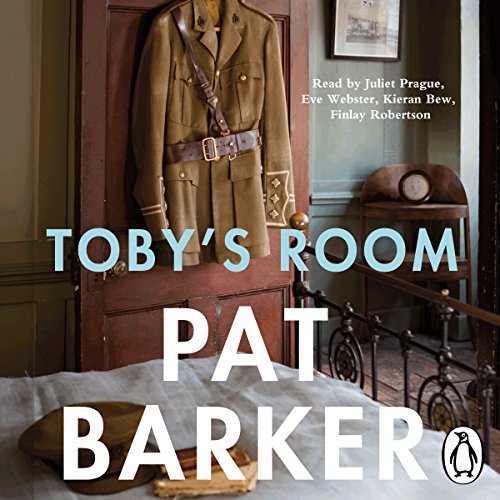
Toby's Room
Failed to add items
Add to basket failed.
Add to wishlist failed.
Remove from wishlist failed.
Adding to library failed
Follow podcast failed
Unfollow podcast failed
Get 30 days of Standard free

Toby's Room
Buy Now for £8.62
-
Narrated by:
-
Eve Webster
-
Finlay Robertson
-
Juliet Prague
-
Kieran Bew
-
By:
-
Pat Barker
Penguin presents the unabridged, downloadable audiobook edition of the second novel in Pat Barker's acclaimed 'Life Class' trilogy - a dark and compelling examination of desire, friendship and the horror of war, from one of our greatest writers on war and the human heart
From the Booker Prize-winning and Women's Prize-shortlisted author of The Silence of the Girls
'Heart-rending... Toby's Room anatomises a world where extreme emotion shatters the boundaries of identity, behaviour, gender' Independent
'Once again Barker skilfully moves between past and present, seamlessly weaving fact and fiction into a gripping narrative' Sunday Telegraph
When Toby is reported 'Missing, Believed Killed', another secret casts a lengthening shadow over Elinor's world: how exactly did Toby die - and why? Elinor determines to uncover the truth. Only then can she finally close the door to Toby's room. Moving from the Slade School of Art to Queen Mary's Hospital, where surgery and art intersect in the rebuilding of the shattered faces of the wounded, Toby's Room is a riveting drama of identity, damage, intimacy and loss.
The Life Class trilogy:
Life Class
Toby's Room
Noonday
Continue the series

Critic reviews
But worse was the narration of Henry Tonks, from which we have the artist’s technique of “tonking” or should this be written with a capital “T”?
Henry Tonks was born in 1862 and yet he sounds like a contemporary of Paul and Kit. This jarred for me. But this is hardly the fault of the chosen narrator. I do wish more care was taken by whomever decides on narrators.
But another very enjoyable book in this trilogy. I have other works in mind by Pat Barker when this trilogy is completed.
Narration
Something went wrong. Please try again in a few minutes.