

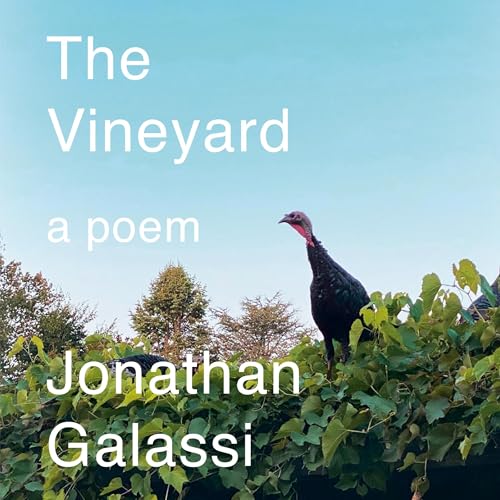
The Vineyard
A Poem
Failed to add items
Sorry, we are unable to add the item because your shopping cart is already at capacity.
Add to basket failed.
Please try again later
Add to wishlist failed.
Please try again later
Remove from wishlist failed.
Please try again later
Adding to library failed
Please try again
Follow podcast failed
Unfollow podcast failed
Get 30 days of Standard free
£5.99/mo after trial. Cancel monthly.

The Vineyard
Narrated by:
Jonathan Galassi
Buy Now for £6.42
-
Narrated by:
-
Jonathan Galassi
-
By:
-
Jonathan Galassi
The delicious long-form poem “The Vineyard” is set in and around the quasi-fictional Long Island village of Oyster Ponds, where the poet spends the summer months. In free-flowing lines and pages that turn with the calendar, the poem unspools impressions that seem confided rather than written, as Galassi observes the “pretend peace’’ of this quiet house and garden, his oasis in the turbulence of dailiness. Themes and imagery recur, swerve, and transform as he watches the vineyard next door come alive, thrive, and die away only to return the next year, different but the same, in our time of plague, climate threat, and a culture that too often seems to attack what is enduring and fundamental.
But this book is not a complaint or a raging against the dying of the light: it is an honest record of seeing and feeling in a beloved place, of gratitude, of searching for one’s center. As the poet describes the wisteria vine that sends out suckers into the lawn and the long and complex tale of the village and its inhabitants, this modern eclogue becomes an ample container for Jonathan’s life: he’s having a chat with us about all he notices and dreams, about tending his plants and cooking and gossiping, about loving a man and aging, about his mother and Vita Sackville-West and bike-riding and having regrets. The narrative swells and touches us in its surprising turns; sometimes whole poems swim up and hold a page in the midst of its ongoing narrative, reminding us of the ways that writing can shape the quotidian.
This intimate, unhurried, and unpretentious poem of past and present will stand as the central work of Jonathan Galassi’s career.
adbl_web_anon_alc_button_suppression_t1
Critic reviews
“A delightful epic of reflection, satisfaction, and just a hint of gentle self-mockery. It’s an ode to a life well lived and the Long Island village where he takes refuge among nature and neighbors.” —Ron Charles, via substack
“A heartening long poem about the fruits of a life—cultivated through experience, refined by love and labor, and gratified with leisure and beauty. 'I’ve hung my garden tools on the wall / under the arbor,' the speaker writes, 'my trophies, my insignia of life and time.' Weaving narratives of relationships, books, and houses, with refreshing candor and compassionate demeanor, the Galassi of The Vineyard is the best company, scintillating and tender. A pleasure, a wonder, an awakening to live alongside it.” —Richie Hofmann, author of The Bronze Arms
“The Vineyard is an unexpectedly redemptive book. Its long title poem unfolds as a love letter to the same island that flowered once for Dutch sailors’ eyes, opens along the way to reflect the author’s personal, yet representative sentimental education, continues in tribute to tutelary friends and neighbors, and becomes finally a testament to the ever timely power of the pastoral as a humanizing ideal. Galassi couldn’t have known when writing it just how timely, but the poem knew, which is what a poet is for.” —Douglas Crase, author of The Revisionist & The Astropastorals
“[Galassi] revitalizes the pastoral tradition in this luscious, witty, and poignant book-length poem chronicling a summer in a Long Island village he calls Oyster Ponds. . . . Everything flows and flowers in supple lines sparkling with nature’s palette as well as the hues and shades of thoughts and feelings. Elegies and other poems-within-the-poem spring up, concluding with a celebration of a marriage. Candid, bemused, grateful, and awed, Galassi embraces moments painful, joyful, and wonderfully ordinary.” —Booklist
“Watchful and intelligent. . . . By turns appreciative and elegiac as the poet ruminates on place and the changing seasons, lending memorializing and pastoral notes to spare meditations. . . . This pulses with feeling beneath its placid surface.” —Publishers Weekly
“A heartening long poem about the fruits of a life—cultivated through experience, refined by love and labor, and gratified with leisure and beauty. 'I’ve hung my garden tools on the wall / under the arbor,' the speaker writes, 'my trophies, my insignia of life and time.' Weaving narratives of relationships, books, and houses, with refreshing candor and compassionate demeanor, the Galassi of The Vineyard is the best company, scintillating and tender. A pleasure, a wonder, an awakening to live alongside it.” —Richie Hofmann, author of The Bronze Arms
“The Vineyard is an unexpectedly redemptive book. Its long title poem unfolds as a love letter to the same island that flowered once for Dutch sailors’ eyes, opens along the way to reflect the author’s personal, yet representative sentimental education, continues in tribute to tutelary friends and neighbors, and becomes finally a testament to the ever timely power of the pastoral as a humanizing ideal. Galassi couldn’t have known when writing it just how timely, but the poem knew, which is what a poet is for.” —Douglas Crase, author of The Revisionist & The Astropastorals
“[Galassi] revitalizes the pastoral tradition in this luscious, witty, and poignant book-length poem chronicling a summer in a Long Island village he calls Oyster Ponds. . . . Everything flows and flowers in supple lines sparkling with nature’s palette as well as the hues and shades of thoughts and feelings. Elegies and other poems-within-the-poem spring up, concluding with a celebration of a marriage. Candid, bemused, grateful, and awed, Galassi embraces moments painful, joyful, and wonderfully ordinary.” —Booklist
“Watchful and intelligent. . . . By turns appreciative and elegiac as the poet ruminates on place and the changing seasons, lending memorializing and pastoral notes to spare meditations. . . . This pulses with feeling beneath its placid surface.” —Publishers Weekly
No reviews yet