

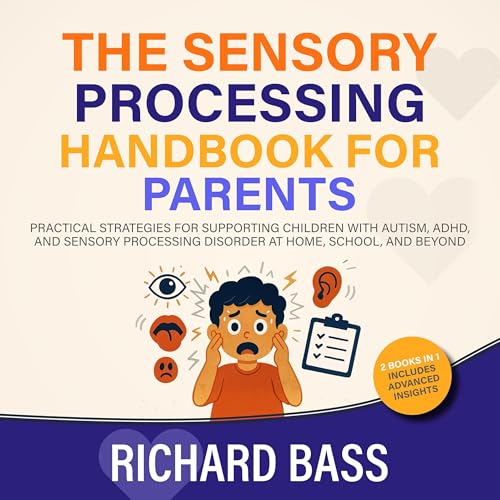
The Sensory Processing Handbook for Parents
Practical Strategies for Supporting Children with Autism, ADHD, and Sensory Processing Disorder at Home, School, and Beyond
Failed to add items
Add to basket failed.
Add to wishlist failed.
Remove from wishlist failed.
Adding to library failed
Follow podcast failed
Unfollow podcast failed
Get 30 days of Standard free

The Sensory Processing Handbook for Parents
Buy Now for £18.29
-
Narrated by:
-
Miles Carter
-
By:
-
Richard Bass
From the Bestselling Author of The Teens’ Workbook to Self-Regulate, The ADHD Parenting Guide for Boys, and Parenting a Child with Autism
Does your child struggle with loud noises, bright lights, scratchy clothing, or certain smells? Do busy public places trigger meltdowns? Or does your child crave constant movement, deep pressure, or intense stimulation making daily life exhausting for both of you?
You’re not imagining it—and you’re not alone.
The Sensory Processing Handbook for Parents is your complete, research-based guide to understanding and supporting children with sensory differences. Whether your child is sensory-seeking, sensory-avoidant, or both—this practical handbook gives you the tools to help them thrive in a world that often feels overwhelming.
This 2-in-1 resource combines foundational strategies with advanced insights, helping you support your child through every stage—from daily routines at home to success in school and public spaces.
Inside, you’ll discover how to:
- Decode your child’s unique sensory profile—and finally understand their behaviors
- Transform your home into a calming, sensory-supportive environment
- Help your child build self-regulation skills through targeted sensory play and proven mindfulness strategies
- Collaborate with teachers and schools to ensure the right accommodations and supports are in place
- Navigate public spaces and social situations with confidence, using preparation techniques and on-the-spot regulation tools
- Plan travel and vacations that work for your child’s sensory needs
- Support sensory processing through nutrition, sleep optimization, and stress management
- Track progress using practical measurement tools and tracking systems
Each chapter combines the latest science with easy-to-use strategies—plus real-world case examples and age-specific tips from early childhood through adolescence.
©2025 Richard Bass (P)2025 Richard BassListener received this title free
A guide to help with troubled children
Something went wrong. Please try again in a few minutes.
Listener received this title free
Helpful tips for raising a neurodivergent child
Something went wrong. Please try again in a few minutes.
Listener received this title free
Parents handbook
Something went wrong. Please try again in a few minutes.
Listener received this title free
Very informative
Something went wrong. Please try again in a few minutes.
Listener received this title free
Excellent tool!
Something went wrong. Please try again in a few minutes.