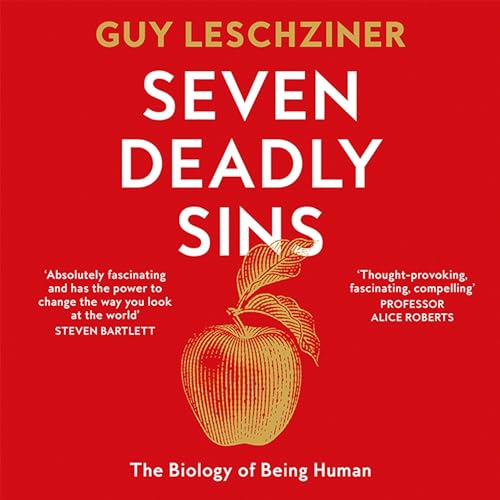
Seven Deadly Sins: The Biology of Being Human cover art

Seven Deadly Sins: The Biology of Being Human

The Biology of Being Human

Preview
Try Premium Plus free
Pick 1 audiobook a month from our unmatched collection - including bestsellers and new releases.
Unlimited access to our all-you-can-listen catalogue of 15K+ audiobooks and podcasts
Access exclusive sales and deals.
£8.99/month after 30 days. Renews automatically.

Seven Deadly Sins: The Biology of Being Human

By: Guy Leschziner
Try Premium Plus free

£8.99/month after 30 days. Renews automatically. See here for eligibility.

Buy Now for £12.99

Buy Now for £12.99

About this listen

'Has the power to change the way you look at the world' Steven Bartlett

'The heir to Oliver Sacks' David Baddiel

A FINANCIAL TIMES BEST BOOK OF 2024

AN INDEPENDENT BOOK OF THE MONTH

Gluttony. Greed. Sloth. Pride. Envy. Lust. Anger.

These are the seven deadly sins, the vices of humankind that define immorality, the roots of all evil in the world. Or so some believe.

But do these sins really represent moral failings, or are they simply human functions that aid us? Are they just the result of how our bodies, psyches, and brains in particular, are wired?

This new book by Dr Guy Leschziner, a professor of neurology and sleep medicine, explores the underlying nature of the seven deadly sins, their neuroscientific and psychological basis, their origin in our genes and crucially how certain medical disorders give rise to them.

Drawing on his clinical practice, we meet individuals whose physical and psychological conditions have given rise to these sins, where brain injury or other experiences have sparked ‘immoral’ actions. He explores how illness can simply expose what lies within us and investigates how the origins of these traits lie in evolutionary imperatives to preserve the wellbeing of the tribe. Perhaps, he suggests, these character traits are less of a moral question and more biological, which raises fundamental issues of responsibility and blame in the face of ‘sin’.

Combining cutting-edge science placed in the context of real-life experience with patients, the book reexamines where the boundaries between normal human nature, pathology and sin are drawn. And, most importantly, whether these hard-wired traits truly represent sin, or simply the intensity of our intrinsic desire to survive and thrive.

©2024 Guy Leschziner (P)2024 Harper Collins Publishers
Biological Sciences Mental Health Neuroscience & Neuropsychology Psychology Psychology & Mental Health Science Human Brain Health Medicine Injury

Listeners also enjoyed...

Big Mouth cover art
Our Brains, Our Selves cover art
The Criminal Mind cover art
How Emotions Are Made cover art
The Shape of Things Unseen cover art
Deadly Silence cover art
Food for Life cover art

Critic reviews

'The London neurologist Leschziner sensitively explores the genetic, neurological and psycholo`gical basis for human failings such as wrath, sloth and gluttony. Along the way we meet patients — the outsized recluse who became wedged in his shower cubicle, the soldier who couldn’t stop talking about sex after a head injury — who reveal how medical conditions are often lashed to the mast of morality' Financial Times

‘An elegantly argued book that does far more than just lift the curtain on what occurs between a neurologist and his patients… As a reader, you feel privileged to be allowed to sit in on his study' Spectator

'A profoundly humane book… Leschziner writes with great empathy and compassion’ Guardian

‘Thought-provoking, fascinating, compelling – Leschziner delves into the psychology, psychiatry and neuroscience of harmful behaviours and asks: can we ever really be free to choose how we behave? His thesis is compelling: if we can understand ourselves better, and particularly the darker aspects of our psychology, we can hope to make the world a better place’ Professor Alice Roberts, author of Crypt

‘An erudite and case-packed study of 'wrath, gluttony, greed, sloth, pride, envy, lust and anger', the supposed 'Seven Deadly Sins' that define human vices’ Independent

‘Guy Leschziner is the heir to Oliver Sacks' David Baddiel

'A captivating examination of the neurological basis for ‘bad’ behaviour… educates as much as it entertains, turning complex neuroscientific topics into fodder for cocktail-party conversations… Outstanding’ Nature

‘ A masterly, original and highly accessible account of the neurological origins of the seven perennial temptations, with ample case studies. His conclusion is wise and compassionate, and his route to it is replete with fascinating detail' Oliver Kamm, author of Mending the Mind

'A riveting exploration of the science behind why humans engage in behaviour that harms themselves and others' Jonathan Kennedy, author of Pathogensis

All stars
Most relevant
The subject matter was spot on and as I’m doing neuroscience, it was very insightful and helped me understand difficult concepts.

Very informative and engaging

Something went wrong. Please try again in a few minutes.