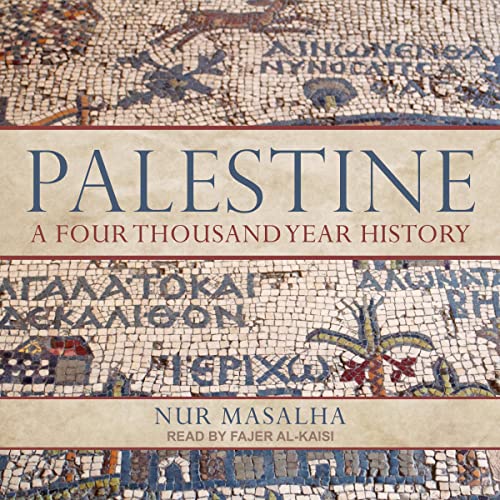
Palestine
A Four Thousand Year History
Failed to add items
Add to basket failed.
Add to wishlist failed.
Remove from wishlist failed.
Adding to library failed
Follow podcast failed
Unfollow podcast failed
Get 3 months for £0.99/mo
Buy Now for £16.99
-
Narrated by:
-
Fajer Al-Kaisi
-
By:
-
Nur Masalha
About this listen
This rich and magisterial work traces Palestine's millennia-old heritage, uncovering cultures and societies of astounding depth and complexity that stretch back to the very beginnings of recorded history.
Starting with the earliest references in Egyptian and Assyrian texts, Nur Masalha explores how Palestine and its Palestinian identity have evolved over thousands of years, from the Bronze Age to the present day. Drawing on a rich body of sources and the latest archaeological evidence, Masalha shows how Palestine's multicultural past has been distorted and mythologized by Biblical lore and the Israel-Palestinian conflict.
In the process, Masalha reveals that the concept of Palestine, contrary to accepted belief, is not a modern invention or one constructed in opposition to Israel, but rooted firmly in ancient past. Palestine represents the authoritative account of the country's history.
©2018 Nur Masalha (P)2021 TantorVery detailed and deep history of the land of Palestine
Myth busting
Something went wrong. Please try again in a few minutes.
thorough and broad information
Something went wrong. Please try again in a few minutes.
Exhaustive
Something went wrong. Please try again in a few minutes.
The premise - which is really pretty much impossible to argue with - is that Palestine / Israel has been continuously populated for thousands of years, with substantial continuity of population, language, place names, and culture. Up until the last century, that is. Even the name Palestine (and its variants - remember the Biblical Philistines?) has proved remarkably resilient.
In addition, as the final couple of chapters detail, there is little hard historical or archaeological evidence for an established Jewish presence on the area, even back when the old Kingdom of Israel was meant to have existed. And, finally, the founders of the Zionist project kinda knew this - albeit I suspect they would have claimed that this evidence was deliberately destroyed - and so set out to create their own historical and cultural myths.
None of this should, really, be controversial. The fact that it has become so is doubtless why the author spends so long laying out quite granular, fairly repetitive examples of how something called Palestine (or similar, as much of the emphasis is on the evolution and continuity of etymology) was acknowledged by observers, travellers, and others throughout history.
This means much of the books is effectively made up of what amounts to lists of references - and in some cases, actual lists. Which makes it rather less engaging than I'd hoped - but a potentially very useful reference book.
It's also reminded me that I've still not read Edward Said's classic book on Palestine, written over 40 years ago now. Maybe one for later in the year.
Interesting, compelling, necessary, but sadly not that engaging
Something went wrong. Please try again in a few minutes.
Also, be carful with people like Jordan Peterson and Ben Shapiro together with Jonathan Pageu. Amount of nonsense that these people are spweeimg because you have Nicea in this book is beyond beleife
Great Book
Something went wrong. Please try again in a few minutes.