

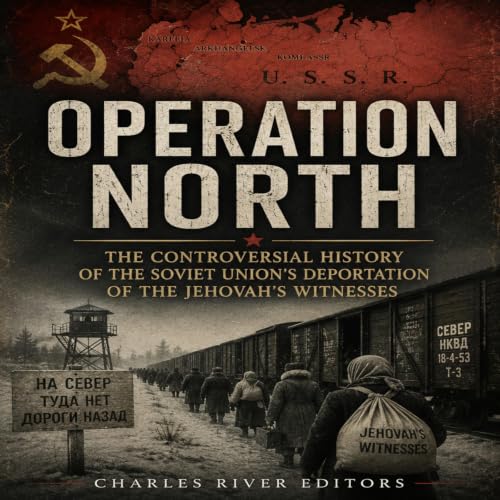
Operation North
The Controversial History of the Soviet Union’s Deportation of the Jehovah’s Witnesses
Failed to add items
Add to basket failed.
Add to wishlist failed.
Remove from wishlist failed.
Adding to library failed
Follow podcast failed
Unfollow podcast failed
Get 30 days of Standard free

Operation North
Buy Now for £11.29
-
Narrated by:
-
Steve Knupp
On the night of April 1, 1951, in six republics along the western edge of the Soviet Union, soldiers moved into villages and towns while the people inside their houses slept. They came with dogs and machine guns, and they carried lists on which names and addresses had already been written. The lists had been compiled over the preceding months by the Ministry of State Security, the agency the Soviets called the MGB. The men knocked, and when the doors opened, they read out an order. The order dictated that the family in front of them was being resettled, and the most important word in the documents was navechno, meaning forever.
The families on those lists were Jehovah’s Witnesses, and over the span of two days in the western republics, and a week later across Ukraine, Soviet security forces seized 9,793 people, loaded them into freight cars built for transporting cattle, and sent them east into Siberia. The MGB called it Operation North, and it ended up being the largest deportation of a single religious group in the history of the Soviet Union, carried out on the direct order of Joseph Stalin. The Jehovah’s Witnesses were dispersed across the special settlements of Tomsk Oblast, Irkutsk Oblast, and Krasnoyarsk Krai, regions of forest and deep cold where the planners believed a small foreign faith could be left to die out among strangers.
The families arrived to find snow still on the ground in late April, and many spent the first winter in shelters they dug into the earth, keeping themselves alive on nettles and the inner bark of trees. Of course, some had already died in the railcars, and others died in the initial months after their arrival. Stalin died in March 1953, less than two years after he signed the order. In the years that followed, the Soviet state dismantled most of the deportation system he had built, and the peoples he had exiled were permitted to return to their homes.
©2026 Charles River Editors (P)2026 Charles River Editors