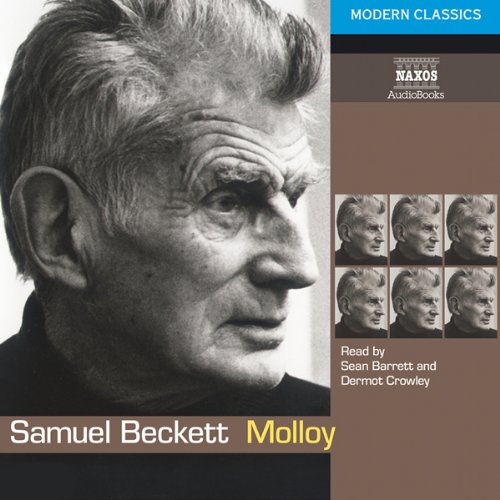
Molloy cover art

Molloy

Preview
Get this deal Try Premium Plus free
Offer ends 29 January 2026 at 11:59PM GMT.
Prime members: New to Audible? Get 2 free audiobooks during trial.
Just £0.99/mo for your first 3 months of Audible.
1 bestseller or new release per month—yours to keep.
Listen all you want to thousands of included audiobooks, podcasts, and Originals.
Auto-renews at £8.99/mo after 3 months. Cancel monthly.
Pick 1 audiobook a month from our unmatched collection - including bestsellers and new releases.
Listen all you want to thousands of included audiobooks, Originals, celeb exclusives, and podcasts.
Access exclusive sales and deals.
£8.99/month after 30 days. Renews automatically.

Molloy

By: Samuel Beckett
Narrated by: Sean Barrett, Dermot Crowley
Get this deal Try Premium Plus free

£8.99/mo after 3 months. Cancel monthly. Offer ends 29 January 2026 at 11:59PM GMT.

£8.99/month after 30 days. Renews automatically. See here for eligibility.

Buy Now for £24.99

Buy Now for £24.99

LIMITED TIME OFFER | £0.99/mo for the first 3 months

Premium Plus auto-renews at £8.99/mo after 3 months. Terms apply.

About this listen

Written initially in French, later translated by the author into English, Molloy is the first book in Dublin-born Samuel Beckett's trilogy. It was published shortly after WWII and marked a new, mature writing style, which was to dominate the remainder of his working life. Molloy is less a novel than a set of two monologues narrated by Molloy and his pursuer, Moran.

In the first section, while consumed with the search of his mother, Molloy lost everything. Moran takes over in the second half, describing his hunt for Molloy. Within this simple outline, spoken in the first person, is a remarkable story, raising the questions of being and aloneness that marks so much of Beckett's work, but is richly comic as well. Beautifully written, it is one of the masterpieces of Irish literature.

PLEASE NOTE: When you purchase this title, the accompanying reference material will be available in your My Library section along with the audio.

©2003 NAXOS AudioBooks Ltd. (P)2003 NAXOS AudioBooks Ltd.
Anthologies & Short Stories Classics Fiction Genre Fiction Literary Fiction Short Stories Scary

Listeners also enjoyed...

Malone Dies cover art
Murphy cover art
How It Is cover art
The Unnamable cover art
Watt cover art
Waiting for Godot cover art
Krapp's Last Tape, Not I, That Time, & A Piece of Monologue cover art
Finnegans Wake cover art
The Man Without Qualities cover art
The Poems of T. S. Eliot cover art
The Third Policeman cover art
Slaughterhouse-Five cover art
The Go-Between cover art
Ulysses cover art
Better Never to Have Been cover art
The Guide to James Joyce's Ulysses cover art

Critic reviews

"These two skilled actors hold the book together remarkably well....In audio this work takes on the full richness of comedy, probably as Beckett, preeminently a dramatist, intended." ( AudioFile)
All stars
Most relevant
Riveting story of pursued and pursuer in the Twentieth Century.

A truly great novel indeed.

Unromantic Quests

Something went wrong. Please try again in a few minutes.

This was my first Beckett novel. Truly spectacular with many deep and psychological themes. Would recommend this to anyone and everyone.

Both the narrators a great, causing this novel to be even more gripping

Gripping with confusion and madness

Something went wrong. Please try again in a few minutes.

What made the experience of listening to Molloy the most enjoyable?

I feel beckett's work lends itself more to being heard with the ears than being read with the eyes. Both Narrators were incredibly expressive, which must have been difficult, since Beckett doesn't give much to work with by way of characterising. So much is left to the listeners interpretation.

Who was your favorite character and why?

That this question is here shows that this little review sheet was not made especially for this book. However without spoiling anything I will say Moran from the second half of the book. It's a much more difficult part to read, and the story becomes rather interesting at that point.

Which scene did you most enjoy?

the part of the book where molloy agonises over the problem of too many 'sucking stones'. There's beckett for you right there. massive amounts of time spent on a tedious problem that should be a non-event - ie the problem of having too many stones against too few pockets. It made me laugh and despair all at once.

If you made a film of this book, what would be the tag line be?

Honestly, I wouldn't. this wouldn't lend itself to film.

Any additional comments?

I will be honest. Samuel Beckett's work is dificult going, but these wonderful audio versions make it just that little bit easier. It's well worth the effort if you're willing to stick with it though for Beckett's commentary on the human condition.

Well done Naxos!

Hard Going, But Worth It

Something went wrong. Please try again in a few minutes.

Molloy is told in two parts that counterpoint one another. Both performances are excellent. Beckett’s absurdist drama employs impeccably wrought language, in abstruse flourishes, that bring clear into focus the fundamental. Grisly and hilarious.

Enigmatic, brilliant, funny

Something went wrong. Please try again in a few minutes.

"Not to want to say, not to know what you want to say, not to be able to say what you think you want to say, and never to stop saying, or hardly ever, that is the thing to keep in mind, even in the heat of composition."

I'm ever so confounded by Beckett. Eluded even. His plays remain impenetrable for the time being, and from among the celebrated novels, "Malone Dies" (1951) and "The Unnamable" (1953), are closed books to me. But "Molloy" (1951) is something different altogether. It's easier to appreciate, to get into, and ultimately, enjoy the ride for as long as it goes on. It is profound, full of actual wisdom instead of mere philosophizing for the narrative's sake, and what might make it difficult is also its greatest strength: its otherworldly slumbering from nowhere to anywhere, and/or vice versa. In short, it draws attention to the act of stopping by coming to a halt itself. What it shares with Joyce is its method of existing in the moment, not before nor after, but in the very moment it is read, as if reading it somehow conjured the words onto the page.

Much of the praises in this review go to Sean Barrett, whose second nature it seems to be to interpret great authors and make it seem like he himself wrote the darn things. He's that good, and he's in his element with Beckett. Dermot Crowley, responsible for the other half, is great, as well, although it takes some to get used to the change.

Perhaps I had all I needed with "Molloy", since "Malone Dies" felt quite impossible to see through, but this one is a book I really like, yet I'm perfectly set on revisiting Beckett in the near future. I have a feeling that one day, all will be revealed, all that at this time doesn't quite seem to add up. In the meantime, I'll keep on standing on the seaside, sucking those stones. Just let me get my greatcoat.

Circles and Straight Lines

Something went wrong. Please try again in a few minutes.

See more reviews