

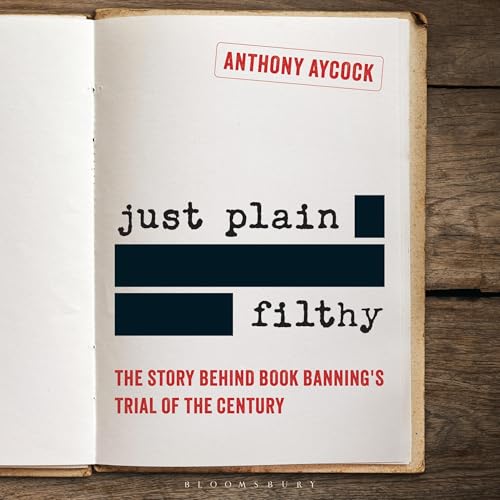
Just Plain Filthy
The Story Behind Book Banning's Trial of the Century
Failed to add items
Sorry, we are unable to add the item because your shopping cart is already at capacity.
Add to basket failed.
Please try again later
Add to wishlist failed.
Please try again later
Remove from wishlist failed.
Please try again later
Adding to library failed
Please try again
Follow podcast failed
Unfollow podcast failed
3 Months Free
£5.99/mo after 3 months. Cancel monthly.
Offer ends on 15 July 2026 at 11:59 BST.

Just Plain Filthy
Narrated by:
John Chancer
Buy Now for £13.52
-
Narrated by:
-
John Chancer
-
By:
-
Anthony Aycock
With the threat to intellectual freedom increasing around the country, this book takes a look at the first ever school book ban case to be decided by the high courts, and offers insights into how we can use history to help the future.
In 1975, the school board members of a small Long Island town did what they thought was a no-brainer: they ordered the removal of nine books from a high school library. The books included some classics – Richard Wright's Black Boy; Desmond Morris's The Naked Ape; Kurt Vonnegut's Slaughterhouse-Five – but that didn't matter to board chair Richard Ahrens, who called the collection "anti-American, anti-Christian, anti-Semitic, and just plain filthy." Maybe he thought the town was with him. Maybe he thought nobody would care. He certainly didn't think he would be sued by seventeen-year-old Steven Pico or that the case would end up before the United States Supreme Court, the first and only book ban dispute ever to do so.
The only one so far. Recent years have seen a surge in book challenges, and it is only a matter of time before another reaches the high court. Island Trees v. Pico ended in a loss for the school board, but not a resounding one. It left enough daylight for the current justices to reach a different conclusion. What was the court's ruling? How did it come about? What was the book ban climate in the 1970s and 80s, and how did it differ from today's? Just Plain Filthy is the first book to tell the complete story of Island Trees v. Pico, the flawed yet fascinating case that is the cornerstone of intellectual freedom in America. For now.©2026 Anthony Aycock (P)2026 Bloomsbury Publishing PLC
adbl_web_anon_alc_button_suppression_t1
Critic reviews
A brief but potent look at how one court case fits in the broader context of book banning, which is more relevant than ever.
A vividly personal case for books that teach young readers how to cope with desire and live a life of self-acceptance.
...an engaging, thought-provoking work.
Just Plain Filthy is a readable, even personable look at the historic context of today’s surge in censorship. Aycock writes engagingly about the legal arguments and specific details of the cases brought before the U.S. Supreme Court about our First Amendment rights. He concludes with what seems a likely prediction: Pico is headed for a revisit – and the longstanding precedents that have underwritten our understanding of intellectual freedom may not survive. (James LaRue, author of On Censorship: A Public Librarian Examines Cancel Culture in the US)
Using his own life as a framework, Anthony Aycock has written a history of book banning that is both specific and comprehensive in scope. The Island Trees v Pico US Supreme Court case provides a perfect historical case for understanding our current intellectual freedom landscape. (Emily J.M. Knox, Professor at the University of Illinois at Urbana-Champaign, USA)
This book is essential reading for anyone concerned about book bans and free expression. Aycock shows how libraries, students, and school boards, as well as judges and juries, shape the First Amendment in real-life applications. (John Chrastka, Executive Director, EveryLibrary, USA)
No reviews yet