

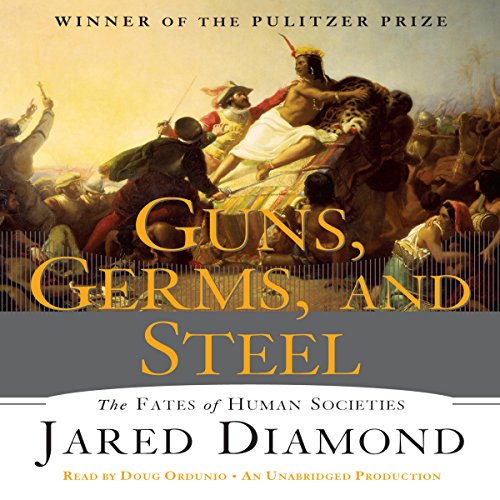
Guns, Germs and Steel
The Fate of Human Societies
Failed to add items
Sorry, we are unable to add the item because your shopping cart is already at capacity.
Add to basket failed.
Please try again later
Add to wishlist failed.
Please try again later
Remove from wishlist failed.
Please try again later
Adding to library failed
Please try again
Follow podcast failed
Unfollow podcast failed
3 Months Free
£5.99/mo after 3 months. Cancel monthly.
Offer ends on 15 July 2026 at 11:59 BST.

Guns, Germs and Steel
Narrated by:
Doug Ordunio
Buy Now for £16.82
-
Narrated by:
-
Doug Ordunio
-
By:
-
Jared Diamond
Having done field work in New Guinea for more than 30 years, Jared Diamond presents the geographical and ecological factors that have shaped the modern world. From the viewpoint of an evolutionary biologist, he highlights the broadest movements both literal and conceptual on every continent since the Ice Age, and examines societal advances such as writing, religion, government, and technology. Diamond also dissects racial theories of global history, and the resulting work—Guns, Germs and Steel—is a major contribution to our understanding the evolution of human societies.
adbl_web_anon_alc_button_suppression_t1
Critic reviews
Artful, informative, and delightful.... There is nothing like a radically new angle of vision for bringing out unsuspected dimensions of a subject, and that is what Jared Diamond has done.—William H. McNeil, New York Review of Books
An ambitious, highly important book.—James Shreeve, New York Times Book Review
A book of remarkable scope, a history of the world in less than 500 pages which succeeds admirably, where so many others have failed, in analyzing some of the basic workings of culture process.... One of the most important and readable works on the human past published in recent years.—Colin Renfrew, Nature
The scope and the explanatory power of this book are astounding.—The New Yorker
No scientist brings more experience from the laboratory and field, none thinks more deeply about social issues or addresses them with greater clarity, than Jared Diamond as illustrated by Guns, Germs, and Steel. In this remarkably readable book he shows how history and biology can enrich one another to produce a deeper understanding of the human condition. —Edward O. Wilson, Pellegrino University Professor, Harvard University
Serious, groundbreaking biological studies of human history only seem to come along once every generation or so. . . . Now [Guns, Germs, and Steel] must be added to their select number. . . . Diamond meshes technological mastery with historical sweep, anecdotal delight with broad conceptual vision, and command of sources with creative leaps. No finer work of its kind has been published this year, or for many past. —Martin Sieff, Washington Times
[Diamond] is broadly erudite, writes in a style that pleasantly expresses scientific concepts in vernacular American English, and deals almost exclusively in questions that should interest everyone concerned about how humanity has developed. . . . [He] has done us all a great favor by supplying a rock-solid alternative to the racist answer. . . . A wonderfully interesting book.—Alfred W. Crosby, Los Angeles Times
An epochal work. Diamond has written a summary of human history that can be accounted, for the time being, as Darwinian in its authority.—Thomas M. Disch, The New Leader
An ambitious, highly important book.—James Shreeve, New York Times Book Review
A book of remarkable scope, a history of the world in less than 500 pages which succeeds admirably, where so many others have failed, in analyzing some of the basic workings of culture process.... One of the most important and readable works on the human past published in recent years.—Colin Renfrew, Nature
The scope and the explanatory power of this book are astounding.—The New Yorker
No scientist brings more experience from the laboratory and field, none thinks more deeply about social issues or addresses them with greater clarity, than Jared Diamond as illustrated by Guns, Germs, and Steel. In this remarkably readable book he shows how history and biology can enrich one another to produce a deeper understanding of the human condition. —Edward O. Wilson, Pellegrino University Professor, Harvard University
Serious, groundbreaking biological studies of human history only seem to come along once every generation or so. . . . Now [Guns, Germs, and Steel] must be added to their select number. . . . Diamond meshes technological mastery with historical sweep, anecdotal delight with broad conceptual vision, and command of sources with creative leaps. No finer work of its kind has been published this year, or for many past. —Martin Sieff, Washington Times
[Diamond] is broadly erudite, writes in a style that pleasantly expresses scientific concepts in vernacular American English, and deals almost exclusively in questions that should interest everyone concerned about how humanity has developed. . . . [He] has done us all a great favor by supplying a rock-solid alternative to the racist answer. . . . A wonderfully interesting book.—Alfred W. Crosby, Los Angeles Times
An epochal work. Diamond has written a summary of human history that can be accounted, for the time being, as Darwinian in its authority.—Thomas M. Disch, The New Leader
Everything is so interesting and well explained.
I highly recommend it.
Brilliant!
Something went wrong. Please try again in a few minutes.
But it's full of brilliant revelations and surprises and it's so huge in its scope that it's impossible not to come back to it, if you ever put it down.
It seeks to answer a simple question: "How come some people have more stuff than others?" The answer reaches into every corner of our history as a species.
Recommended.
Dense and dry but very rewarding
Something went wrong. Please try again in a few minutes.
I absolutely recommend this book, just manage your own expectations; google the author and make sure your interest in history is general enough to embrace biology and geology.
Not exactly what you’d expect but certainly interesting
Something went wrong. Please try again in a few minutes.
Brilliant.
Something went wrong. Please try again in a few minutes.
True academic porn
Something went wrong. Please try again in a few minutes.