

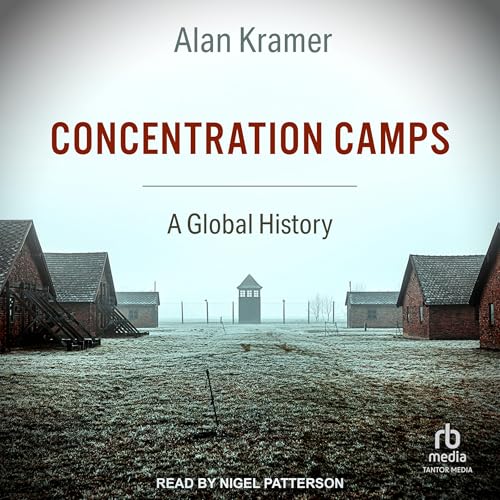
Concentration Camps
A Global History
Failed to add items
Add to basket failed.
Add to wishlist failed.
Remove from wishlist failed.
Adding to library failed
Follow podcast failed
Unfollow podcast failed
3 Months Free + £10 Audible voucher

Concentration Camps
Buy Now for £28.74
-
Narrated by:
-
Nigel Patterson
-
By:
-
Alan Kramer
In popular perception concentration camps are synonymous with genocide and Nazi racial extermination. Yet concentration camps were and are a global phenomenon, not restricted to Nazi Germany, used at times even by democracies, with an astonishing range of functions.
Alan Kramer provides here a comprehensive history of concentration camps, charting their first establishment at the beginning of the twentieth century on the colonial periphery, through their most extreme and inhuman instances in the mid-twentieth century, to their continued use today. Concentration camps are shown to be a truly transnational phenomenon that emerged both simultaneously (within and between imperial spheres―Britain, Spain, the USA, and Germany around 1900), and diachronically (from then to the First World War, the Gulag, and Nazi camps). Such camps existed (and exist) under a variety of regimes, often concomitant with empire-building by revolutionary dictatorships, as sites of genocide, mass murder, and performative violence, but also as central elements of utopian schemes of social and racial transformation. Integrating the perspective of perpetrators and the victims and contextualizing them within the historiography of other carceral institutions, the book will reshape the way we think about concentration camps as part of modern civilization.