

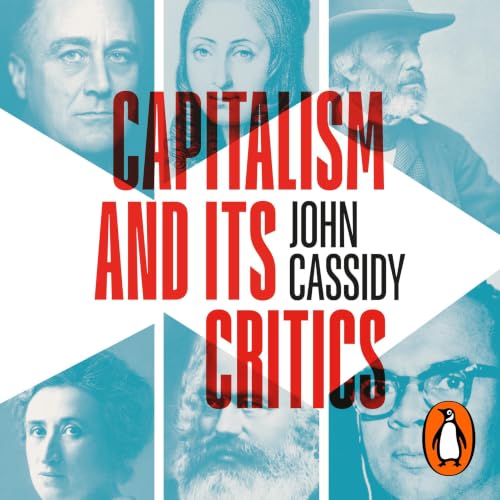
Capitalism and Its Critics
A Battle of Ideas in the Modern World
Failed to add items
Add to basket failed.
Add to wishlist failed.
Remove from wishlist failed.
Adding to library failed
Follow podcast failed
Unfollow podcast failed
Get 30 days of Standard free

Capitalism and Its Critics
Buy Now for £15.24
-
Narrated by:
-
Nathaniel Priestley
-
By:
-
John Cassidy
Brought to you by Penguin.
A sweeping history of capitalism as seen through the eyes of its fiercest critics
At a time when we are faced with fundamental questions about the sustainability and morality of the economic system, Capitalism and Its Critics provides a kaleidoscopic history of global capitalism, from colonialism and the Industrial Revolution to the ecological crisis and artificial intelligence.
John Cassidy adopts a bold new approach: he tells the story through the eyes of the system’s critics. From eighteenth-century weavers who rebelled against early factory automation to Eric Williams's paradigm-changing work on slavery and capitalism, to the Latin American dependistas, the international Wages for Housework campaign of the 1970s, and the modern degrowth movement, this absorbing narrative traverses the globe. It looks at familiar figures – Smith, Marx, Luxemburg, Keynes, Polanyi – from a fresh perspective, but also focuses on many less familiar, including William Thompson, the Irish proto-socialist whose work influenced Marx; Flora Tristan, the French proponent of a universal labour union; John Hobson, the original theorist of imperialism; and J. C. Kumarappa, the Indian exponent of Gandhian economics.
Blending biography, panoramic history, and lively exploration of economic theories, Capitalism and Its Critics illuminates the deep roots of many of the most urgent issues of our time.
©2024 John Cassidy (P)2024 Macmillan Audio
One of the book’s great strengths is its balance. Cassidy treats his subjects with seriousness and sympathy, even when he ultimately disagrees with them. He is particularly good at identifying the internal tensions and blind spots in many critiques of capitalism, noting where critics underestimated capitalism’s adaptability, overestimated the coherence of their own alternatives, or ignored uncomfortable trade-offs. At the same time, he avoids complacency: a recurring theme is that many older criticisms, about inequality, instability, financial excess, and the corrosive effects of markets on social life, remain stubbornly relevant today, even if their original formulations now feel dated.
The book’s panoramic scope is another major asset. Cassidy moves fluently across centuries, disciplines, and geographies, and he devotes real attention to figures who rarely appear in mainstream accounts of political economy. The chapter on J. C. Kumarappa, for example, stands out as a thoughtful exploration of a Gandhian, anti-industrial critique of capitalism that feels strikingly contemporary in an age of climate anxiety and debates about sustainable development. Throughout, Cassidy’s clear prose and journalistic instincts make complex ideas readable without flattening them.
Overall, Capitalism and Its Critics succeeds as both intellectual history and contemporary diagnosis. It does not pretend that capitalism has a single fatal flaw or a single silver-bullet alternative. Instead, it shows that capitalism has always been shaped, and often improved, by its critics, even when those critics were wrong in important ways. For readers looking for an accessible, nuanced, and historically grounded account of why capitalism remains so contested, this is an excellent place to start.
An Even-Handed History of Capitalism’s Critics
Something went wrong. Please try again in a few minutes.
cassidy is always good
Something went wrong. Please try again in a few minutes.
Overall a fascinating listen with a well chosen narrator.
Fascinating look back through history
Something went wrong. Please try again in a few minutes.
Low Marx
Something went wrong. Please try again in a few minutes.